
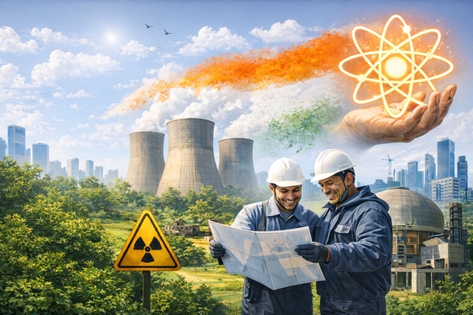
For decades following the independence of India, nuclear energy has occupied an uneasy place in the larger public imagination, with its potential for civilian and non-military usage being squandered due to leadership failure, runaway anxiety, and bureaucratic lethargy. As a consequence, even as the world moved forward by putting nuclear power into effective public use, India remained in an uncertain scenario when it came to figuring out how to harness this powerful tool for its own civilians.
It is within this uncertain scenario that the Union Government decided to introduce the Sustainable Harnessing and Advancement of Nuclear Energy for Transforming India (SHANTI) Bill on 15 December 2025. As such, it is not merely a legislative milestone but part of a long-standing structural overhaul of a legacy tainted by political inertia, nuclear anxiety, and missed opportunity under earlier dispensations. Thus, it decisively anchors India’s shift from nuclear hesitation to nuclear stewardship.
Liability Frameworks and the Cost of Policy Paralysis
Very swiftly following independence, nuclear energy became integral to India’s vision of a modern, self-reliant country, with the Atomic Energy Commission being established in 1948 under the leadership of Dr Homi Jehangir Bhabha. Dr Bhabha’s three-stage programme, designed to leverage India’s thorium reserves, reflected long-term strategic thinking that also required patience and political willingness. Sadly, the dispensation of the time, specifically after the 1960s, did not provide much help in maintaining strategic continuity.
The biggest blow to the growth of the nuclear vision was struck by the tragic demise of Dr Homi Bhabha in 1966, which gradually disconnected the discourse around nuclear power from India’s broader development needs. Even with the momentous Smiling Buddha test in 1974, nuclear ambition remained largely symbolic, with civil nuclear capacity staying constrained for decades, especially when compared to nations that normalised nuclear power as baseload infrastructure.
Arguably, the most damaging intervention followed in 2010, when the UPA government enacted the Civil Liability for Nuclear Damage Act. By imposing supplier liability even in cases of operator error, India became a global outlier. No major nuclear country followed such a regime because it makes nuclear projects commercially unviable in terms of scale and partnership. The impact was clearly visible following the landmark 2008 Indo–US Civil Nuclear Agreement, when notable foreign reactor suppliers such as Westinghouse and Areva refused to operate under India’s liability framework.
The consequence was clear. Nuclear power accounted for less than 3 percent of India’s electricity generation, even as other countries deployed nuclear energy strategically to anchor industrial expansion.
Others Used Nuclear Energy as Strategy, Not Sentiment
In most countries harnessing nuclear energy, the issue is guided not by sentiment but by strategic necessity. What analysts call the “second nuclear renaissance” is driven by climate urgency, energy security, and the physical limitations of the renewable energy ecosystem. Nuclear power delivers electricity with lifecycle emissions of roughly 12 grams of CO₂ per kilowatt-hour, comparable to wind and solar, while providing uninterrupted baseload power. Intermittent renewables, though essential, cannot independently sustain advanced economies without massive storage or fossil fuel backup. As Bill Gates has stated, “We can’t power an advanced economy on wind and solar alone.”
Today, nuclear power operates in over 30 countries, generating around 10 percent of global electricity and one fifth of all low-carbon power. Pakistan, despite economic and political instability, derives over 16.7 percent of its electricity from nuclear energy and plans to expand capacity further to 40 GW by 2050. China, from negligible capacity in the early 1990s, now operates over 55 GW, with another 25 GW under construction, anchoring its industrial and climate strategy. France sources nearly 65 percent of its electricity from nuclear power.
The SHANTI Act 2025: Key Provisions
The SHANTI Act primarily deals with an important and unavoidable axiom of the present time: “Energy security is national security”. Rather than treating nuclear energy as an inherited risk, the government has approached it as critical infrastructure requiring capital, regulation, and institutional credibility.
The most enterprising reform is the allowance of private sector participation in nuclear power generation for the first time since 1962. For decades, the Nuclear Power Corporation of India Limited (NPCIL) operated as a protected monopoly. This arrangement only satisfied political caution. It delivered neither speed nor scale, thereby squandering the real potential of nuclear energy.
The SHANTI Act introduces a calibrated hybrid model. Private firms may hold up to 49 percent equity, while the state retains majority control over sensitive domains such as enrichment, reprocessing, and waste management. This does not imply that the Act promotes rampant privatisation. Control over the nuclear fuel cycle remains with the state, while opening space for protracted competition. Whether this architecture accelerates capacity or creates new bottlenecks will depend on execution, but this move recognises that competition, capital, and execution discipline are essential.
The reform of liability is equally decisive. The SHANTI Act replaces the anomalous Congress-era framework with a capped operator liability regime, clarifies sovereign compensation mechanisms, and limits supplier liability to wilful negligence or defective equipment, backed by a state-supported insurance pool. This aligns India with global norms and restores investor confidence.
Another important factor addressed by the SHANTI Act is the promoter regulator conflict, by granting statutory independence to the Atomic Energy Regulatory Board. This step ends the absurd arrangement in which safety regulators reported to the same department responsible for promoting nuclear power.
Safety and Liability Safeguards Remain Strong Under SHANTI
The SHANTI Act balances investor clarity with robust public protection and nuclear safety. It caps operator liability at ₹3,000 crore but clearly places legal responsibility for all nuclear damage beyond this limit on the Central Government, ensuring that victims and environmental remediation are fully covered. Operators are required to maintain insurance or other financial security, guaranteeing the immediate availability of relief funds, while government nuclear installations remain backed by sovereign liability and public accountability.
Supplier responsibility is retained through contractually defined recourse and liability for deliberate acts or omissions causing damage. The Act also establishes a statutory nuclear governance framework, reinforcing regulatory oversight, safety standards, and institutional accountability.
Scale, Capital, and Climatic Realism
Reaching India’s target of 100 GW nuclear capacity by 2047 means adding nearly 90 GW over the next two decades. This requires USD 450–630 billion in investment. Previous administrations lacked the fiscal imagination and intent to address this scale. The current leadership recognises that this cannot be done through public budgets alone.
By opening the sector to private capital, SHANTI unlocks economic ecosystems that were deliberately excluded. Each 1 GW reactor generates thousands of construction jobs, hundreds of permanent jobs, and strengthens heavy engineering, metallurgy, and precision manufacturing capabilities.
Beyond electricity, India has now positioned nuclear energy as a development enabler. The Kalpakkam desalination plant, producing 6.3 million litres of water daily, demonstrates nuclear energy’s role in water security. Nuclear-enabled hydrogen offers a stable pathway to decarbonise steel, fertiliser, and transport. These facets of energy policy were never addressed in more than 75 years of India’s independence.
On the climate front, India’s renewable expansion has accelerated more than ever, with over 220 GW of installed solar and wind capacity. Yet the current government has been more honest than its predecessors about the limitations of renewables. Intermittency, storage cost, and grid stability cannot be overlooked. The policy framework has long treated nuclear energy as politically inconvenient in climate discourse, preferring rhetorical commitments over engineering reality. SHANTI thus reflects a mature climate strategy: nuclear and renewables are complementary, not competing.
Energy Independence Is National Security
India imports 85 percent of its crude oil, which ties the country’s economic fortunes to possible flashpoints in the Middle East or disruptions in global supply chains. The need to push for nuclear energy therefore becomes even more obvious, as it offers a combination of attributes that fossil fuels cannot: domestic control, long fuel cycles, and low carbon intensity.
Unlike oil and gas, nuclear power is insulated from short-term geopolitical turbulence once reactors are operational. This directly aligns with New Delhi’s evolving role on the global stage.
What Comes Next
For decades, India has treated nuclear energy as an inherited burden, something to manage defensively. SHANTI treats it as what it should have been all along: an asset for sovereignty, development, and climate leadership.
India should also weaponise this as soft power. By leading consortiums for thorium-based reactor development, offering nuclear partnerships to Global South nations, and positioning itself as a responsible nuclear steward, India can project influence while securing strategic alliances.
By integrating private capital, fixing liability distortions, and strengthening regulation, India can achieve 100 GW of nuclear capacity by 2047. This milestone is essential for energy security, climate credibility, and geopolitical autonomy. Where inaction once produced stagnation, a clear shift towards action and transformation is now visible.