
There has been a lot to concern the business community this year, including but not limited to: tariffs, increasing inflation, rising unemployment, higher pension contributions, a wage indexation and various warnings about profitability. And it doesn’t help that Europe is struggling to secure the natural resources it needs for the Green Transition, that the continent is hardly winning the AI or EV races, or that the war in Ukraine trudges depressingly on.
Despite all this, sentiment in specific bits of the business world has been pretty resilient. Downright upbeat in some cases.
Start-ups and innovation
In late March, the government released its long-touted ten point action plan to help boost the start-up scene and nurture more of them to scale-up phase. It had been teased since the previous summer and the sector agreed the final package was certainly better than a slap in the face.
Representatives of the 20 start-ups selected for the Fit 4 Start scheme in 2026 © Photo credit: MECO
One prominent illustration of the plan in action came in late October when, alongside announcing the successful applicants for Fit 4 Start 2026, Economy Minister Lex Delles also introduced Fit 4 Scale. It is a new booster programme to help an initial five promising young businesses into their expansion phase.
On 17 December, Luxembourg’s parliament voted to introduce a new tax credit from 2026 to encourage investments of Luxembourg resident individuals in start-ups.
The House of Startups was ranked 26th out of 150 incubators in Europe. René Beltjens of Alter Domus was named Entrepreneur of the Year, and Luxembourg sent space start-up Exobiosphere to the Startup World Cup.
The company was an appropriate winner during a year when the space sector seems to have cemented its status even more at the heart of Luxembourg’s innovation scene.
The year started with news that Luxembourg’s space investment (per capita) is among the biggest in the world, after just the US and Russia. In mid-January, the University of Luxembourg launched a small cube-sat called Poquito, which it is still controlling and monitoring from Kirchberg. More than a mere classroom exercise, the university hopes it will help drive miniaturisation of satellites for a cheaper and more accessible future space sector.
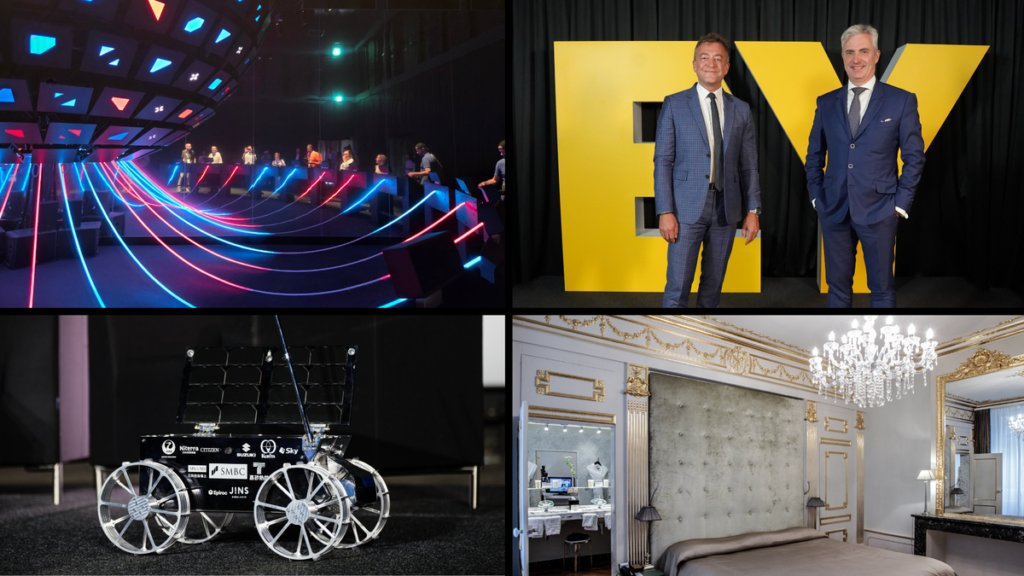
The failure of iSpace’s moon landing in mid-June didn’t dampen the company’s spirits. Its Luxembourg-built rover would have worked well, it was generally agreed, and the viability of a private moon mission is now established. It will happen soon enough, the company said.
SES started the year in the doldrums but later sealed its acquisition of Intelsat and ended the year on an impressive promise to start building satellites in the Grand Duchy. And talking of big players: Blue Origin, the space launch company owned by Amazon billionaire Jeff Bezos, decided to open its European headquarters in Luxembourg. While its “before the end of 2025” timescale for opening might now seem unlikely, the last we heard (in the autumn) things were still on track.
Long-delayed plans for the national space campus were finalised in July, with ground broken in November. Space Cargo Unlimited opened its new HQ and partnered with a French-German company on plans for a European foothold in space, post-International-Space-Station.
OQ Technology has ten satellites in low orbit and is aiming for 80. It signed contracts for 5G ‘internet of things’ coverage in several countries and demonstrated potentially lifesaving emergency messaging technology.
Meanwhile, the government’s Luxembourg Earth Observation System (Luxeosys) project satellite lifted off successfully in August and, in the same month, investment of €501 million in space defence was also announced – with a significant share allocated to a second defence satellite, GovSat-2.
The Luxembourg-based Asteroid Foundation celebrated the 10th world Asteroid Day, bringing a sense of wonder and fun to a serious topic that humanity would do well to address before any threat is confirmed.
Also read:Space campus mission to help sector reach for the stars
The Big Four
The Luxembourg branches of Deloitte, EY, KPMG and PwC might be quaking in their boots about the turbulent business environment and how AI could impact their services – but if they are, they’re not letting on.
The Big Four’s Luxembourg headquarters © Photo credit: © Photo credit: Archives LW/Anouk Antony, Gerry Huberty (montage)
Deloitte Luxembourg celebrated its 75th anniversary with 5% revenue growth, it announced at the end of November. It closed its Belval satellite office – though insisted this was only because staff were not using it as much as expected. PwC did the same thing – though it has several other satellites, while Deloitte only ever had one. Deloitte appointed a raft of partners and managing directors in 2025, plus a new partner to lead its AI charge.
EY Luxembourg also hailed strong growth, announcing turnover up by 10% at a press conference in September. Three months earlier, in June, the firm confirmed Alban Aubrée would become its new managing partner, moving Olivier Coekelbergs into a specially created role spanning Western Europe, but still based in Kirchberg.
KPMG Luxembourg reported 9% revenue growth earlier this month – revealing its earnings a month earlier than last year. AI is starting to affect how the firm bills its clients – moving away from billing hours and instead billing outcomes, but without negative financial impact to date.
PwC Luxembourg released its 2024 annual report last autumn, but at the time of writing was the only Big Four not yet to have done so for 2025. The reason for this is that the firm is preparing its first full CSRD report due for release in January, it said.
PwC Legal Luxembourg split from the PwC network on 1 July. While the law firm was not owned by the consultancy, which would have been illegal, its services were previously integrated into PwC’s offerings.
Also read:Big Four big-up AI, despite big threats
Retail and hospitality
People continued to spend money in 2025. Amazon, for example, posted over €50 billion in worldwide profit and had a record high share price in Q3 – but has nevertheless decided to ditch 10% of its workers. In Luxembourg, this could have amounted to 470 job losses, but negotiations with the staff delegation saw the eventual number drop to 370.
The Gridx shopping and mixed-use complex is in the process of opening (without a radiology centre). Cloche d’Or wants to beat the seven million visitors barrier next year. And a new Cactus supermarket opened – with other shops and, unusually for a supermarket, residential flats upstairs – to great fanfare at the end of October.
While some sectors thrive, traditional high street shops continue to struggle. Over half the Grand Duchy’s retail space is now in shopping centres, it was confirmed in September – incrementally leaving town and city centres more to bars, cafés and restaurants.
Brasserie Alfa is located inside the Marriott hotel in the capital’s Gare district © Photo credit: Jiri Lizler
On the hospitality side, Marriott now has two hotels in Luxembourg City, with both opening within about six months of each other. The brand-new Villa Pétrusse – with just 22 rooms – was named the fourth-best hotel in Europe at an awards ceremony in London less than six months after opening. And a more venerable stalwart – the Hôtel Le Place d’Armes – found its way into the first Michelin hotels guide.
The better-known Michelin restaurant guide lists 45 restaurants in Luxembourg (nine of which have a Michelin star, and two of which have two stars). Among them is Villa de Camille et Julien, which was taken off the market and will not be closing after all. Restaurateurs generally love what they do and say it’s not all doom and gloom.
The capital city’s reputation as a good place to visit continues to grow, and the hotel trade is expanding to keep up. Elsewhere in the country, the opposite has been true, with years of decline in the north and east of Luxembourg. There are signs of a revival, though, thanks partly to the fancy new hotel on the lakes near Weiswampach, and a concerted effort to invest in regeneration in the Mullerthal.
The situation remained less rosy for bars and cafés in Luxembourg, with closures far outstripping openings; especially outside the centres of the biggest towns.
Also read:How Luxembourg is dealing with the summer surge in tourism
Personal highlight
One of my personal highlights of the year was travelling to Japan as part of Luxembourg’s participation in the 2025 World Expo in Osaka, joining overlapping visits by a trade delegation, Crown Prince Guillaume (now grand duke), Foreign Minister Xavier Bettel, Economy Minister Lex Delles and Research and Higher Education Minister Stéphanie Obertin.
Hereditary grand duke Guillaume signing the guest book outside the Luxembourg pavilion, sharing a joke with André Hansen (r), the pavilion’s commissioner general © Photo credit: Alex Stevensson
Both Delles and Bettel pulled out of the trip at short notice. It was nevertheless considered a success – though trade missions prove their financial worth over years rather than months. Luxembourg’s entire participation at the expo was heralded as a triumph by the pavilion’s organisers.
As with every year, 2025 ends with many chapters unfinished and a level of continuity going into next year. Will Google ever build its Bissen data centre? Will the government and unions ever agree on opening hours and Sunday working? Will the CNS funding gap be closed before all the doctors quit? Will AI take everybody’s job? All this, and much more, coming up after the New Year…
Also read:Getting under the skin of Luxembourg’s World Expo pavilion