
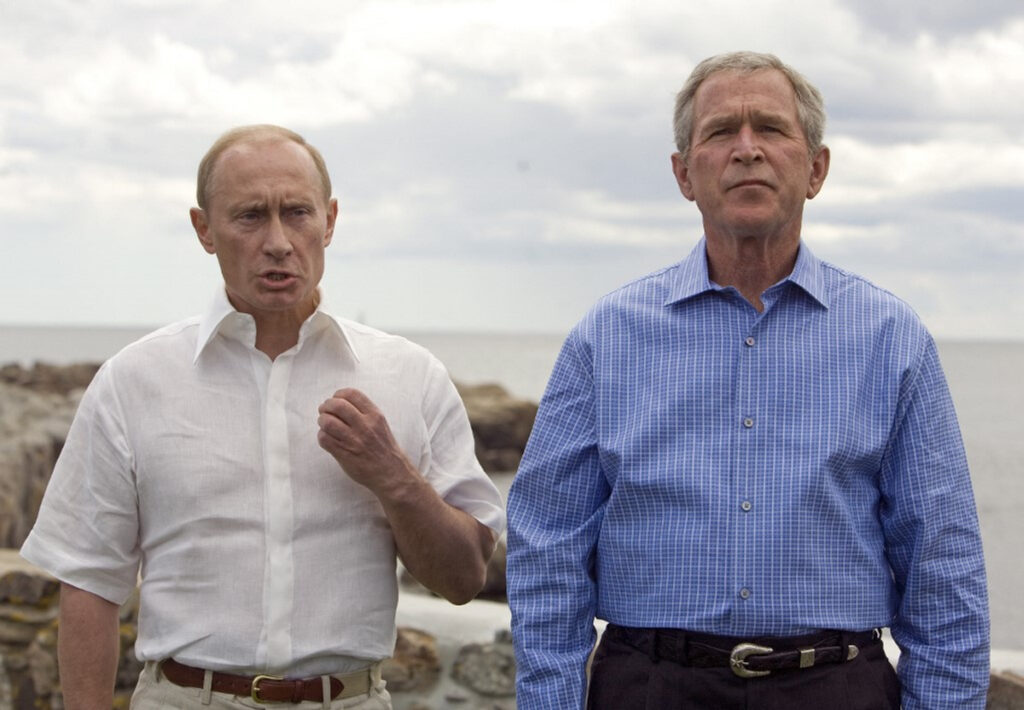
Declassified transcripts between Kremlin leader Vladimir Putin and former US President George W. Bush between 2001 and 2008 have shed light on the Russian leader’s stance on Ukraine over the years.
In some conversations, Putin expressed bitterness over the collapse of the USSR, partially contradicting his publicly pro-Western stance in the early 2000s, and his position on Ukraine’s NATO bid in 2008.
Follow our coverage of the war on the @Kyivpost_official.
The documents were publicly released on Dec. 22 by the NGO National Security Archive after winning a Freedom of Information lawsuit.
On the breakup of USSR
In a transcript dated June 16, 2001, based on a restricted meeting between Bush and Putin, the latter shared what the archive described as “a brief history lecture on (his interpretation) of the breakup of the Soviet Union.”
“What really happened? Soviet goodwill changed the world, voluntarily. And Russians gave up thousands of square kilometers of territory, voluntarily. Unheard of. Ukraine, part of Russia for centuries, given away. Kazakhstan, given away. The Caucasus, too. Hard to imagine, and done by party bosses,” Putin said.
The Soviet republics broke away from the USSR due to a mix of political, economic, and social factors, including the fallout from the Afghanistan invasion and political reforms prompted by rising dissent and economic stagnation in the late 1980s and early 1990s, making Putin’s claim of “goodwill” questionable.
Other Topics of Interest
Ukraine’s Football Year: New Achievements and Fight for the World Cup Dream
Kyiv Post looks back on what 2025 brought for Ukraine’s national football team
However, the claim does mirror some of his other purported statements in the 2000s, such as “He who does not regret the break-up of the Soviet Union has no heart; he who wants to revive it in its previous form has no head.”
In the years that followed, Putin would utilize Soviet nostalgia as a tool to consolidate his control and justify his invasion of Ukraine, framing the invasion as a fight against Nazism and an ideological continuation of WWII, as apparent in monuments placed in occupied Ukraine that morphed WWII history with the ongoing war.
Putin on NATO
Putin also touched on Russia’s NATO membership bid in the same 2001 meeting with Bush.
In it, he questioned why Russia is not in NATO with statements that might shed light on his rationale.
“Now let me return to NATO enlargement. You know our position. You have made an important statement when you said that Russia is no enemy. What you said about 50 years in the future is important,” Putin said.
“Russia is European and multi-ethnic, like the United States. I can imagine us becoming allies,” he added. “But we feel left out of NATO. If Russia is not part of this, of course it feels left out.”
He then used the USSR’s 1954 application for NATO as an example, arguing that the conditions for rejection at the time no longer apply.
“NATO gave a negative answer with four specific reasons: the lack of an Austrian settlement, the lack of a German settlement, the totalitarian grip on Eastern Europe, and the need for Russia to cooperate with the UN disarmament process,” Putin added.
“Now all these conditions have been met. Perhaps Russia could be an ally.”
But Putin added that the issue with Russia not in NATO was that “NATO is enlarging and we have nothing to say about it.”
Putin on Ukraine’s 2008 NATO bid
Putin revisited the question of NATO in 2008, this time on Ukraine’s membership bid, according to a transcript dated April 6, 2008 – the last meeting between Putin and Bush.
According to Kyiv Post’s coverage at the time, Bush had supported Kyiv’s NATO Membership Action Plan (MAP), saying, “As every nation in the world told me, Russia will not have a veto over what happens in Bucharest, and I take their word for it,” calling that “the right policy to have.”
The plan was ultimately rejected by Germany and France, among others.
In the 2008 Bush-Putin meeting in Sochi, the Kremlin leader voiced similar concerns that are now listed as his official war goals for his invasion of Ukraine.
“It won’t be new to you, and I don’t expect a response; I just want to say it out loud. I’d like to emphasize that the accession to NATO of a country like Ukraine will create, in the long term, a field of conflict for you and us – long-term confrontation,” Putin said.
During the conversation, Putin also called Ukraine an “artificial country” – a term that he would use in recent years to justify the invasion.
“Ukraine is a very complex state. This is not a nation built in a natural manner. It is an artificial country created back in Soviet times,” he said.
“If you go to western Ukraine, you’ll see villages where the only spoken language is Hungarian and people wear those bonnets. In the east, people wear suits, ties, and big hats. NATO is perceived by a large part of the Ukrainian population as a hostile organization,” he added.
“This creates the following problems for Russia. It creates the threat of military bases and new military systems being deployed in close proximity to Russia. It creates uncertainty and threats for us.”
The statements contrasted his earlier, public remarks on Ukraine-NATO relationships, where he said in 2003 that he was “absolutely convinced that Ukraine will not shy away from the processes of expanding interaction with NATO and the Western allies as a whole… At the end of the day the decision is to be taken by NATO and Ukraine. It is a matter for those two partners,” according to the Kremlin’s transcript at the time.
Putin on Georgia’s NATO bid
Also noteworthy are Putin’s remarks on Georgia’s NATO bid – the conversation took place four months before Russia invaded the Caucasus country.
“Now, with Georgia, they believe that under NATO’s shield they can restore their territorial integrity. Is this the right way to go – to spread NATO’s military umbrella and let them launch military operations in Abkhazia and South Ossetia?” he said.
“The people in Georgia should be forced to resolve their internal problems by other means. They will do it if forced to.”
Putin also argued that NATO membership would force Georgians to take up arms.
“Georgia should be caused to address this issue by peaceful means. Letting them into NATO will only encourage them to address it by military means, taking up arms,” Putin said.
“And for Russia, there is always the threat of new military bases and weapon systems in the proximity of our borders.”
On April 20, a Georgian reconnaissance drone was reportedly shot down by a Russian warplane – a claim Moscow denied, instead blaming NATO. At the time, NATO Secretary General Jaap de Hoop Scheffer quipped he’d “eat his tie” if a NATO MiG-29 had “magically appeared in Abkhazia and shot down a Georgian drone.”
Russia launched a ground invasion into Georgia in August that year.