
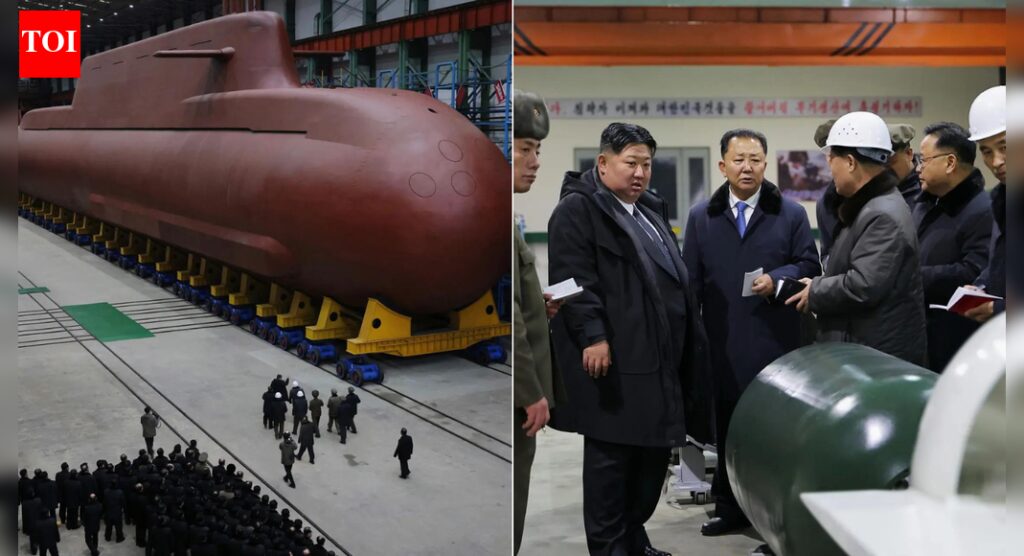
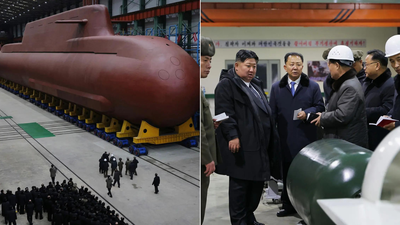
North Korea on Thursday unveiled the completed hull of what it described as a nuclear-powered submarine, signalling progress in one of leader Kim Jong Un’s top weapons projects, even as Pyongyang condemned South Korea’s plans to build a similar vessel as a threat to its security.State media carried photographs of Kim inspecting the completed hull of what it called a nuclear-powered strategic guided missile submarine at a manufacturing base. Kim had designated the development of a nuclear submarine as a priority project during a Workers’ Party congress in 2021. While North Korea has not announced when the vessel will be finished or deployed, analysts said the unveiling suggested tangible progress.
“The completed and welded hull means that they have already mounted a nuclear reactor inside,” said Hong Min, an expert on the North Korean military at the Korea Institute for National Unification in Seoul.Analysts have long questioned how North Korea could acquire the complex technologies and components needed for a nuclear-powered submarine, including a small nuclear reactor. Hong said the speed of progress raised speculation that Pyongyang was receiving technological assistance from Russia in return for sending troops and weapons to support Moscow’s war effort against Ukraine.Military experts said the submarine appeared capable of carrying ballistic and cruise missiles as well as torpedoes. North Korea has conducted multiple tests of submarine-launched missiles and torpedoes in recent years, claiming they are designed to deliver nuclear warheads. Pyongyang has justified its nuclear weapons programme by citing what it calls growing military threats from the United States and its allies, South Korea and Japan.Kim said North Korea regarded South Korea’s plan to build nuclear-powered submarines as “an offensive act” and “a threat to its security that must be countered.” He said it compelled North Korea to accelerate “the modernization and nuclear weaponization of the naval force.”The remarks came after the United States agreed in November to help South Korea build its first nuclear-powered submarine. Seoul has said its submarines would not carry nuclear weapons, arguing it relies on the US nuclear umbrella for deterrence.On Thursday, Pyongyang also criticised the arrival of the USS Greeneville, a US nuclear-powered attack submarine, at a naval base in Busan earlier this week. North Korea’s defence ministry described the port call as “a grave act of causing instability and escalating military tensions.” South Korea’s navy said the visit was for resupply and crew rest.North Korean state media also reported that Kim inspected the first test of a new high-altitude, long-range surface-to-air missile under development. The test, conducted on Wednesday, saw missiles hit mock targets at an altitude of 124 miles, according to Pyongyang. South Korea’s military confirmed the launches but did not provide further details.The developments coincided with deepening ties between North Korea and Russia. Pyongyang said Kim received a message from Russian President Vladimir Putin hailing the countries’ “invincible friendship.” Putin said the “heroic” efforts of North Korean soldiers in Russia’s Kursk region had “clearly proved the invincible friendship” and their “militant fraternity,” according to the Korean Central News Agency.South Korean and Western intelligence agencies have estimated that North Korea has sent thousands of troops, along with artillery shells, missiles and other weapons, to support Russia. South Korea estimates around 2,000 North Korean soldiers have been killed and thousands wounded. North Korea acknowledged this month that some of its troops deployed in Kursk had died.Analysts said Kim’s military push has gained momentum since Russia’s invasion of Ukraine, with Moscow believed to have provided North Korea with fuel, food and military technologies to modernise its ageing navy and air defence systems.North Korea is expected to hold a Workers’ Party congress early next year, the country’s most important political event, where Kim is likely to showcase recent military advances and outline policy goals for the next five years.