
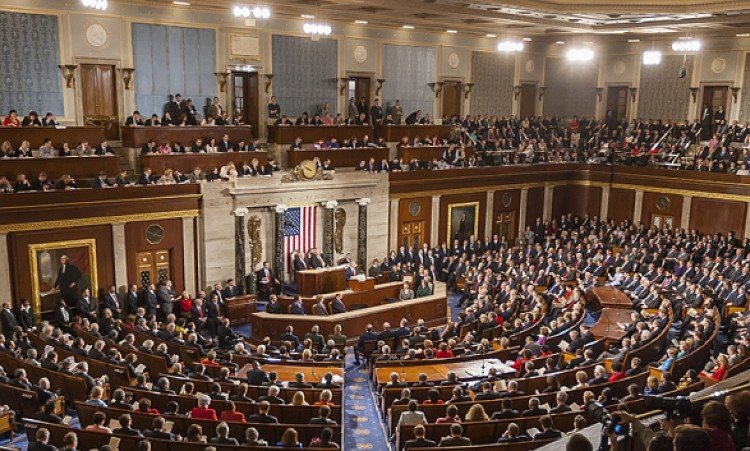
The end of the year is usually a time when people eagerly await presents under the Christmas tree, and Serbia and the Western Balkans were met by something from America, wrapped in a Senate ribbon: a place in the National Defense Authorization Act (NDAA).
This act is adopted every year, but in last year’s document Serbia and the region were not mentioned – which has now triggered numerous reactions in Belgrade, mostly from the opposition and critics of the government.
The document highlights problems with corruption, electoral laws, dependence on Russian gas, malign influences from Moscow and Beijing, and the state of human rights in Serbia.
The adoption of the law raises many questions, among which the most important are how far its reach extends and what practical consequences it could have.
Members of Congress have differing views on Serbia, but the fact that this law was adopted with votes from both parties, the ruling Republicans and the opposition Democrats, points out Amanda Thorpe from the Atlantic Council in Washington, speaking to BBC Serbia.
“It is clear that there is still concern in Congress about allegations that threaten the security of important elements of Serbian society,” Thorpe says.
BBC Serbian requested a comment from Marko Đurić, Serbia’s foreign minister, but no response had been received by the time of publication.
This is a kind of warning from Congress to the administration regarding its foreign policy towards Serbia and other countries in the region, says Evelyn Farkas, executive director of the McCain Institute, in a written response. “It is significant when Congress adopts a law instructing the executive branch to take the concerns of that body into account,” Farkas told BBC Serbia.
In the law, parts of which refer to the Western Balkans and Serbia, accusations by Serbian officials that peaceful protesters, opposition parties and civil society are “trying to destabilise the government” are also assessed as worrying.
It is stated that the United States should continue to support the achievement of a comprehensive final agreement between Kosovo and Serbia, based on mutual recognition, and that the US government will not pursue a policy advocating territorial exchange, partition, or other forms of redrawing borders along ethnic lines in the Western Balkans.
In the NDAA section entitled “Western Balkans Democracy and Prosperity Act”, Serbia is the only country in the region whose situation is explicitly analysed.
“Parliamentary and local elections held in Serbia on 17 December 2023 and their immediate aftermath are a cause for deep concern about the state of Serbian democracy, among other reasons due to the final report of the OSCE Office for Democratic Institutions and Human Rights (ODIHR),” the act states.
What is the NDAA and why is Serbia mentioned?
The National Defense Authorization Act (NDAA) is the most important legislative act for US defence policy, but it “only” authorises the defence budget, Alex Noyes, a fellow at the Brookings Institution in Washington, told BBC Serbia.
“The fact that Serbia and the Western Balkans are mentioned means that the American defence establishment will be paying more attention over the next year,” he explains.
But this does not necessarily mean that the United States will change its diplomatic course towards the region.
“The Department of Defense can often ignore political directives, but when something is in line with the NDAA, officials pay attention.
“The NDAA is a defence-focused law, but both the president and the State Department have significant room for manoeuvre,” Noyes emphasises.
This act sets guidelines for those who allocate funds, but it also speaks on behalf of Congress as a whole on issues of foreign and defence policy. “It is a law that has been adopted every year for decades and, as such, it is incredibly powerful. These documents really do have a tangible impact,” says Farkas, a former deputy assistant secretary of defence during the Barack Obama administration.
Under the law, the administration must create a five-year regional economic development strategy, include the Western Balkans in the State Department’s European Democratic Resilience Initiative programme, and produce a report on the “malign activities” of Russia and China.
“In this comprehensive package, there are guidelines, instructions, levels of funding authority and certain restrictions on the executive branch for the entire national security, defence and intelligence apparatus,” Amanda Thorpe explains.
Where does the bipartisan support in Congress come from?
The author of the Western Balkans law is Democratic congressman from Massachusetts William Keating, but it passed through the House of Representatives and the Senate thanks to Republican votes as well. This is not unusual, because the document is a serious and significant product of the work of representatives from both parties, Thorpe assesses. Since the NDAA is a product of legislative compromise, there are some parts of the law that Democrats might potentially remove, and vice versa for Republicans. However, viewed as a package, it is a consensus product and represents the general mood of Congress regarding defence policy,” she says.
BBC Serbian contacted representatives of Keating’s office, but no response had arrived by the time of publication.
The document adopted at his proposal states, among other things, that despite economic progress, poverty and unemployment rates remain higher than in neighbouring EU countries.
“The Western Balkans is a complex region, but those in Congress who know it, know it well, and they are the authors of these provisions,” says Alex Noyes, a fellow at the Brookings Institution.
Sanctions, corruption and Russian gas
The law stipulates that the President of the United States shall impose sanctions on “any foreign person determined to have engaged in, or attempted to engage in, corruption related to the Western Balkans”, no later than 90 days from the date the Act enters into force.
Sanctions are also предусмотрed for individuals and policies “that threaten the peace, security, stability or territorial integrity of any area or state in the Western Balkans”, as well as for persons “who undermine democratic processes or institutions”, and for serious human rights violations.
Milorad Dodik, President of the Republic of Srpska, was removed from the sanctions list at the end of October, where he had been since 2017 due to obstruction of the Dayton Agreement.
“The United States regularly reviews sanctions to ensure that they contribute to US economic, security and foreign policy objectives, and this case is no exception,” a State Department spokesperson told the BBC at the time.
The State Department announced that it would continue to work closely with political actors and stakeholders from across the political spectrum in Bosnia and Herzegovina to advance shared priorities.
“There is wording that directs sanctions towards specific criteria against those who would destabilise the region – the administration must assess violations and take action to impose those sanctions, but Congress’s guidelines are clear,” Amanda Thorpe of the Atlantic Council explained to the BBC.
Corruption is highlighted as another problem, including among key political leaders, which “continues to stifle the Western Balkans and represents one of the greatest obstacles to further economic and political development in the region”.
Dependence on Russian energy resources is another issue pointed out in the law, and for the past two months the Serbian authorities have been trying to resolve a problem caused by US sanctions against the Oil Industry of Serbia (NIS), a powerful company majority-owned by Russia’s Gazprom Neft.
“Implementing the adopted document will require time, funding and additional steps,” Thorpe concludes.
(BBC Serbia, 23.12.2025)
https://www.bbc.com/serbian/articles/c20geen45gdo/lat