
One thing the fashion business is known for is variety, but this plethora of products complicates manufacturers’ packing processes. Ensuring that the right merchandise makes it to the right customer is crucial, but checking purchase orders manually is time consuming and subject to human error.
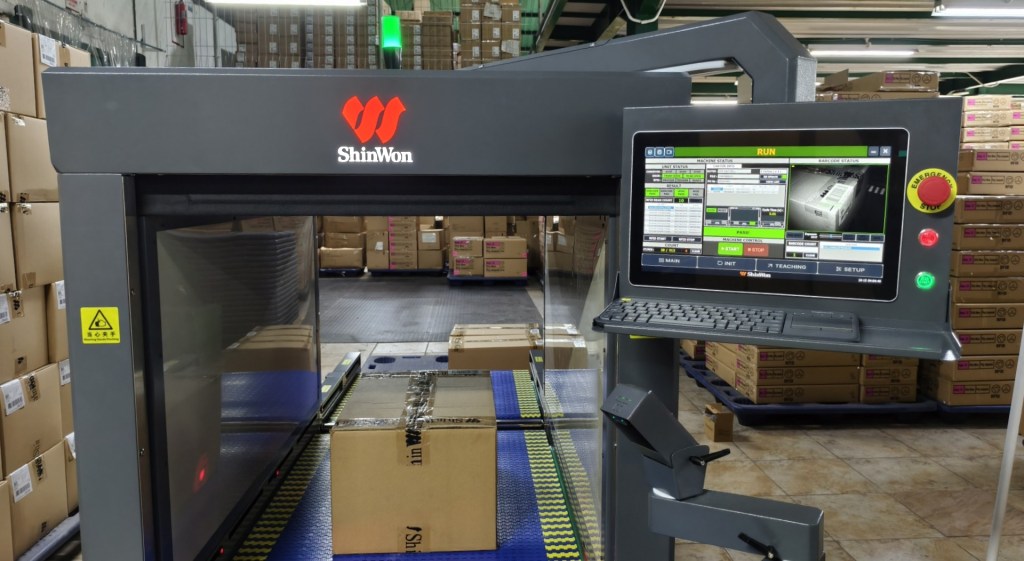
South Korea-based garment manufacturer ShinWon is replacing manual inventory checks with an artificial intelligence-powered tunnel system, which packages travel through on a conveyor to be automatically scanned with radio frequency identification (RFID) readers. Initially, ShinWon piloted the RFID system at its Pt. Fashion Stitch Joshua plant in Indonesia, but it is now expanding this solution to its entire network of subsidiaries around the globe, including factories in Guatemala, Nicaragua and Vietnam. Alongside efforts in quality uniformity and digitalization, this tunnel system is intended to support the producer’s “zero claim” goal.
“Since ShinWon operates a network of global production hubs, maintaining a consistent quality assurance standard across all factories was essential,” Eunice Kim, vice president of corporate strategy at ShinWon, told Sourcing Journal. “Implementing full RFID inspection was not merely an operational improvement; it was a strategic initiative designed to enforce global standardization and significantly strengthen buyer confidence.”
Before adopting this system, the Pt. Fashion Stitch Joshua plant was opening just a sample of boxes to verify that the contents matched the purchase order, including colors and sizes. This meant that only approximately 30 to 40 percent of shipments were being checked. The manufacturer had also tried incorporating handheld RFID scanners, but there were limits to the technology, including inconsistent accuracy down to the item level. “Relying solely on worker training and selective checking made it challenging to consistently meet the high level of assurance our buyers expect,” said Peter Lee, deputy team leader of ShinWon’s smart engineering team.
ShinWon chose to build the software that underpins the tunnel system in house. As Lee explained, “Buyer requirements vary widely, and off-the-shelf external solutions couldn’t nimbly address the continuous evolution in RFID technology and packing methods. We needed a solution capable of continuous enhancement rather than a one-time development.”
Featuring a “user-friendly workflow,” the system only requires employees to enter three pieces of information: the buyer, file and purchase order. Once input, the system uses robotic process automation (RPA) to register RFID tags and packaging information. Due to the automation, frontline employees can start using the system with minimal training. “This user-centric design facilitated rapid change management, which now acts as a critical foundation for our next-stage digital initiatives,” said Kim.
As a result of this system, Pt. Fashion Stitch Joshua has improved its inspection efficiency by 32 percent. Today, it inspects 100 percent of all outbound shipments using the scanning system, at a rate of roughly 1,740 cartons each day—equivalent to about 30,000 garments. Further aiding efficiency, the company reduced the tunnel length from around 16.5 feet to roughly 10.5 feet, creating space for additional lines.
This technology integrates with ShinWon’s existing manufacturing execution system (MES), and it will also provide a base as the company builds out and upgrades its digital manufacturing platform that also includes logistics automation and AI-powered quality projections. “Ultimately, RFID adoption is not just about inspection efficiency; it is a turning point in shifting our global operations to a fully data-driven ecosystem,” said Kim.
Following the global tunnel rollout—which is expected to be completed by the first quarter of 2026—ShinWon will establish an internal traceability solution that tracks the process from packaging to shipment. Taking visibility further, the producer is developing a traceability solution that spans from raw materials to finished product shipping, leveraging RFID and UPCs. It has also integrated a blockchain-based solution for verifying vendor social compliance.
Data is also a big push for the manufacturer, as ShinWon uses AI-powered analytics for trend forecasting, scraping sources such as social media. The company is also tapping generative AI for fashion design and building virtual reality showrooms for its customers.
The tunnel system is a key milestone in these wider digitalization efforts, according to Kim. “In essence, it marks our evolution form a ‘traditional manufacturer’ to a ‘technology-driven manufacturing partner,’” she said.