
Published on
December 27, 2025
 Understanding Sustainable and Community-Based Tourism
Sustainable and community-based tourism refers to travel models designed to benefit local populations while protecting cultural heritage and natural environments. Rather than prioritizing visitor volume or large-scale infrastructure, this approach emphasizes local ownership, low environmental impact, and meaningful cultural exchange.
In practice, this form of tourism supports family-run accommodation, locally guided activities, traditional food systems, and everyday cultural life. Travel is slower, smaller in scale, and more closely connected to place. The goal is not only environmental protection, but long-term social and economic resilience for host communities.
Why Azerbaijan Provides a Strong Case Study
Azerbaijan’s geography, history, and settlement patterns make it particularly well-suited for community-based tourism development. Across the country, many rural areas continue to maintain traditional livelihoods such as farming, herding, craft production, and small-scale trade. These practices have survived largely intact due to relative isolation and limited mass tourism.
Several factors strengthen Azerbaijan’s potential in this sector:
- A dense network of historic villages across the mountain and lowland regions
- Lower levels of overtourism compared to many European and Asian destinations
- Compact distances between diverse ecosystems, including alpine zones, forests, and coastlines
- Strong traditions of hospitality, oral culture, and regional cuisine
For many rural regions, tourism offers an alternative source of income that complements existing livelihoods rather than replacing them, helping reduce outward migration and economic dependency on extractive industries.
Community Tourism in Mountain and Rural RegionsKhinalug: High-Altitude Community Tourism
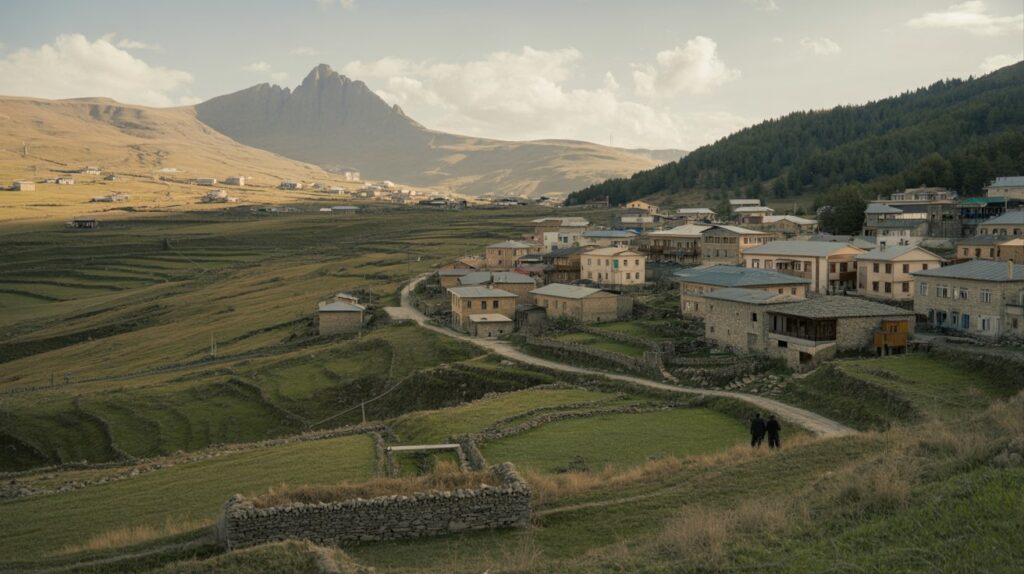
Located in the Greater Caucasus, Khinalug is one of the highest permanently inhabited villages in the region. Tourism here operates largely through locally managed homestays and community-guided hiking routes. Visitors experience daily village life while contributing directly to household incomes.
The preservation of Khinalug’s ancient language and customs is reinforced rather than disrupted by tourism, as economic value is placed on cultural continuity rather than modernization.
Lahij: Craft-Based Village Tourism
Lahij is known for its long-standing copper-working tradition, practiced in small, family-owned workshops. Tourism supports these crafts by creating demand without industrializing production. The village’s pedestrian layout and traditional water management systems naturally limit environmental impact.
Rather than functioning as a staged heritage site, Lahij remains a working settlement where tourism integrates into daily routines.
The Sheki Region: Silk Road Continuity
In and around Sheki, tourism builds on historical trade routes and architectural heritage. Restored caravanserais provide accommodation while employing local staff, and nearby villages offer home stays centered on traditional cooking and hospitality.
Silk production heritage, once integral to a wider regional economy, is now increasingly linked to cultural tourism through demonstrations and storytelling.
Eco-Tourism and Conservation Through LivelihoodsHirkan National Park and the Lankaran Region
Hirkan National Park protects rare subtropical forests with high levels of endemism. Community-based eco-tourism initiatives train local guides in forest interpretation, allowing residents to earn income through conservation rather than land conversion.
Small-scale guided walks and educational visits limit ecological disturbance while building local support for long-term protection.
Ilisu and Zagatala Reserves
In the northwestern mountains, Ilisu and Zagatala reserves illustrate how nature tourism can replace extractive land use. Family-run guesthouses, hiking, and birdwatching create economic incentives aligned with conservation goals.
Here, environmental protection is reinforced through livelihoods rather than enforced restrictions alone.
Food Tourism as a Community Development Tool
Food-based tourism plays a central role in community-focused travel across Azerbaijan. Meals are often prepared in private homes using seasonal, locally sourced ingredients, reducing dependence on imports and supporting small-scale agriculture.
Regional food traditions also serve as cultural anchors:
- Pomegranate cultivation and harvest traditions in Goychay
- Tea culture linked to subtropical farming in Lankaran
- Dairy and pastoral foodways in the Quba region and Shahdag foothills
These experiences sustain culinary heritage while creating direct economic value at the household level.
Women-Led and Family-Based Tourism Initiatives
In many rural areas, women play a central role in managing guesthouses, preparing food, and hosting craft or cooking workshops. These activities generate income that often supports education, healthcare, and household stability.
Family-based tourism spreads economic benefits across generations and reduces reliance on external operators, strengthening social sustainability alongside environmental goals.
Practical Ways Travelers Support Sustainable Tourism
Travelers play a direct role in reinforcing or undermining sustainable tourism models. In Azerbaijan, the positive impact is most likely when visitors:
- Choose locally owned accommodation
- Hire village-based guides
- Purchase crafts directly from artisans
- Respect cultural norms and daily routines
- Travel outside peak seasons
- Minimize waste and single-use plastics
Such choices influence how tourism develops over time, particularly in small communities.
Story Angles for Travel and Policy Journalism
Sustainable tourism in Azerbaijan lends itself to several strong editorial narratives, including:
- Rural revitalization through village-based tourism
- Low-impact travel models in the Caucasus
- Craft preservation along historic Silk Road routes
- Post-crowd tourism in emerging destinations
These angles connect local experience to global conversations around ethical travel and sustainability.
The Long-Term Outlook
As international travelers increasingly seek authenticity, cultural connection, and responsible travel options, Azerbaijan is gradually positioning itself as a destination aligned with these values. Growth remains measured, with an emphasis on small-scale development and community participation rather than rapid expansion.
The challenge moving forward lies in maintaining this balance—supporting economic opportunity without eroding the cultural and environmental qualities that make these destinations distinctive.
Where Community Tourism Finds Its Strength
Sustainable and community-based tourism in Azerbaijan demonstrates how travel can function as a tool for preservation rather than extraction. By supporting local livelihoods, maintaining cultural practices, and protecting fragile landscapes, this model offers an alternative to mass tourism development.
For travelers, it provides deeper, less crowded experiences. For communities, it offers continuity and agency. In the context of Silk Road revival travel and global shifts toward responsible tourism, Azerbaijan’s approach illustrates how growth and restraint can coexist.
