
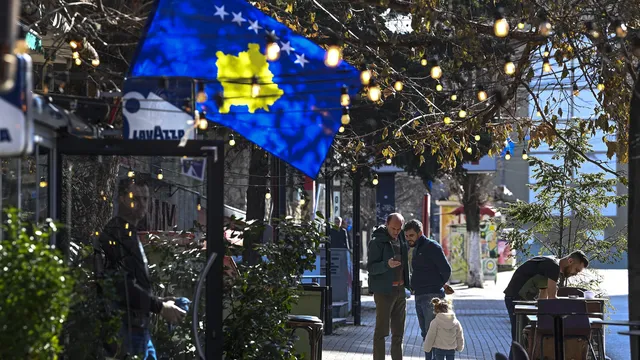
Early elections in Kosovo are scheduled for December 28.
Even before the first vote is cast in Kosovo’s early elections on December 28, experts predict that it is unlikely to end the political crisis that has been gripping Europe’s youngest country for almost a year.
The Balkan state has been in political deadlock since the inconclusive elections in February, which were won by Prime Minister Albin Kurti’s Self-Determination party, but without enough seats to form a government.
After months of wrangling in a deadlocked parliament, the interim prime minister is turning to voters in an election that analysts say will change very little.
“I don’t think the December 28 election will bring clarity,” said economist Mehmet Gyata, predicting that Kurti’s party would win again.
Political analyst Fatime Hajari agreed that “the chances are high” “Self-Determination” will win the most votes, but pointed out that almost nothing else is clear.
Charismatic Kurti
If anyone can secure a majority, it is Kurti, once called the Che Guevara of Kosovo because of his radical past, who has a rare record. His party came to power in 2021 with the biggest election victory since the country declared independence from Serbia in 2008, winning over 50% of the vote.
From student radical to political prisoner, Kurti’s long road to the prime minister’s office has made him one of Kosovo’s most recognizable and influential politicians. His combination of nationalism and reform agenda proved popular in a country whose sovereignty is still contested by Serbia, more than two decades after the end of the war for independence.
But Gjata believes things may have changed since Kurti’s last term. “I fear that the current political crisis will repeat itself because Self-Determination will not get more than 50% of the vote. Once again, we will have no winner,” the economist said.
The largest opposition parties have refused to join Kurti’s coalition, which almost guarantees a fragmented parliament.
The only realistic challenge for Self-Determination would be “cooperation” between the three main opposition parties, said former foreign minister and opposition candidate Enver Hoxhaj. “I think only they can offer stability,” he noted.
Popular Serb policy blamed for “instability”
For Kurti and his party, countering Serbian influence in Kosovo has long been a focus, which has earned him support at home but criticism abroad.
When Serbian forces withdrew after NATO’s air campaign in 1999, they left many of their state structures in place for ethnic Serbs, who live mainly in the north.
Kurti described these services as “instruments of intimidation, threat, and control” and spent most of his second term uprooting the system — and in the process angering Belgrade.
As a result, tensions in the north, which erupted into violence in 2023, led to sanctions from the European Union and prompted Washington to accuse Kurti’s government of increasing “instability.”
But among his voters, the removal of Serbian influence remains popular. “The expansion of sovereignty there is seen by citizens as a great success,” Haidari said.
Most opposition parties avoid the issue, but the Serbian List — which contests and holds most of the ten reserved seats for Serbs in parliament — regularly clashes with Kurti’s agenda in the north.
The small party, which has close ties to Belgrade, has previously described the government’s actions in the north as “ethnic cleansing” and said it was prepared to work with other parties to prevent Kurti from coming to power.
A year of “colossal damage”
Without a parliament, key international agreements were not ratified, putting hundreds of millions of euros in aid at risk.
Two national votes and local elections cost one of Europe’s poorest countries at least €30 million ($35 million) this year. More than a dozen government institutions and agencies were also left without leadership as their heads’ terms expired without new appointments being made.
Gjata believes that divided MPs have caused “enormous damage” to the economy in recent months. “They have put Kosovo in a state of anarchy,” he said.
While MPs argue, the cost of the crisis will be felt by the citizens of the Balkan country, Haidari warned. “That is why Kosovo needs a stable and functioning government that focuses on development and prosperity,” he stressed. | BGNES
—
AFP analysis