
India will end 2025 on quite a high.
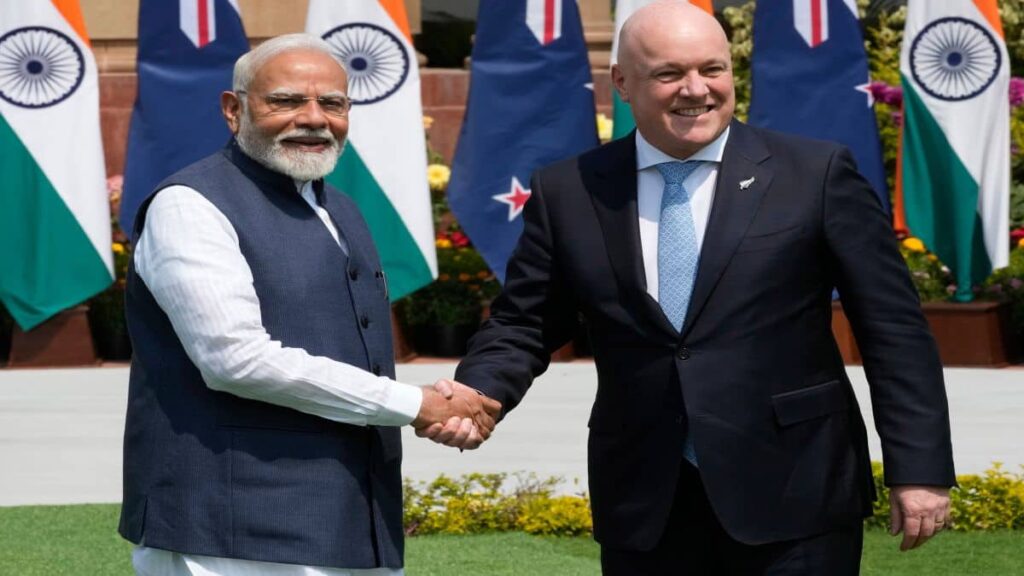
The country announced the conclusion of negotiations of a free trade agreement with New Zealand and both nations are expected to sign the deal in the next two-three months. In a post on X, Prime Minister Narendra Modi said, “Concluded in just nine months, this historic milestone reflects a strong political will and shared ambition to deepen economic ties between our two countries… The India-NZ partnership is going to scale newer heights. The FTA sets the stage for doubling bilateral trade in the coming five years.”
India also saw its space agency, the Indian Space Research Organisation (Isro), successfully launch the LVM3-M6/BlueBird Block-2 mission for its US-based commercial customer, AST SpaceMobile. This was the ninth flight of the LVM3 rocket, which has maintained a perfect track record so far.
And following the IndiGo Airlines fiasco, India’s Civil Aviation Ministry granted approvals to new airlines. The move is an attempt to challenge the aviation duopoly that exists in the nation.
But it wasn’t just about the highs. The country also saw violent protests break out over the lynching of a Hindu man in Bangladesh. From Kolkata to Delhi, angry Indians spilled out on the streets, highlighting the fragility in the relationship between India and Bangladesh.
As we wrap up this year, we take a look at these big events in our weekly roundup.
Activists burn posters of Bangladesh’s flag in Ahmedabad during a protest against the brutal murder of Hindu youth Deepu Das in Bangladesh. File image/AP
1) The India-Bangladesh ties nosedived even further this week. The reason: the lynching of a Hindu man, identified as Dipu Chandra Das, in Bangladesh’s Mymensingh district over alleged blasphemy on December 18.
The incident prompted many Hindus across the country to come out on the streets, demanding for justice. Several activists thronged the Bangladesh High Commission in Delhi on Tuesday, resulting in Dhaka summoning the Indian envoy to lodge its protest over the incident.
The angry protesters could be heard shouting slogans and accusing Bangladeshi groups of wrongly targeting minorities. They carried placards and banners with slogans including “India will not tolerate torture of Hindus in Bangladesh” and “Our silence should not be mistaken as weakness, we are lions.”
Other parts of the country, such as West Bengal, Madhya Pradesh also saw agitations over the lynching, with protesters demanding justice.
How bad was the situation? Our
report explains it all.
2) India is looking to improve its trading ties with countries across the world. And this week, New Delhi announced that it had concluded negotiations with Wellington on a free trade agreement.
This is one of India’s fastest-concluded FTAs — talks on it began in March and concluded in December.
This FTA enhances market access and tariff preferences for Indian exports to New Zealand, while serving as a gateway to the wider Oceania and Pacific Island markets. The agreement also opens opportunities for India to emerge as a key supplier of skilled workforce.
How else does India benefit from this FTA?
Read on to find out.
Indian Space Research Organisation (Isro) launches the BlueBird Block-2 communication satellite of AST SpaceMobile, USA, onboard its launch vehicle LVM3-M6 from the Satish Dhawan Space Centre, in Sriharikota, Andhra Pradesh. File image/PTI
3) On Wednesday (December 23), Isro launched a LVM-3 rocket carrying its
heaviest-ever satellite — BlueBird Block-2 — from the Satish Dhawan Space Centre. The BlueBird Block-2 weighs 6,100 kilogrammes (over six tonnes), highlighting the space agency’s ability to handle complex, high-stakes missions for global clients.
This mission extended LVM3’s unbroken streak to nine consecutive successes. Even PM Modi congratulated Isro, writing on X, “The successful LVM3-M6 launch, placing the heaviest satellite ever launched from Indian soil – the spacecraft of the USA, BlueBird Block-2 – into its intended orbit, reinforces India’s growing role in the global commercial launch market. This is also reflective of our efforts towards an Aatmanirbhar Bharat.”
4) It’s been around two weeks since the frightful IndiGo crisis that saw multiple flights being delayed and thousands of passengers being severely inconvenienced.
Now, the Ministry of Civil Aviation has granted permission to three new airlines — Al Hind Air, FlyExpress, and Shankh Air — to take to the skies in an attempt to break duopoly that exists in the Indian aviation sector.
But how will this
benefit Indian flyers?
5) Indians love to study abroad. We aren’t the ones saying it — it’s a government report that reveals that the country continues to face a brain drain. In its report, the Niti Aayog stated that a whopping 13.36 lakh students went overseas to pursue their educational dreams. Moreover, “for every one international student coming to India, nearly 28 Indian students went abroad”, the Niti Aayog said in its report.
The report also revealed that Canada remains the most preferred destination for Indian students. In 2024, the Western country hosted 4,27,000 Indian students, with another 3,37,630 Indian students visiting the US, followed by 1,85,000 to the UK, 1,22,202 to Australia and 42,997 to Germany.
In our
explainer, we dwell further into these numbers and also how this could be a problem for the country.
Deliverymen of food aggregator Swiggy wait along a roadside in New Delhi. File image/PTI
6) Your New Year’s Eve plans may be in jeopardy, all thanks to the countless of gig workers connected to Swiggy, Zomato, Amazon, Zepto and other such platforms. These delivery workers have announced they will be going on strike on December 31 against their deteriorating working conditions.
Shaik Salauddin, National General Secretary of Indian Federation of App-Based Transport Workers (IFAT), told The New Indian Express, “We want the government to come out with a Policy for gig and platform workers with a fixed minimum wage.”
What are their
other demands?
7) An Oxford Union debate has garnered quite a lot of attention on social media this week. Why? Because a Mumbai-born student delivered a fiery address on India-Pakistan ties at the event.
In the debate, Viraansh Bhanushali, who has become a social media sensation, argued against Islamabad’s Moosa Harraj, that New Delhi’s approach towards Pakistan is rooted in genuine national security concerns rather than political populism.
He also said, “We have learnt it the hard way, you cannot shame a state that has no shame”, referencing major attacks, including Pathankot, Uri, and Pulwama. He stated that a country that harbours terror networks cannot claim moral superiority.
But who is Viraansh Bhanushali?
Read here to find out.
That’s it from us for this week. If you liked what you read and are looking for more such explainers,
bookmark this page.
PS: We would like to wish each and one of you all a very Happy New Year!
End of Article