
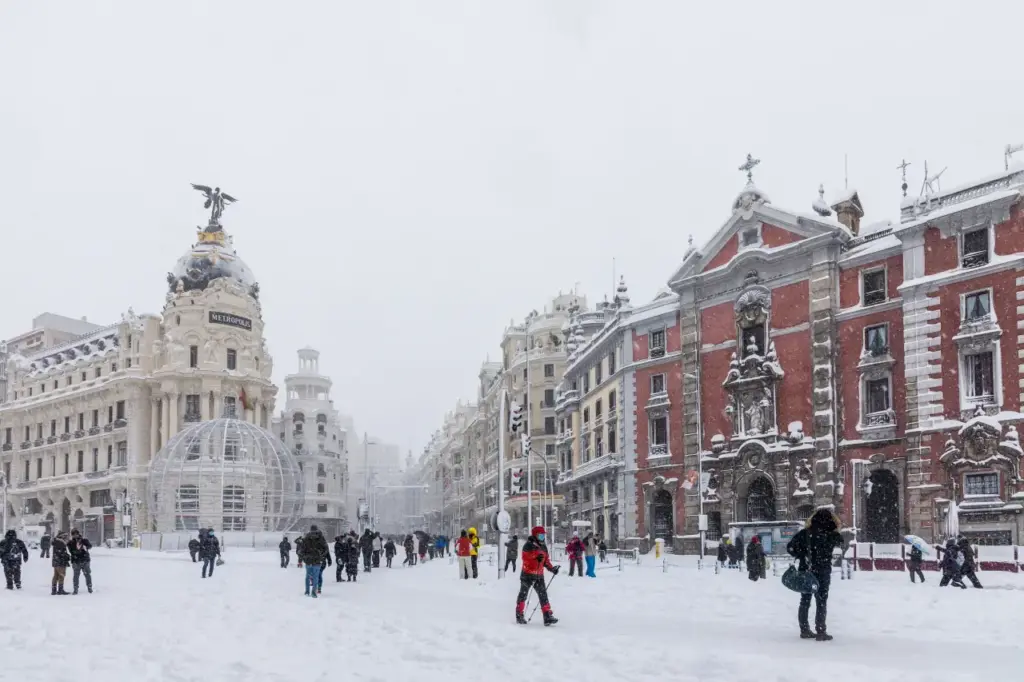
Spain is experiencing its coldest Christmas in 15 years, with temperatures on 24 and 25 December 2025 dropping sharply across much of the country, according to forecasts from the State Meteorological Agency, Aemet. The sudden cold snap follows a year that had been on track to rank among the warmest on record, making the timing and intensity of the festive chill particularly striking for winter travellers.
The plunge in temperatures affects large parts of the Iberian Peninsula and the Balearic Islands, with frost, snow and daytime highs struggling to rise above 5ºC in several inland cities. Meteorologists link the conditions to a Scandinavian high-pressure system that has redirected cold, humid air from the North Atlantic and Siberia towards Spain, creating an unusually wintry start to the holiday season.
Why Spain is colder than usual this Christmas
Extreme cold at Christmas is no longer typical for much of Spain, where winters have steadily become milder over recent decades. Aemet notes that to find a comparable festive period, it is necessary to look back to 2010, when average temperatures were similarly low. Since then, the overall trend has been towards warmer winters, with fewer cold waves recorded across the country.
Data from the past decade underline how unusual this moment is. Spain has experienced the lowest number of cold waves in the historical record, which dates back to the 1960s. While a cold wave once occurred almost every winter, 2024 became the fifth year with none at all, joining 2014, 2016, 2018 and 2020. The last truly harsh winter remains 2005, when Spain endured 34 consecutive days of cold wave conditions.
Last winter offers further context for travellers expecting milder conditions. The average temperature across mainland Spain reached 7.8ºC, sitting 1.2ºC above the 1991–2020 reference period and ranking as the fifth warmest winter of the century. December 2025 initially appeared to follow that pattern, with temperatures running above average for much of the month before the sudden atmospheric shift.
The turning point came with the formation of what meteorologists describe as a Scandinavian blocking pattern. A large anticyclone over northern Europe altered the jet stream, allowing cold air masses from both the North Atlantic and northeastern Europe to sweep southwards. The result has been a sharp and widespread drop in temperatures, particularly noticeable over Christmas.
What winter travellers should expect
For visitors, the effects are already visible. Christmas Day began with widespread frost and snowfall in northern regions, while rain fell across the northeast and the Balearic Islands, at times heavily. In Madrid and several other provincial capitals, daytime temperatures are not expected to exceed 5ºC, with cities such as Segovia and Lugo hovering closer to 3ºC.
The cold is unlikely to ease quickly. Duncan Wingen, meteorologist at Meteored, said Duncan Wingen, Meteorologist at Meteored, “El modelo europeo vaticina que las próximas tres semanas serán frías en España, con temperaturas inferiores a los valores medios de las fechas”. Forecasts indicate anomalies of between -1ºC and -3ºC across most of the country from 29 December through the start of January, with deviations of up to -6ºC in the Pyrenees.
New Year’s Eve under winter skies
This means New Year’s Eve celebrations are also set to unfold under wintry conditions. In major cities, outdoor gatherings and midnight traditions are likely to take place in freezing temperatures, a marked contrast to the milder evenings many travellers have come to expect in Spain. Inland destinations and higher-altitude towns may see frost well into the night, while snow remains possible in northern and mountainous areas.
Although the situation does not necessarily meet the technical definition of a prolonged cold wave, it points to a sustained period of below-average temperatures. Snowfall is expected to be frequent in the Pyrenees, which may appeal to travellers seeking winter sports or alpine scenery during the holiday break. Elsewhere, colder evenings may shift celebrations indoors, towards restaurants, theatres and smaller-scale festivities.
Aemet stresses that Christmas periods this cold are becoming increasingly rare as global temperatures rise. Even with the current anomaly, meteorologists note that the first week of Christmas 2025 is still around 2.1ºC warmer than comparable periods in the mid-20th century, making a return to winters like that of 1962, when Barcelona recorded 46cm of snow over three days, highly unlikely.
For winter travellers, the contrast is part of the appeal. Spain’s festive season in 2025 offers a reminder that sharp cold spells can still punctuate a warming climate. Those visiting now encounter a country briefly shaped by frost and snow, where New Year’s Eve unfolds against a backdrop more reminiscent of northern Europe than the Spain many expect at the end of December.
Photo Credit: Jose Luis Vega / Shutterstock.com