
As political tides shift around the world, Germany is working to tune its approach to the the Pacific and how it will work with the United States in the
region.
This month Alexander Taylor-Fowles, a German diplomat working in his country’s embassy in D.C.
as the first secretary of its Indo-Pacific Affairs Political Section, visited Hawaii. During the trip he met with military officials and diplomats around the island, and made a stop at the East-West Center to talk about Berlin’s interests in the region.
“Germany is an export economy, the fact that so much of world trade goes to the South China Sea and the Taiwan Strait has direct implications on our prosperity if there is a problem in that part of the world,” said
Taylor-Fowles. “But the other aspects include the absolute explosion in population in this part of the world that leads to issues around education, innovation, the cultural significance coming out of (Asia).”
Taylor-Fowles has deep diplomatic experience on both sides of the Pacific, working in both the U.S. and China. Between 2017 and 2020 he served as Germany’s Deputy Consul General in Chengdu, China and before his latest posting at the German Embassy, he was a Trans-Atlantic Diplomatic Fellow in the U.S. State Department.
His stop Hawaii came just after the White House released its controversial new national security strategy. It calls for the U.S. to pull military forces from much of its global operations to focus military and diplomatic efforts in the Western Hemisphere as the administration of President Donald Trump launches deadly strikes on alleged drug traffickers and says it seeks to fight Chinese influence throughout the Americas and assert U.S. power.
The strategy also had harsh words for Europe. The White House said that it would push European countries to tighten borders, deport immigrants and refugees, and that the U.S. would seek to back right-wing “patriotic” political parties in those countries to advance those goals.
Stay in touch with breaking news, as it happens, conveniently in your email inbox. It’s FREE!
The strategy has ruffled feathers and raise concerns across the Atlantic. But Taylor-Fowles said that when it comes to the Pacific — and China — the U.S. and Germany are still largely aligned and that he believes there’s still lots of room for cooperation.
“Many of the conversations that we Europeans have had with the U.S. administration over the last few months is that this is a new era now in how we look at China,” he said. “Because they have shown that they have this weapon of massive (economic) dependency of the rest of the world … and they are willing to use it.”
Germany has robust trade with countries across Asia and more recently has been beefing up engagement in Pacific Island nations. In August 2023 it opened a new embassy in Fiji. Germany has been working with island nations on climate resilience and infrastructure, along with other engagements.
“We do a lot of these things because they are valuable, and because we have partners in the region that for whom this is valuable,” said Taylor-Fowles. “But at the same time (though) it’s not because of this … it also helps bolster against sort of Chinese malign influence in the region.”
In recent years Beijing has invested heavily in
Pacific island nations through its Belt and Road Initiative, a series of Chinese government-backed infrastructure projects aimed at promoting trade with China. The BRI has drawn criticism from some observers who charge that China is using “debt trap ” diplomacy meant to lure and force countries into a subservient relationship with Beijing. Analysts have also argued that the BRI includes “dual use” projects that can also support Chinese military and intelligence operations.
“The way that China has put itself at the center of the spider’s web of international trade, and has made everyone so dependent on it, is a feature, not a bug,” said Taylor-Fowles. “They have done this with great deliberateness since joining the international trading system (and) untangling that is a huge challenge, and one that can only be met if we do it together.”
Russia’s full-scale invasion of Ukraine in 2022 was a major shock to Europe’s economic and foreign policies. Much of Europe, including Germany, heavily used Russian oil and gas to power their electrical grids and fuel their cars. The breakdown in trade has been a shock to Europe’s economy.
The breakout of a major war in Europe has also prompted a major effort among European countries to bulk up their militaries and think much more seriously about their security policies.
“(The war) has also changed the way we view other parts of the world,” said Taylor-Fowles. “The three biggest supporters for Russia in its war against Ukraine are in Asia: China, India and North Korea. North Korea sent about 12,000 troops to fight in Ukraine, India buys enormous amounts of Russian oil, China also buys oil and also exports all sorts of dual use equipment.”
But Germany, which boasts the fourth largest economy in the world, has also had deep trade ties with China. In 2023 Berlin released its first China strategy, which called Beijing a “systemic rival” and advocated that Germany work to reduce economic dependence on its largest trading partner.
“China has changed,” the document stated. “As a result of this and China’s political decisions, we need to change our approach to China.”
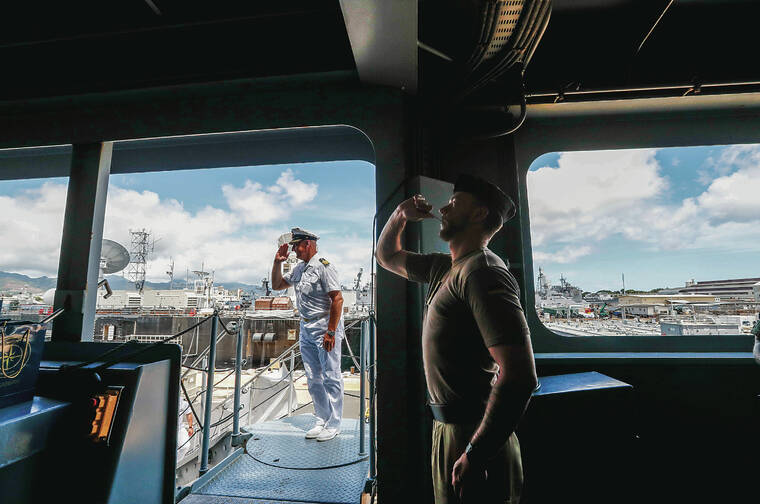
In 2024 the German military sent a small Navy task force across the Pacific, which came to Hawaii to participate in the biennial Rim of the Pacific exercise. It was the German military’s first time participating.
German Defense Minister Boris Pistorius stopped in Hawaii during the exercise. In the islands, he told reporters “we need to show that many countries in this world say this rules-based international order is the foundation, the prerequisite for security and prosperity of many people across the world. And so this is why we bear this
responsibility together. And we need to show that we really support that.”
Afterwards the Germans sailed west to the Sea of
Japan to participate in international sanction enforcement operations against North Korea and sailed through the Taiwan Strait and into the South China Sea, making stops in ports along the way.
“We have an inherent
interest to our long-term prosperity in keeping waterways and shipping routes clear,” said Taylor-
Fowles. “But the other reason is that we have many other allies and partners in the region that ask us to be there.”
He noted longstanding diplomatic and security
cooperation with Japan, South Korea and Australia. Germany has also been
engaging more with the Philippines on security operations. Taylor-Fowles said “we have many allies and partners in the region that think it is important to
message and to signal to potential adversaries in the region that this isn’t just a regional issue or an American issue.”
Though Berlin is working to re-arm its military in historic ways, a sustained military presence in the Pacific isn’t likely. For most European countries — Germany included — building up forces to deter Russia is the top priority and where forces will be based.
But Taylor-Fowles noted that Germany has decades of experience from the Cold War on protecting undersea cables and securing sort of maritime infrastructure that it has been sharing with countries in the region, arguing “even though we might not be a big sort of military player in terms of hardware in the Pacific, there is a lot that we can do bring to various issues in the region.”
“Security in the Pacific, which includes economic security, human security, and those other issues, that is one of those areas where I think we all acknowledge and we all see that is something we can only do together” the German diplomat argued. “America can’t win the strategic competition with China by itself, America needs allies and partners — America needs us, we need America.”