
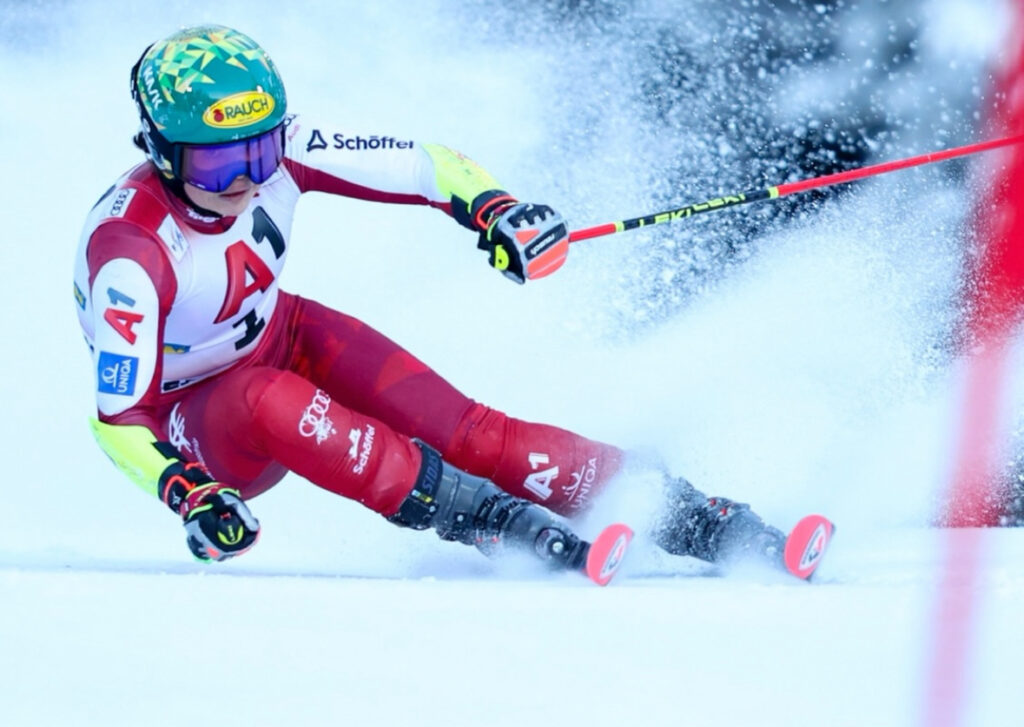
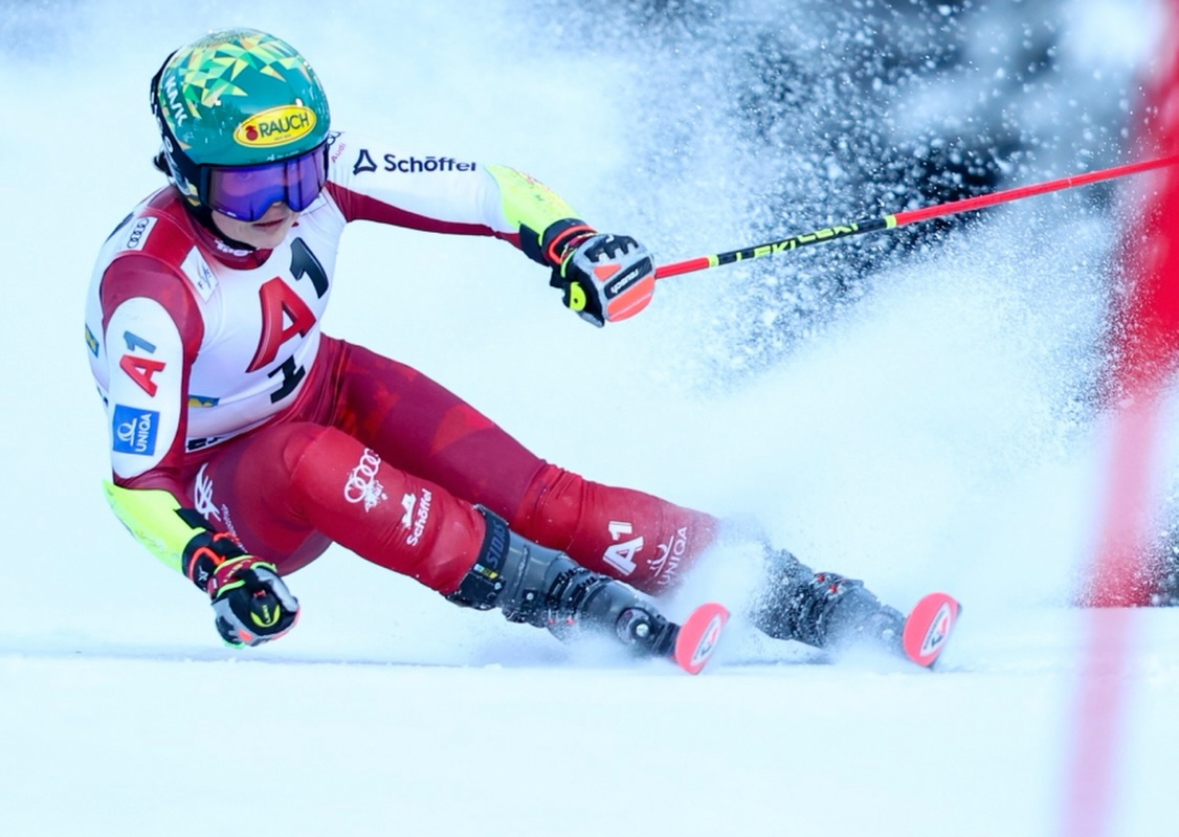
 Julia Scheib claimed her third career victory—all three of which this season. | Image: FIS Alpine IG
Julia Scheib thrilled the home crowd in Semmering, Austria, on Saturday, December 27, storming to victory in a dramatic women’s World Cup Giant Slalom. Scheib edged Switzerland’s Camille Rast by just 0.14 seconds, with Sweden’s Sara Hector rounding out the podium in third after a razor-tight battle that stayed unresolved until the final skier crossed the line. In tricky light, aggressive course setting, and with 22 DNFs on the day, Semmering once again lived up to its reputation as one of the most punishing stops on the women’s technical calendar.
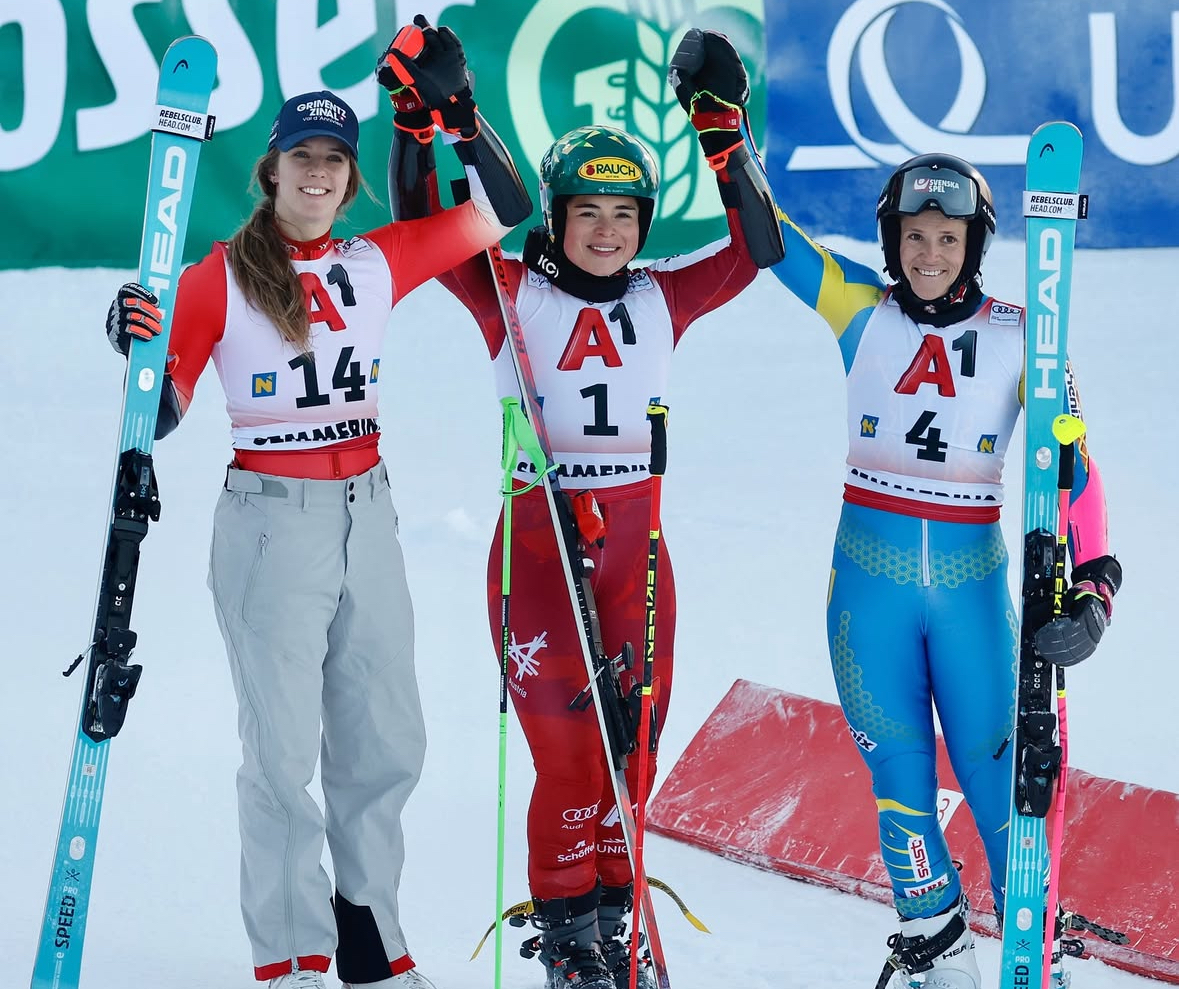 The Giant Slalom podium at Semmering, Austria: Julia Scheib 1st, Camille Rast 2nd, Sara Hector 3rd. | Image: FIS Alpine IG
Run 1: Early Bibs Dominate, DNFs Pile Up
Scheib laid down an immediate marker from bib 1, stopping the clock at 57.17 seconds and setting the tone for the race. Norway’s Thea Louise Stjernesund, skiing directly after her in bib 2, couldn’t match the pace, finishing 0.61 seconds back. Rising star Lara Colturi slid into the gap in bib 3, before Sweden’s Sara Hector delivered the cleanest run of the opening group, sneaking ahead of Scheib by just 0.02 seconds.
Those first four bibs would ultimately lock down the top four positions after run one—and remain largely untouchable throughout the day.
Team USA’s Paula Moltzan finished fifth, 0.19 seconds behind Stjernesund, while Giant Slalom standings leader Alice Robinson suffered a costly DNF from bib 6, sliding out in the top section after getting unsettled by a roller. “I’m a bit disappointed. I really wanted to charge and push and it was tough conditions,” Robinson said afterward. “Maybe I should have backed off a bit. I hit a bump and face-slammed. But I always want to push and not ski on reserve.” The New Zealander grazed her face and suffered a small cut on her chin.
Croatia’s Zrinka Ljutić struggled to find rhythm, finishing 2.16 seconds back, while Mikaela Shiffrin safely qualified for run two in eighth from bib 9. Her teammate Nina O’Brien was on track for a top-five run before spinning out violently, recording another high-profile DNF.
The chaos continued deeper in the field. By the end of run one, 19 skiers had failed to finish, with DNFs increasing sharply as bib numbers rose. Still, there were bright spots: Italy’s Lara Della Mea charged into ninth from bib 25, Germany’s Clara Diez finished 13th from bib 26, and Austria’s Ricarda Haaser qualified in 17th from bib 28.
Late-bib breakthroughs highlighted the morning. Germany’s Jana Fritz (bib 52) climbed 28 places into 24th, while Canada’s Justine Lamontagne (bib 58) jumped 29 spots into 29th. Along with Italy’s Alice Pazzaglia, all three were on track to earn their first career World Cup points. (Spoiler alert: and they all did after a successful run 2–remember that the combined time counts in Giant Slalom, putting pressure to complete a smooth second run on the top 30 that qualify for run 2.)
Run 2: Crashes, Comebacks, and a Home-Crowd Eruption
Austria’s Nina Astner opened the second run aggressively, firing off a 58.32-second run—two seconds faster than her opener—for a combined time of 1:58.87. She held the leader’s chair for an impressive 15 skiers, steadily climbing the rankings and finishing in a career best 12th place. Several seasoned tech skiers failed to unseat her, including Team USA’s AJ Hurt, who finished 0.93 seconds back Astner in what was ultimately 21st place. Finally, 17th starter Lena Dürr—Germany’s Slalom ace—unseated Astner with a calm, controlled run on a deteriorating surface, that earned her a 10th place on the Semmering course. The 34-year-old German is having the best Giant Slalom season of her career.
Poland’s Maryna Gąsienica-Daniel then raised the bar again, taking over the lead from Dürr by 0.59 seconds. She withstood pressure from several heavy hitters—including Shiffrin, who skied with trademark precision but finished just 0.09 seconds behind.
Canada’s Valerie Grenier finally knocked Gąsienica-Daniel from the top spot with a fierce, committed run, setting the stage for the final group.
Then came the final, fastest six skiers—and with them some serious nail-biting performances.
Paula Moltzan, often dubbed the queen of the second run, attacked aggressively but crashed hard, spinning violently and tumbling down the hill. While the fall looked severe, Moltzan was able to ski off under her own power. Initial reports indicated back pain but no apparent ligament damage.
 Paula Moltzan spinning out on run 2. | Image: Screenshot FIS live coverage
Switzerland’s Camille Rast followed with a fearless run—briefly skiing on one leg—but her aggression paid off. She took the lead by 0.63 seconds with just four skiers remaining. Stjernesund fell out of contention, Colturi recorded a second-run DNF, and suddenly Rast was guaranteed a podium.
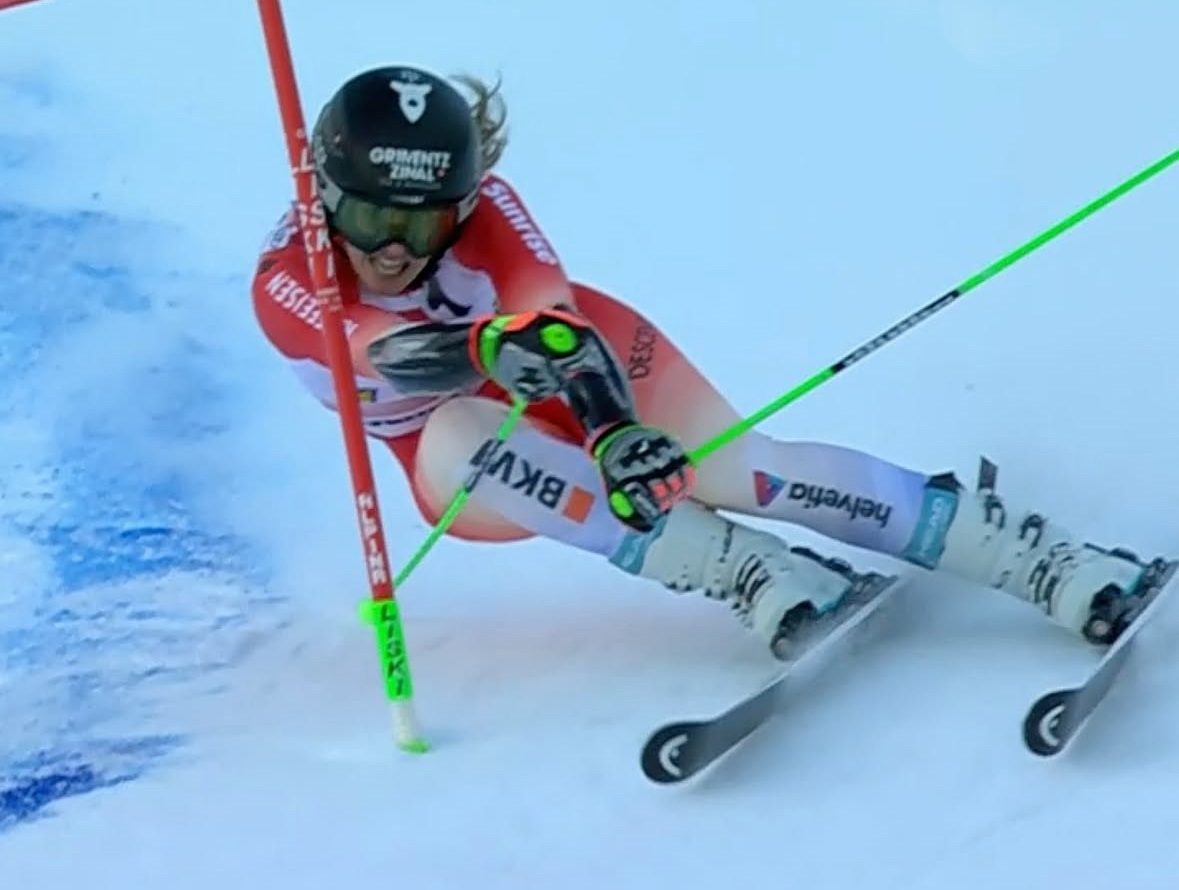 Camille Rast delivered a fierce run. | Image: FIS Alpine IG
Scheib, skiing second-last, rallied to the moment. Despite losing time up top, she delivered a near-flawless bottom section, surging into the lead by 0.14 seconds. The Austrian home-crowd erupted in cheers.
Last out was Sara Hector, holding a narrow 0.02-second advantage over Scheib from run one. The Swede extended her lead early but struggled in the lower section, where Scheib had excelled. Hector slipped into third, earning her 23rd career Giant Slalom podium.
This meant that Grenier narrowly missed the podium in fourth place while Shiffrin was the top American, finishing sixth place.
With the victory, Scheib reclaimed the Giant Slalom leader’s bib from Robinson, capping off a statement win on home snow in one of the season’s most unpredictable races.