
LExicon of Archaeology of Montenegro, recently promoted at the Montenegrin Academy of Sciences and Arts, presents a comprehensive overview of the archaeological heritage of Montenegro.
This publication, recently published as the sixth lexicon published by the Montenegrin Academy of Sciences and Arts, was created as a result of many years of cooperation between numerous scientific institutions and experts in this field. The editor-in-chief of the Lexicon is Dr. Dejan Gazivoda, while the editorial team consists of Dr. Čedomir Marković, Radmila Ćapin, Mr. Milena Vrzić, Mitra Cerović, M.Sc., Dr. Lenka Bulatovic, Dr. Jelena Cvijetić i Dušan Medin, M.Sc.. The alphabet includes 519 headings, of which 406 articles deal with concepts from Montenegrin archaeology from prehistory to the 16th century, archaeological sites, the most important movable finds and relevant national professional institutions. One summary article presents researchers and travel writers from the 15th century to the Second World War, while archaeologists and experts in related disciplines, 112 of them, as the most significant actors in the development of Montenegrin archaeology, are presented in separate biographical headings. 52 authors, who are academics, professors, scientists, experts from Montenegro, Albania, Serbia, Bosnia and Herzegovina, Croatia, Slovenia, Poland, the United Kingdom and the United States of America, participated in the preparation of the articles.
The texts are accompanied by rich visual material – photographs of sites and findings, drawings, technical documentation, as well as a map of archaeological sites made up of several segments, which allows a clear perception of the entire material on the territory of Montenegro. Thanks to the authors who often supplemented the articles with current information from the field until the final proofreading and editing, the high quality of the entire material and the topicality of the Lexicon for a longer period of time were achieved. Lexicographic articles were formed through the areas of prehistory, antiquity, the Middle Ages, basic concepts, biophysical anthropology, biographies and institutions, following the development of this science in our country. It can be said that, despite the interest in the antiquities of Montenegro that appeared in the 15th century by numerous travel writers and researchers who collected and published data on archaeological monuments, archaeology as a recognizable scientific discipline appeared at the end of the 19th century with the first official archaeological research carried out in 1890. Pavel Apollonovich Rovinsky at Duklja, and at the initiative of Prince Nikola I PetrovicThe very beginnings of the study of the prehistory of Montenegro can be traced back to the 70s and the English archaeologist Arthur EvansThe first Montenegrin archaeologist was Marko Martinovic, who graduated in the late first decade of the 20th century in St. Petersburg, while archaeology as a modern science experienced development after World War II, when protection institutions and trained personnel were formed.
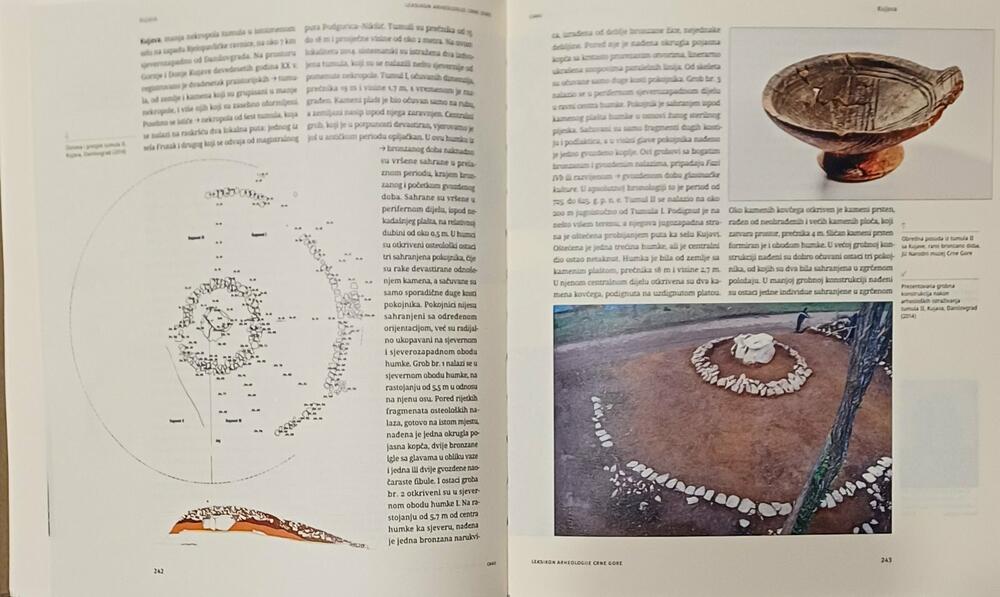
The sixth lexicon published by CANUphoto: vijesti.me
Numerous researches were conducted by archaeologists of the former Yugoslavia, experts, professors and academics from Belgrade, Sarajevo, Split and other centers, with the participation of the first educated Montenegrin archaeologists. Then began the research of prehistoric sites listed in the Lexicon. Among them is the particularly important undercut of Crvena stijena, which is a multi-layered archaeological site in the village of Petrovići in Nikšić, significant for the Balkans and Southeast Europe. The oldest period of prehistory, the Old Stone Age – the Paleolithic, lasts from 3,3 million years ago to 11 thousand years ago. The oldest traces of human presence on the territory of Montenegro were recorded in the fossil cave Trlica near Pljevlja, dated to the middle of the Lower Pleistocene (1,8 – 1,45 million years ago). Finds from the Middle Paleolithic were discovered in Crvena stijena, Bioče cave and Mališina stijena. The stratigraphy of Crvena stijena includes 31 layers, with almost all layers containing levels that testify to individual episodes of settlement, and it is very likely that it was settled several hundred times. At the end of the Pleistocene (15-11,5 thousand years ago), the intensity of settlement of the hilly and mountainous areas increased. The largest number of remains were found in Crvena and Medena stijena, as well as in the Trebački krš sub-slope near Berane. The younger layers of Crvena stijena belong to the Mesolithic – the Middle Stone Age, which lasted from the middle of the 10th to the end of the 7th millennium. With the development of the New Stone Age or Neolithic in the territory of Montenegro, which lasted from the end of the 7th to the middle of the 5th millennium, the production of ceramic vessels began, which indicates a change in the way of settlement and nutrition. The earliest ceramics appear on the Adriatic coast (Spila cave near Perast) and in its hinterland (the Koronina cave near Cetinje, Odmut at the confluence of the Vrbnica and Piva rivers, Crvena stijena).
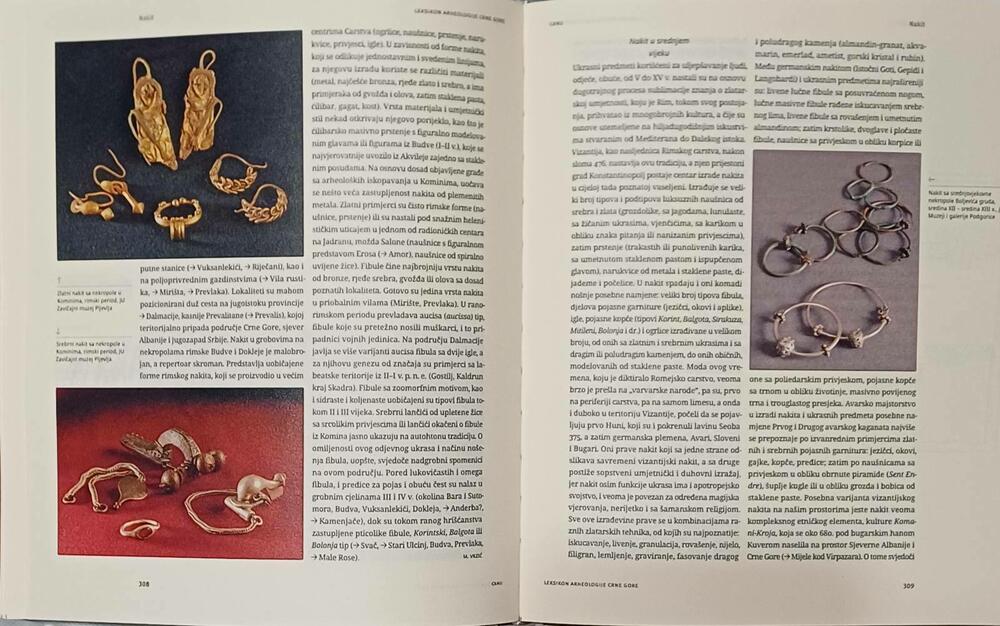
The book is the result of many years of work.photo: vijesti.me
The Eneolithic or Copper Age of Montenegro is characterized by fortified settlements, in dominant, naturally protected places, so-called hillforts, although in some regions, smaller communities still use well-protected caves for housing, most often inherited from the previous period. Certain changes are observed in material and spiritual culture, as well as in the emergence of new forms of grave structures and burial methods, where the use of grave mounds, or tumuli, is particularly emphasized. Finds from this period were discovered in the Spila cave above Perast, Odmutu in the Piva canyon and a multi-layered settlement on the Beran karst near Berane. The latest analyses indicate a period from the middle of the 5th millennium to the end of the 4th millennium. The development of the Bronze Age in the territory of Montenegro, from the end of the 4th to the beginning of the 1st millennium, can be traced through the tumuli of Boljevića gruda, Velika and Mala gruda, which, together with other “princely tumuli” in the southern region of Montenegro, testify that at the end of the Copper Age and the beginning of the Bronze Age, new, well-organized, rich and culturally unified sedentary communities emerged in that area, on indigenous foundations, led by an elite of distinguished leaders and meritorious warriors. Certain characteristics also point to a distinctive variant in ceramic production known as the Kotor facies.
The development of the Iron Age in Montenegro can be traced through two phases – the Early Iron Age or Hallstatt (8th-4th century BC) and the Late Iron Age or La Tène (4th-1st century BC). Based on archaeological material today, it is possible to conclude that the territory of Montenegro during the Early Iron Age represented only a part of a large and organized community, whose cultural manifestations were observed in a wide area, which could be conditionally called the central Illyrian area. Certain objects, customs and movable finds were singled out as special determinants. Tumuli and hillforts were processed within three geographical units: the northern, central and southern regions.
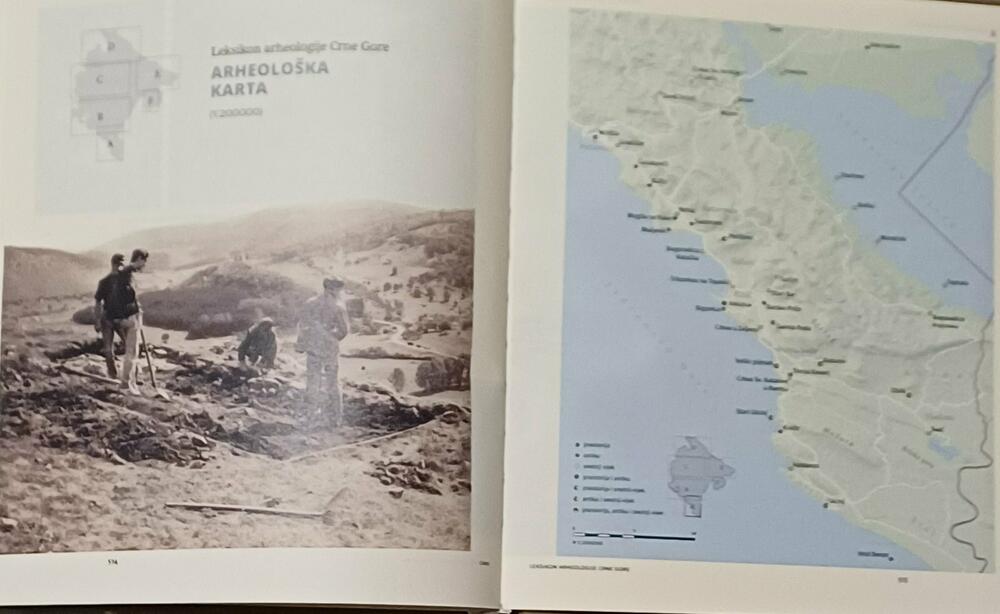
Comprehensive overview of archaeological heritagephoto: vijesti.me
Ancient archaeology began with the first research on Duklja, which has already been mentioned. In this sense, within the field of early antiquity and Hellenism, the Lexicon includes definitions that view the Illyrian communities, the Enchelians, the Ardijeans, the Labeats and others from different angles, as well as key data on ancient cities in the area of today’s Montenegrin coast. Among the Illyrian cities on the southeastern coast of the Adriatic, Risan (Rizon), Budva (Buthoa) and Ulcinj (Olcinium) stand out in particular. Their development was based on exceptional geostrategic positions, since they represented important ports on the Adriatic maritime route, but also communication points towards the interior of today’s Montenegro and the wider Balkan area. These land routes spread Hellenic influence, which was reflected in material and spiritual culture. Because of all the above, it is not surprising that ancient ports and trading posts were the core of the emergence and development of the regional Illyrian alliance, known in ancient sources as the Illyrian Kingdom. It was an alliance of tribal communities and cities formed on the model of Hellenistic monarchies. The rulers of the Ardian community from the area of southwestern Montenegro were Balej, Agron i Teuta, they ruled in Risan, which is confirmed by the palace complex. The power of the Ardian kings is evidenced by the fact that there was a mint in Risan. King Baley already in the 3rd century BC, with a much wider circulation, as confirmed by finds in central Dalmatian cities of present-day Croatia, as well as in Apulia in Italy.
519 entries were processedphoto: vijesti.me
In the interior of today’s Montenegro, in the Skadar Lake basin, the necropolises in Momišići near Podgorica and in the Zeta village of Gostilj stand out. Among the hillfort settlements are Samobor, Đuteza, Medun, Oblun and Vladimir. In the area of the Zeta village of Mataguži, a unique fortified settlement with a preserved square-shaped tower was discovered, which belonged to the Hellenized Labaetian community, whose members were most likely buried in the necropolis in Gostilj. Numerous archaeological sites, both on the coast and in the hinterland, testify to the period of the last three centuries BC. Both terrestrial and underwater finds have been recorded along the Montenegrin coast, stretching from Ulcinj, through Kruče and the Volujica peninsula near Bar and Budva, all the way to the southern coast of Boka Kotorska and the bay itself.
After the pacification of the Illyrian communities on the eastern Adriatic coast, the Roman province of Dalmatia was formed at the beginning of the new era, the southernmost part of which included the area of present-day Montenegro. During this period, intensive construction of transport infrastructure began. On this road network, known thanks to Roman itineraries, above all Antonin’s itinerary i Peutinger’s map, which originally date back to the 3rd and 4th centuries, several way stations were established. Among them are Saltua near Nikšić, Alata, Berzumno and Cinna. In the area of present-day Montenegro, Dokleja was one of at least two cities with the status of a municipality, i.e. with independent administration. The second municipality, located in Komini near Pljevlja, is known thanks to epigraphic inscriptions under the name Municipality of S…, which is most often associated with the Roman Splonum. Risinium may have had the rank of a colony. In the Roman period, villas rustica, or agricultural farms, were also built in Montenegro, which are found not only on the coast, but also in the interior, including the Lim valley. In urban centers, we find examples of several villas urbana, the most famous of which is the villa of Hypnos in Risan, which most likely had the function of a hospitium. In late antiquity, a separate province, Prevalis, was separated from the province of Dalmatia. The Lexicon also presents finds of exceptional archaeological value. The reader can thus become more familiar with Hellenistic belt plates, imperial portraits of Septimius Severus and Marcus Aurelius, the diatretus from Municipium S…, the Podgorica Cup, as well as numerous other significant finds. The field of medieval archaeology included localities and concepts that are representative of this period on the territory of Montenegro.
A richly and clearly illustrated bookphoto: vijesti.me
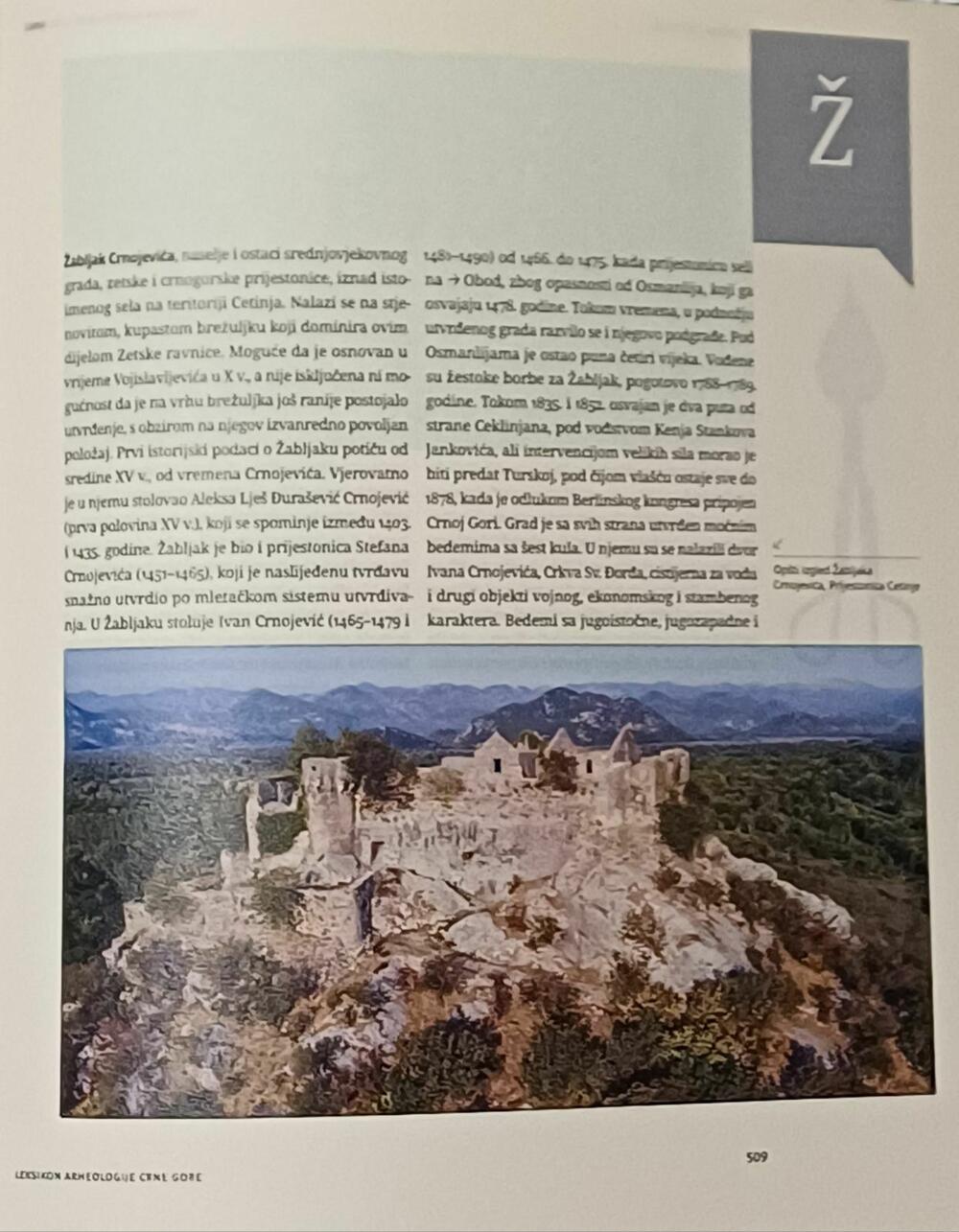
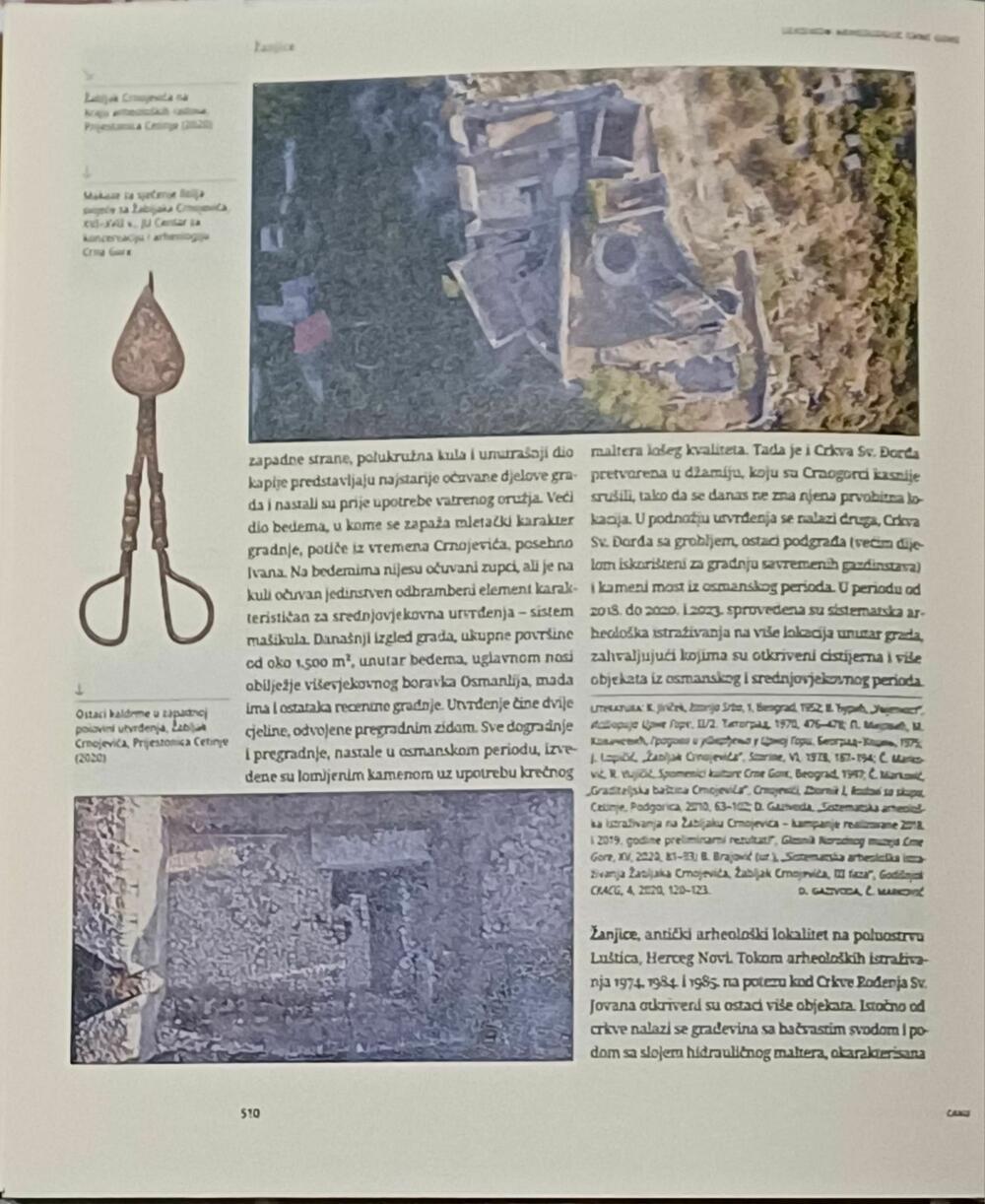
Medieval archaeology in Montenegro began at the end of the 19th century, with British explorations of Doclea with John Arthur Ruskin Munro at the head, who excavated an early Christian complex from the 6th-9th centuries. Over the course of more than a hundred years, a large number of medieval sites have been examined, such as Stari Bar, Svač, Bogorodica Ratačka, Prevlaka, Doljani, the necropolis of Mijela, Trikonhos on Topolica Beška, Starčevo, Moračnik, Bogorodica Krajina, the monastery on Ćipur, Martinićka Gradina, Samograd, Tumbarica, Brskovo, Đuteza, Oblun, Žabljak Crnojevića, etc.
The typological and chronological development of jewelry, ceramics, and weapons is also covered in special headings. Basic concepts introduce the reader to archaeology as a science through articles that indicate the presence of various civilizational achievements in an accessible manner. Biophysical anthropology deals with man as an integral part of a large number of articles in the Lexicon. Biographical headings for the first time systematically provide data in one place on individuals who have, over the course of several centuries, directly or indirectly, participated in the study of the archaeological heritage of today’s Montenegro. These headings will contain data on archaeologists, but also experts related to archaeology and relevant to the understanding of Montenegrin archaeology. Individual biographical headings include experts from the end of the 19th century, through the formation of the first educated personnel and the institutionalization of archaeology after World War II, to contemporaries who have significantly contributed or continue to contribute to the development of Montenegrin archaeology through their active work. The main text of the article provides an overview of professional work, with special emphasis on field research, projects, publications, and other activities that relate exclusively to the archaeological heritage of Montenegro. A special curiosity in the Lexicon is the article about Marko Martinović, born in Cetinje in 1883, an archaeologist, officer and diplomat, educated in Sofia and St. Petersburg, where he graduated from the Military, Military-Legal Academy and the Imperial Archaeological Institute. He is considered the first Montenegrin archaeologist and officer of the military-judicial profession.
Institutions for which archaeology is the main or one of the activities are also presented through 13 articles. The first institutional foundations were laid in 1948 with the establishment of the Institute for the Protection and Scientific Study of Cultural Monuments and Natural Rarities of the People’s Republic of Montenegro in Cetinje, later known as the Republic Institute for the Protection of Cultural Monuments. As an umbrella institution in the field of cultural heritage protection, this Institute was the bearer of almost all significant archaeological research for several decades. The first specialized archaeological institution, the Archaeological Collection of Montenegro, was founded in 1961 in Titograd, and since 1998 as the Center for Archaeological Research of Montenegro, it has been actively engaged in research throughout Montenegro. The scientific backbone of the institutional system of archaeology in Montenegro is the Montenegrin Academy of Sciences and Arts, founded in 1971. Already in 1975, the Commission for Archaeology was formed within its framework, later the Board for Archaeology, which today represents practically the only institutional framework for systematic scientific work in this field. Through projects, scientific conferences and extensive publishing activities, CANU has enabled archaeological research to be included in a broader scientific and interdisciplinary context, thus making a crucial contribution to the development of archaeology as a scientific discipline in Montenegro.
The Municipal Institute for the Protection of Cultural Monuments in Kotor, or the Regional Institute for the Protection of Cultural Monuments, responsible for the area of Kotor, Herceg Novi and Tivat, played a key role in the reconstruction of the Old Town of Kotor and other settlements of the Boka Bay after the earthquake, but also in archaeological research. In addition to the Archaeological Museum of the National Museum of Montenegro, numerous archaeological collections in local museums throughout Montenegro also play a significant role in the preservation and presentation of archaeological heritage, which have been preserving archaeological movable funds from the territories of individual municipalities since the post-war period. With the reorganization of the system in the field of cultural heritage in 2011, the Administration for the Protection of Cultural Property and the Center for Conservation and Archaeology of Montenegro were formed, with headquarters in Cetinje and regional departments in Kotor and Mojkovac. The administrative and strategic framework of the entire system is provided by the Ministry of Culture and Media of Montenegro, which is the bearer of cultural policy and financing of archaeological research.
As the authors point out, the goal of this project is to create the most complete database and overview of Montenegrin archaeology in one place for contemporary and future archaeologists, experts and admirers of archaeological cultural heritage. This can also be seen through the volume of literature and sources provided, with the desire to direct young colleagues and all those interested in archaeology to as many bibliographic units as possible that deal with the archaeology of Montenegro. Of course, a large number of institutions such as the Center for Conservation and Archaeology of Montenegro, the Administration for the Protection of Cultural Heritage, the Faculty of Philosophy in Belgrade, the Archaeological Institute in Belgrade, the Faculty of Philosophy in Zagreb, the Faculty of Philosophy in Sarajevo, and municipal museums have made a huge contribution through the availability of their extensive documentation. The Ministry of Culture and Media, as the umbrella institution of archaeology, confirmed the importance of this project by funding it. In line with European integration and the process of modern presentation of the cultural heritage of Montenegro, the Lexicon of Archaeology of Montenegro represents the backbone for future scientific archaeological projects.

News