
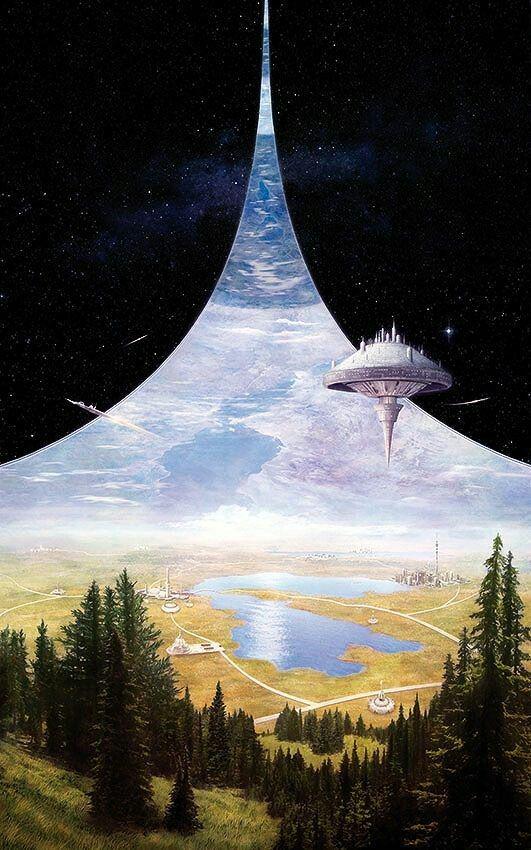
I am writing a fiction book set on a Ringworld
(An enormous artificial construct millions of Earths in volume,
e.g. Larry Niven)
I am trying to figure out, could you see the curve of the ring from
ground level?
I tried looking it up, no luck.
Thank you for any information you can provide!
Edit: Thank you everybody for all the helpful and inciteful replies!
https://i.redd.it/6688kp80dt9g1.jpeg
30 Comments
Yes. For the most part it would look like a glowing line across the sky, except where it was in Shadow
I recall in the Niven books the inhabitants calling the sky “The Arch”, which is what it should look like
Probably. The thinner the atmosphere, the easier it would be. The Niven ring world was so flat that atmospheric haze blocks the view of the horizon. So you see the ring in the sky, but you don’t see th curvature rise off of the ground.
Play Halo 1, see ring, admire ring
I believe in the original book, there is a character towards the end who’s trying to walk to the “arch” which is the ring seen far up in the sky.
I think he was a native of Ringworld.
It’s been years since I read the book so it might be in the sequel instead.
You wouldn’t be able to tell that your immediate surroundings curved, but you would see the ring curving in the sky.
[https://www.youtube.com/watch?v=acDpO7Ya00I&t=11s](https://www.youtube.com/watch?v=acDpO7Ya00I&t=11s)
here this could help you.
Niven’s Ringworld is insanely huge, it’s diameter is equivalent of the orbit of Mercury, IIRC.
I don’t believe you would see the curvature from ground level, the curve would be beyond the limits of human vision in atmosphere, it would probably have a weird effect of “thining”, before disappearing into the haze of distance.
In the books they can see “the arch”, i.e. the ring curving around the star, during the shadow-panel night, but I suspect it’s so big you wouldn’t see much more than a thin line, if that.
I could be wrong though, would be interesting if someone has done the proper math.
On smaller ringworlds, such as Halo, you might be able to see the curve, but not certain.
I’ve often wondered this. If I remember correctly, Ringworld is a million miles wide. So if you’re looking toward the horizon, would it look like a very tall triangle, or just a thin vertical line in the distance?
Given a stupid thought experiment on my part: I can see the curvature of the earth – it’s the horizon.
I think of an inverse horizon that bends upwards… you’d see it in a vacuum. The question becomes light and atmospheric conditions.
As a question of geometry and scale, yes – you would see it.
When you first saw the ringworld were you blinded by its majesty?
With almost 8,000 hours into Rimworld I can tell you this: nobody lives long enough to care.
>millions of Earths in volume
The sun is about 1.3 million Earths in volume. So you’re really talking about something the size of several of our suns.
And you can see the sun from here despite it being a distance of over 100 suns’ diameters away from us.
So something that is multiples the size of our sun could be seen from at least 100 light years away, assuming it was emitting enough energy (light, radiation, etc.) to be detected.
In sum: yes, you could see it, easily, although depending on the width of the ring it could appear a faint line in the sky or it could be chonky if the width is significant.
As for the curve itself….. you probably couldn’t see the curve. It would just taper off and appear as a straight line. The curve might really only appear on the parts closer to you and if you were on the edges of the ring. Once it hits a certain distance it’s just a line. It does depend on how wide the ring is.
I don’t know anything about your story, but you might want to revisit the sizing elements to be more in line with what you’re really trying to communicate. Unless you did in fact mean something significantly larger than our sun.
Yes you would, *extremely* clearly. The ring is in full sunlight at all points and has a very high albedo. You can see Jupiter, much further away, and with a lower albedo.
Niven describes what it looks like.
IIRC, the Ring is the width of Eaths diameter.
Circumference same as Earth’s orbit .
Rims high enough to hold atmosphere equal to earth.
Ramjets providing spin.
So, look up what a human eye can theoretically resolve and the rest is math
It’s actually surprisingly easy to see, just look down.
*Millions* of Earths in volume? Approximately 3k Earths could fit in the area of the moon’s revolution. Assuming the ring planet’s thickness is the same as the moon, it would look like a narrow pin stripe where not in shadow and *maybe* visible during the day.
I think you should look at the Culture Orbitals, especially Consider Phlebas book. They are fairly close to what you are describing.
https://theculture.fandom.com/wiki/Orbital
That being said, depends on how large an orbital is, how dense the atmosphere is and most importantly, if it’s permanent day or night… if it’s permanent day, orbitals so big they have a radius of millions of kilometers it’s quite possible that during the day nothing is visible, just like being on a planet… if they have a night, it is possible to distinguish a thin, very bright line in the sky.
Think about the radius of the earth, but the other way around, going up, not down. Usually, on a VERY clear day visibility can be around 30km or so. Which means on an orbital with a width of about 100kms or so, if you sit in the middle, you can still see the walls if the are about 1000+ m high… ish.
What kind of never played Halo rage bait is this?
I mean, you can in halo, and that’s a pretty accurate documentary /s
But yeah you should be able to, similarly to how you’d see rings of a planet
From some time back… http://news.povray.org/povray.binaries.images/thread/%3Cweb.4360929f30852916731f01d10%40news.povray.org%3E/?mtop=10
That thread does a rendering of what you would see.
One of the trigonometry things that is of interest to some is that the angular size of the night and day parts of the arch of heaven are equal sized no matter how far away.
However, you wouldn’t be able to see the curvature of the ring at “regular” distances. Consider that there’s a 1:1 map of Earth in the ocean on there. We can’t see the curvature of the Earth easily… Ringworld has less curvature than the Earth does.
Not on a Niven-style ring world. An earth-like atmosphere will turn everything into a blue-green haze after about 250 miles, less with dust and other such. The curvature at that distance won’t be noticeable. It would look like a flat world with a very thin arc rising in the distance.
https://www.reddit.com/r/printSF/comments/7owy24/im_reading_ringworld_for_the_first_time_and_its/
This thread has links to some renders
Niven said the locals called it the arch of heaven. One character was chasing the base of the arch.
A large enough ring world would have an atmosphere thick enough to obscure the other side, and only visible if you fly above the clouds.
Ring-deniers would be real
Coincidentally just watched this:
https://youtu.be/JNpkNYngSvs?si=cAb2alXQnPpvlRop
It’s a huge part of the book, seeing the ring in the sky…
Check out Iain M Banks’ descriptions of various ring orbitals in the Culture novels. Maybe Google a few excerpts.
From memory, Consider Phlebas and Look to Windward have some pretty detailed descriptions, as the orbitals are pretty central plot settings.
The section about trying to use anti-grav equipment in an orbital which relies on centrifugal force, instead of actual gravity (due to the mass of the body) is neat.
No idea of the scientific validity of some of his descriptions, like checking some of his calculations, but it might give an idea of the scale. He leans into “exotic materials” and force fields being of central importance to the structures. Look past the handwavium, and there are pretty cool concepts that are well fleshed out
This image isn’t a great depiction of how it would look, as everything below the horizon has a hint of a convex curvature. There are also some size and spacial inconsistencies as well, but is an otherwise decent illustration of a setting.
I believe any horizon you would see should be where the clouds or whatever visible atmosphere you might see would be where it would appear to meet the terrain as it curved up and into the sky.
Depending on your altitude and your atmosphere, the ring may disappear into the clouds or diffuse in the Rayleigh scattering before becoming more visible as it rises high enough to whatever point the atmosphere is thin enough to see through to it, assuming it’s not obscured by clouds.
The Halo series are accurate in their depictions of ring worlds for the size depicted in their setting. There are some ring worlds depicted that are utterly, almost inconceivably massive by comparison. You might need to sit down and think about some things, if you plan on going that route. For example, if your ring is large enough to wrap around a star, it may very likely appear to be bent due to the speed limit of light.
I saw it discussed at length in the early days of the web, unfortunately links seem to be dead now. The discussion was thorough and even included some POV renderings.
*Note it was for a Niven ring specifically, which completely encircles a star, not a Banks orbital for example, which is smaller and more practical.*
Basically, yes, the sunlit parts would be visible, but different from most book cover art. It wouldn’t be the inverted funnel shape in the image attached to this post, it would be a pencil-thin line slamming directly into the horizon. Without an atmosphere, you’d see it flare outward right where it meets the ground, but with an atmosphere that part gets lost in the haze, since you’re looking through millions of miles of air at that point.
Edit: Found a rendering on google images that matches what I remember. https://www.johnstonsarchive.net/spaceart/render/ringworld2.jpg