
Bulgaria will introduce the euro on January 1, 2026, making it the 21st member of the Eurozone.
Joining the monetary union represents a significant milestone for the Eastern European country, which joined the European Union in 2007.
Bulgaria’s membership leaves only six of the 27 EU countries outside the eurozone: Sweden, Poland, the Czech Republic, Hungary, Romania and Denmark.
The euro “is not just a currency, but a strategic choice” that strengthens Bulgaria’s position in Europe, Bulgarian Prime Minister Rosen Zhelyazkov said at a conference in the Bulgarian capital Sofia in November.
At the same event, Christine Lagarde, President of the European Central Bank, said that the introduction of the euro “strengthens Bulgaria’s economic foundations, builds its resilience to global shocks and strengthens its voice in decision-making in the Eurozone.”
How does the Bulgarian economy work?
Bulgaria’s national currency, the lev, has been pegged to the euro since its introduction in 1999. Sofia officially began the process of joining the eurozone in 2018, and the lev was subsequently included in the European Exchange Rate Mechanism in July 2020.
The European Commission and Eurozone finance ministers approved Bulgaria’s candidacy for membership in the zone earlier this year.
Joining the Eurozone shows how the Bulgarian economy has improved over the past decade. Macroeconomic indicators remain stable and inflation now hovers around 2.8%, compared to around 13% in 2022.
Budget deficit and debt levels are low – around 3% and 24%, respectively – in line with EU rules that require member states to keep their deficits within 3% of economic output and total fiscal debt within 60% of GDP.
Growth prospects also look positive. The EU estimates that the country’s real GDP will grow by around 3% this year, by 2.7% in 2026 and 2.1% in 2027.
Bulgaria still has “a lot to catch up on”
“Bulgaria’s macroeconomic performance has been stable in recent decades, although economic growth has not been optimal,” Guntram Wolff, an expert on eurozone fiscal policy at the European economic think tank Bruegel, told DW.
Norbert Beckmann, head of the Konrad Adenauer Foundation (KAS) office in Bulgaria, shares a similar opinion. Bulgaria meets all the convergence criteria to join the Eurozone, he said, noting in particular that the country has one of the lowest debt ratios in Europe.
“However, the Bulgarian economy still has a lot to catch up on in terms of structure and performance. The wage level in Bulgaria is also only 59% of the EU average.”
But experts warn that the Bulgarian government should not relax financial regulations and overspend after the introduction of the euro.
“The main risk is that after joining the eurozone, the political system will find budget restraint less binding and that deficits could increase,” Wolff said. “But given the low debt levels, I don’t think this risk is significant,” he added.
Beckmann also stressed the need to avoid market distortions.
“It is important that incomes always reflect the capacity of the economy and that people do not live beyond their means. If incomes are separated from the market and artificially inflated by borrowing, this can lead to disorders, as we saw in Greece,” he told D.W.
Political unrest poses risks
At the same time, political instability represents a serious challenge. Public anger and frustration are high due to economic mismanagement and widespread corruption.
Bulgaria – one of the poorest countries in the EU – ranks among the most corrupt in the EU, according to Transparency International’s Corruption Perceptions Index. The Balkan country of 6.4 million people has already held seven parliamentary elections since 2021 – and could face more in the coming months.
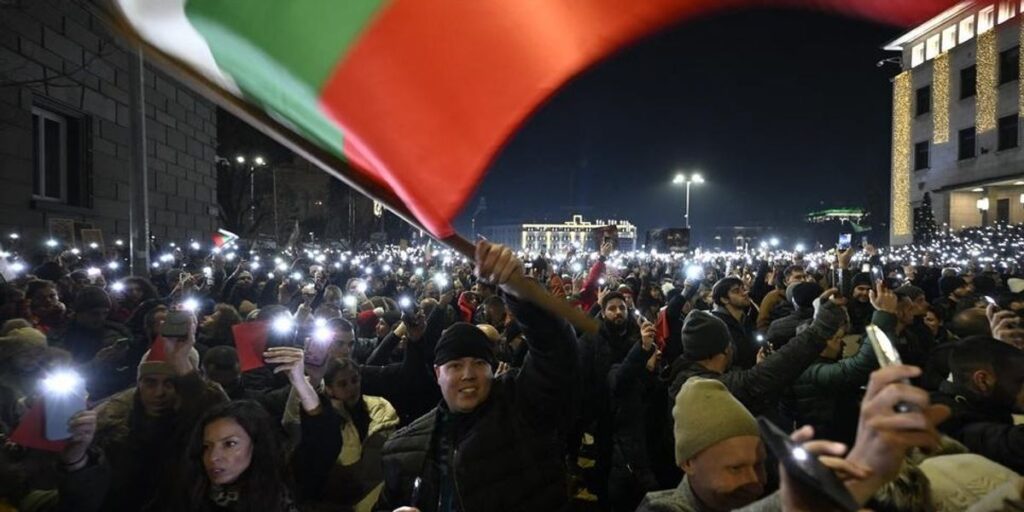
Prime Minister Zhelyazhkov’s government resigned on December 11 amid mass protests over corruption and the administration’s budget plans, including higher taxes and increased social security contributions.
Even though the budget has been withdrawn, public anger continues. If efforts to form a new government fail, the President will appoint an interim administration and call early elections, which will be the eighth in four years.
And if the vote fails to produce a workable coalition, it could prolong political turmoil and erode investor confidence.
Public divisions over the introduction of the euro
Polls show that Bulgarians are divided on the introduction of the euro. Supporters of the common currency say that it will, among other things, encourage the flow of foreign investment into the country, eliminate exchange rate costs and lead to greater integration into the EU single market.
However, skeptics fear a sharp rise in inflation as prices of goods and services are converted from the national currency, the lev, to the euro after the currency change. Some also worry about losing control of monetary policy from the European Central Bank in Frankfurt.
While there are real concerns, Wolff said, there are also disinformation campaigns and conspiracy theories that have exacerbated anti-euro sentiment as the accession date approaches.
“Bulgaria is regularly targeted by the Russian disinformation campaign, and Russia is certainly trying to persuade the country to return to its sphere of influence,” says Wolff.
“By joining the euro, Bulgaria is more deeply anchored in Western Europe, which strengthens the European Union. It will be necessary to strengthen efforts to suppress Russian hybrid warfare, as well as to strengthen the fight against corruption,” says Wolff.
Despite frequent changes of government in recent years, Beckmann said, “parties and politicians in Bulgaria who want to introduce the euro and promote the country’s integration with the West have always had a majority in parliament.”
He stressed that Eurosceptic views “have always been a minority in Bulgaria.” “I don’t think this will change in the future,” the expert added. “Therefore, there is no reason to assume that Bulgaria’s accession to the Eurozone could somehow weaken the euro.”