
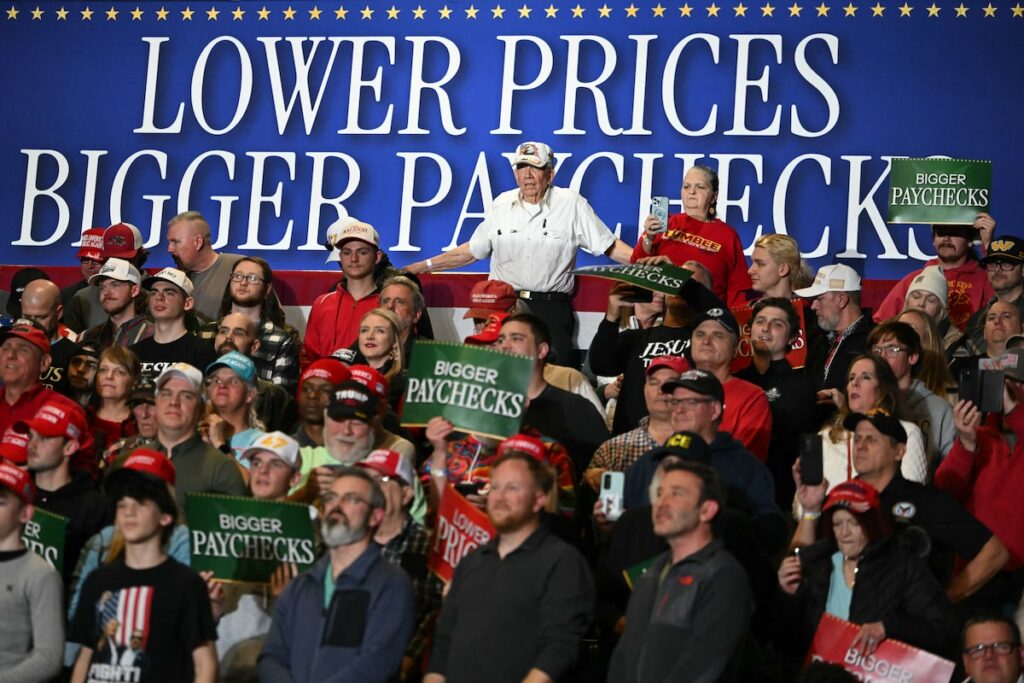
Supporters listen to U.S. President Donald Trump speak during a political rally in Rocky Mount, North Carolina on Dec. 19.ANDREW CABALLERO-REYNOLDS/AFP/Getty Images
John Rapley is a contributing columnist for The Globe and Mail. He is an author and academic whose books include Why Empires Fall and Twilight of the Money Gods.
Someone needs to tell Donald Trump that yelling a lie won’t make doubters believe it.
In his defensive, Scrooge-like message from the White House last week, Shouty Claus railed about the awful economy he’d inherited and how hard it’s proving to mend. Nonetheless, he boomed in staccato until he grew breathless, the economy was doing great, it was on the cusp of a take off ‘the likes of which the world has never seen,’ prices were coming down and wages were going up.
Unfortunately, according to a growing mountain of polling evidence, the folks who voted him into office are starting to doubt it. Wage growth has been slowing, prices are rising and jobs are getting harder to find. And unlike the other lies that peppered his speech, these are ones that ordinary people fact-check daily with their own eyes – on their grocery shelves, doctor’s visits and electricity bills.
It’s possible that Mr. Trump knows what he’s doing and is being clever by extolling the virtues of an economy which belies the facts. Reports from the White House press corps suggest he’s convinced that fiscal and monetary stimulus, as well as the benefits of AI, will supercharge the economy in 2026. This week’s report on third-quarter GDP came in strong, and once the Big Beautiful Bill’s tax cuts kick in and the Federal Reserve reduces interest rates, Americans will have so much to spend that the economy will break free of its shackles. In this line of thought, by the time of the mid-term elections everyone will have come around to Mr. Trump’s supreme confidence and realized they were right to vote for him.
Opinion: In 2025, the Trump administration had us asking: Who thinks up these things?
However, you don’t have to look far on Wall Street to find skeptics with serious doubts about this rosy scenario. For starters, the GDP report revealed that spending rose, but incomes didn’t. Americans have been buying on credit and running down savings, which indicates rising stress. Estimates of current growth from Federal Reserve ‘nowcasts’ suggest the economy is already slowing, in line with the weakening jobs market.
But despite this slowing, most Federal Reserve governors appear not to be persuaded yet that inflation has been licked. All the while, bond yields keep rising. As a result, the tailwind Mr. Trump expects from interest-rate cuts may not materialize. Indeed, if the economy were to show signs of the acceleration he anticipates, the Fed would be more likely to raise than cut rates.
Meanwhile the tax cuts may not be as stimulating as Mr. Trump expects. Because of the distribution of relief, which will favour wealthier households, their impact on spending may not be that significant. Meanwhile at the lower end of the income spectrum, where the marginal propensity to consume is higher, their positive effects will be offset by potentially serious increases in medical insurance, student loan repayments and reduced assistance from food stamps.
As for AI, maybe it will supercharge growth. So far, though, we’ve yet to see much if any evidence of that. And if the AI bubble were to burst, the impact on the economy could turn negative, at least over the short term.
Opinion: Trump’s National Security Strategy is more of a MAGA rant than foreign-policy playbook
Mr. Trump therefore appears to have fallen into the same trap that tanked Joe Biden’s presidency – responding to bad pocketbook news with aggregate figures, like the growth of GDP, the scale of investments or the revenue from tariffs. None of these measures resonate with the vast majority of people. What does matter is what they see in their daily lives, and Mr. Trump, who used to be very good at connecting with his voters, now seems distant and detached – telling them, for instance, that they’ve fallen for a hoax when they complain about affordability.
Yet the data support what ordinary Americans are telling pollsters. For those on lower incomes, economic conditions are getting more challenging. Even the recent inflation report, which apparently revealed slowing price gains, was likely skewed by the incomplete data collection during the government shutdown. Most economists expect the next inflation report’s figure to bounce back up.
So where does this leave the MAGA coalition? Broadly speaking, there are two main elements to Mr. Trump’s voter base. Traditional Republicans, middle and upper class, will love the tax rebates and bubbling stock market. But the low propensity swing voters that have turned out for Mr. Trump were drawn by his attention to their concerns. They’re now losing faith. They won’t necessarily vote Democrat, but they may not turn out next November.
This has been showing up in the results of recent elections. Almost everywhere, Democrats have improved their margins over last year, in some cases by huge swings. Thus, if the economy doesn’t turn around as Mr. Trump hopes, his party could face a bloodbath in next year’s mid-term elections.
No wonder he sounds petulant.