
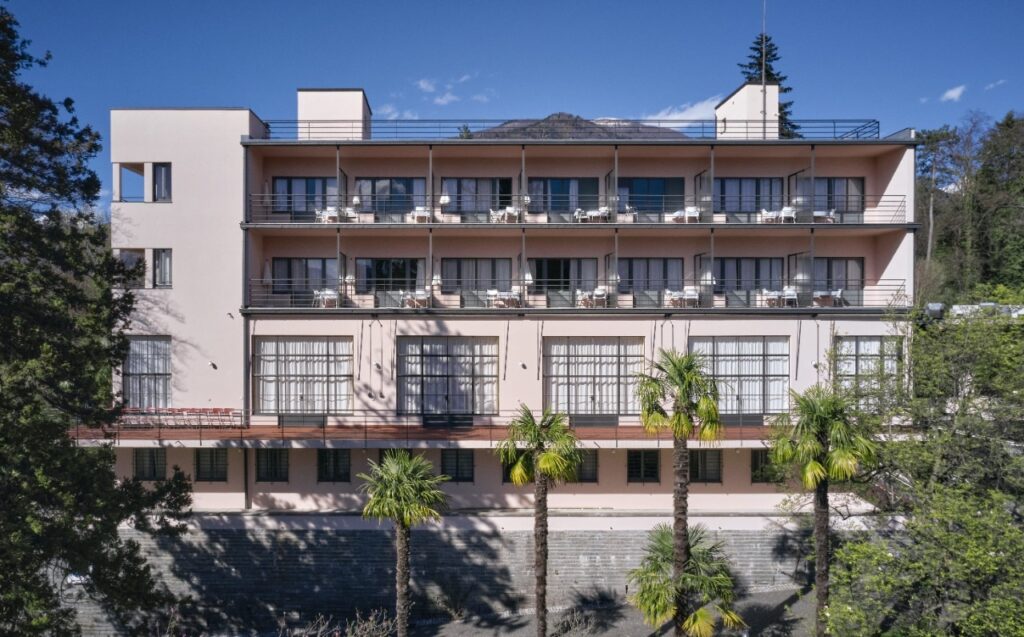
Among them was Henri Oedenkoven, an industrialist from Antwerp, who in 1900, together with his partner Ida Hofmann—a piano teacher and pioneering feminist—founded the first sanatorium on Monte Verità. It was based on principles of anti-industrialization, vegetarianism, matriarchy, and theosophy. This international commune was a refuge built on naturist and nudist principles. For many, it represented Europe’s first “hippie” experiment: living off the land in small huts, practicing dance, heliotherapy, and other activities designed to restore body and mind.
Over time, with multiple ownership changes, Monte Verità hosted figures such as Richard Wagner, Otto Braun, Otto Gross, Isadora Duncan, Arthur Segal, Hugo Ball, Hans Arp, and many other artists, anarchists, and theosophists. Yet it also transformed, from a refuge from civilization to a tourist destination for industrialists and entrepreneurs. The esotericism surrounding the hill, however, never faded: numerous studies place Ascona at the center of gravitational fields, energy points, and initiation paths—names that continue to attract visitors to these hills.