
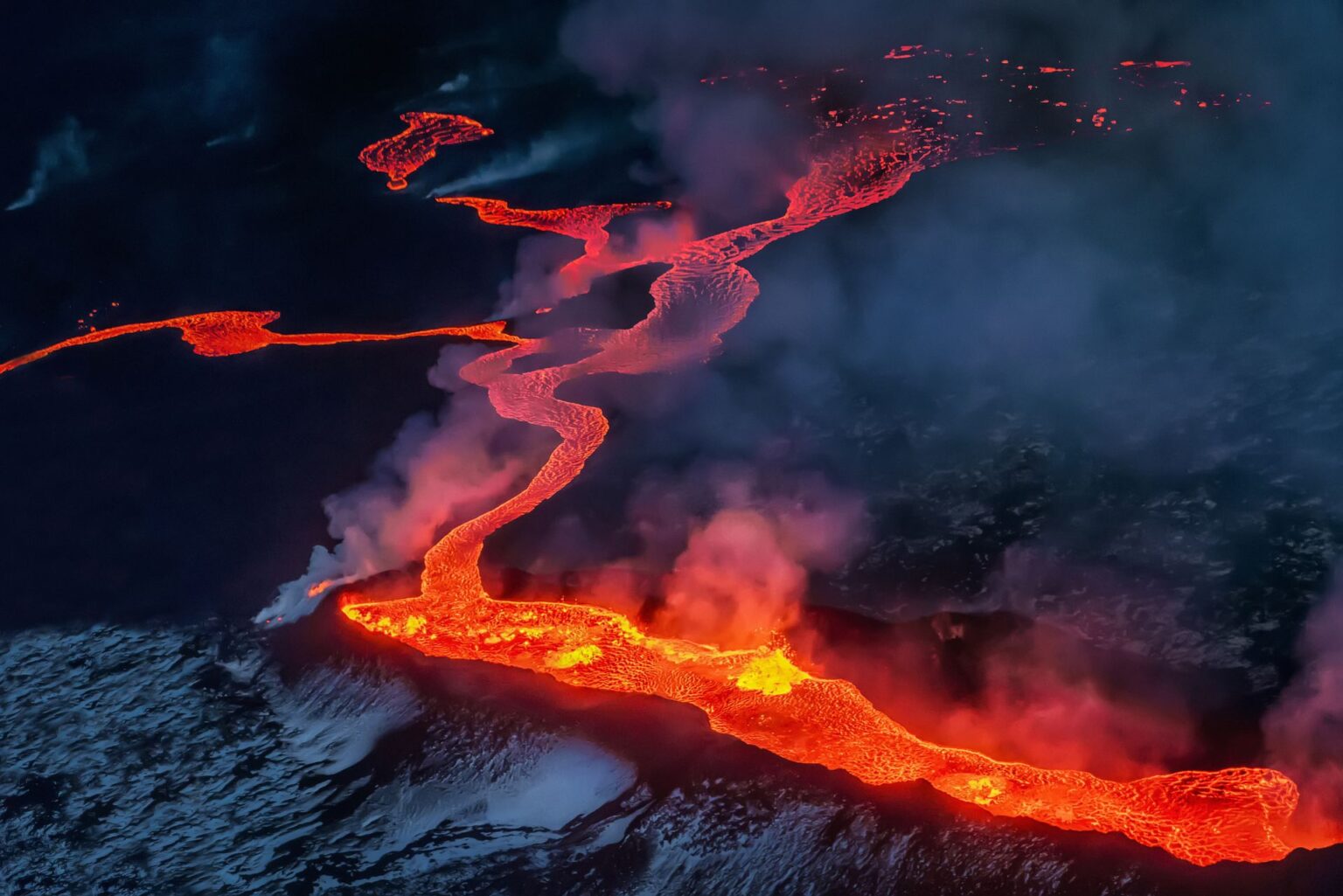
A study on the Fagradalsfjall volcano reveals that microscopic life establishes itself on newly formed rocks with unprecedented speed, challenging theories about extreme environments in volcanic lava.
Science has overturned what we knew about biological resilience after discovering that microorganisms colonize volcanic lava almost immediately after it solidifies.
An exhaustive investigation conducted on the Reykjanes Peninsula, Iceland, has documented how diverse bacterial communities manage to settle in sterile volcanic terrains in a time span counted in hours, not years as previously thought.
The phenomenon was observed during the eruptions of the Fagradalsfjall volcano that occurred between 2021 and 2023.
The team of scientists detected that, despite the fact that the newly cooled rocks are practically devoid of organic nutrients and have almost nonexistent moisture levels, life manages to find a way.
Through the analysis of DNA samples obtained from the lava, atmospheric aerosols, and rainwater, experts confirmed the presence of vibrant and stable microbial activity.
 Volcán en erupción
Survival strategies in basalt
This discovery is particularly relevant because newly formed basalt represents one of the most hostile habitats on the planet.
The researchers noted that although microbe populations suffer a logical decline during the harsh Icelandic winters, the overall structure of these communities remained constant throughout the study period.
The speed with which these microorganisms colonize the lava suggests that dispersion through the air and rainfall plays a crucial role in the “seeding” of life in new geological terrains.
This process of primary ecological succession, which was traditionally thought to take decades to consolidate, actually occurs almost instantaneously, transforming inert rocks into biologically active ecosystems in record time.
Implications for astrobiology
The study not only changes the perspective on terrestrial geology but also opens new doors in the search for life on other planets. If microorganisms can thrive in such extreme conditions and lacking organic resources on Earth, the chances of finding similar life forms in volcanic environments on Mars or distant moons increase significantly.
The data collected in Iceland demonstrate that life does not wait for conditions to be perfect; it adapts and conquers the territory as soon as the temperature allows for the physical stability of the environment.