
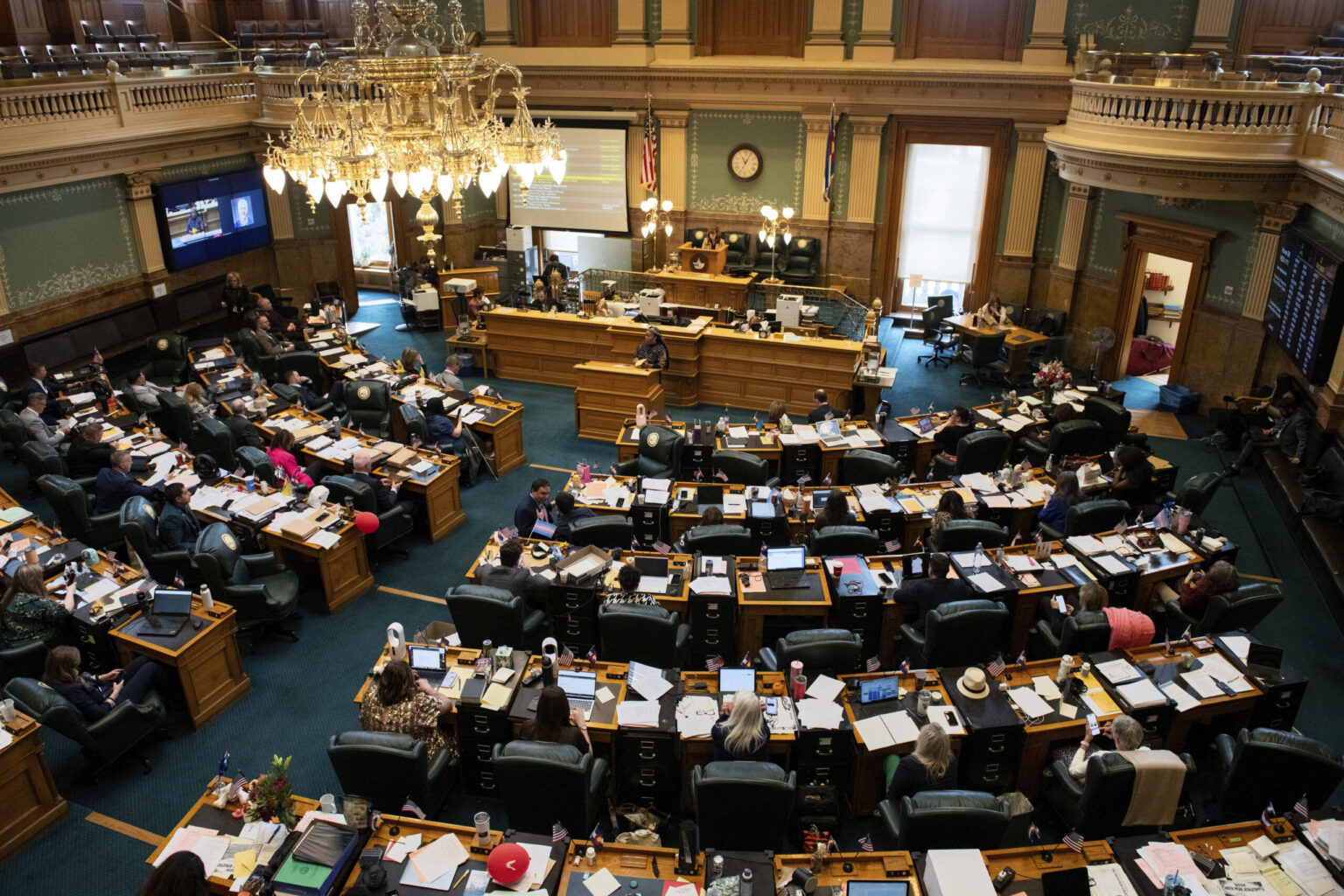

From affordability and labor rights to gun policy — as well as public safety and gubernatorial vetoes — 2025 proved to be one of the most consequential and contentious years in recent Colorado political history.
Lawmakers entered the session pledging bipartisan action to lower costs, but the months that followed saw fierce debates and sharp divisions that extended well beyond the state Capitol.
These are the stories — and the decisions — that shaped Colorado politics in 2025.
 FILE — In this Oct 2, 2018, file photo, a for sale sign stands outside a home on the market in the north Denver suburb of Thornton, Colo. U.S. home price growth slowed in October, likely due to higher mortgage rates that worsened affordability and caused sales to fall. (AP Photo/David Zalubowski, File)
Affordability
The 2025 legislative session began with both parties committing to pass legislation to make everyday life in Colorado more affordable, notably in the areas of housing and groceries.
House Speaker Julie McCluskie, D-Dillon, cited measures from the 2024 session that provided tax credits for community college students, as well as proposed legislation this year to tackle what sponsors described as rent-setting algorithms by landlords.
“Let’s foster an even stronger economy in this state by lowering costs for businesses and working families, and finding fair opportunity for all,” she said.
Former Minority Leader Rose Pugliese, R-Colorado Springs, echoed that message, but approached affordability from a different angle.
“We, as a legislature, have to acknowledge the role that we have played in making Colorado unaffordable,” she said. “I think it is incredibly important that we have a conversation about fees. Literally, people are talking about these fees at the door and (how) they cannot afford to raise their families here. Seniors are scared that they’ll have to leave the state because they can’t live on a fixed income.”
She added: “The legislature did that. And when we talk about affordable and attainable housing, we, the legislature, we did that.”
Gov. Jared Polis also talked about affordability in his State of the State speech: “In the Free State of Colorado, we are doubling down on our efforts to save people money on housing, keep our neighborhoods and communities safe, invest in our students, strengthen our economy and workforce, and allowing all Coloradans to thrive.”
Labor
Three bills dealing with organized labor received dozens of hours of debate, both in committees and on the floor.
The first, Senate Bill 005, sought to repeal the Colorado Labor Peace Act’s requirement that employees hold a second election to establish a “union security” agreement at their workplace. The bill cleared both the Senate’s Business, Labor and Technology and Appropriations Committees before passing through the chamber on a 22-12 party-line vote. It would be three months before the bill, which divided business and labor, as well as many progressive Democrats and the governor, would reach the House floor.
After clearing the House on a 43-22 vote, the governor vetoed the bill, as he had promised to do if labor and business could not reach a compromise.
In his veto letter, Polis said his most significant issue had to do with requiring all employees to pay union dues, regardless of whether they are union members. The 80-year-old Labor Peace Act has maintained “peace and stability” between employers and unions, and it was the stability that he sought in pushing for a deal, the governor said.
The unions and their allies said they will reintroduce the bill in the 2026 session.
Guns
For the third year in a row, lawmakers introduced a bill that would prohibit the purchase and sale of semiautomatic weapons with detachable magazines, sometimes referred to as “‘assault weapons.”
Unlike previous years, the bill was introduced in the Senate rather than the House, and it seemed to have better luck there. Senate Bill 003 passed the State, Veterans, and Military Affairs Committee on a 3-2 vote and made it out of the chamber on a 19-15 vote, with all Republicans and three Democrats — Tony Exum and Marc Snyder of Colorado Springs and Nick Hinrichsen of Pueblo — voting in opposition.
However, the bill had undergone significant changes by the time it got to the House. Following conversations with the governor, sponsors made an amendment that allows for the purchase of semiautomatic firearms, but only after completing a hunting safety course taught by Colorado Parks and Wildlife.
After 12 hours of debate, the House passed the bill, which the governor signed into law.
The following month, House Republicans sent a letter to U.S. Attorney General Pam Bondi, requesting that she review the law’s constitutionality.
‘Deadnaming’
A bill drew more than 700 Coloradans who signed up to testify at committee hearings, both in support of and in opposition, in particular over its provision requiring courts to consider whether a parent recognized a child’s gender identity when making custody decisions.
Sponsors eventually stripped that provision from the bill, leaving a section that makes it a discriminatory act to “deadname,” which means to not refer to a transgender person by the “chosen” name; allows individuals to change their gender marker on a driver’s license for a second or third time without needing a court order; and permits county clerks to issue new marriage licenses to someone who has legally changed their name to match their gender identity.
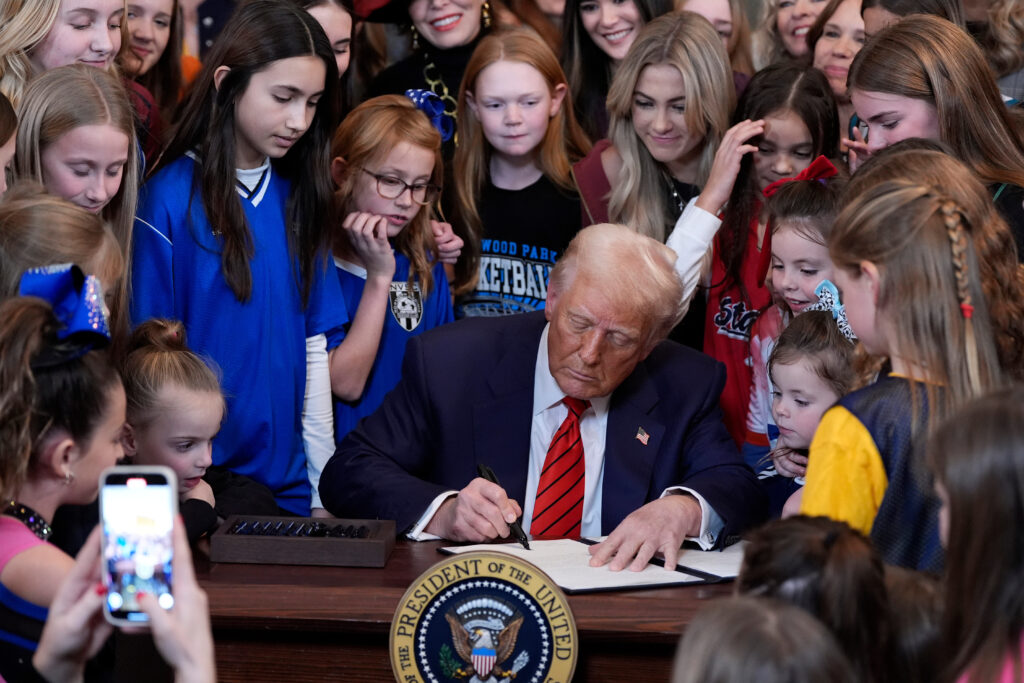 President Donald Trump signs an executive order at the White House in Washington, Feb. 5, 2025, barring transgender female athletes from competing in women’s or girls’ sporting events. (AP Photo/Alex Brandon, File)
Vetoes and override attempts
April marked a first for the Polis administration — and a first in Colorado in over 35 years — when the Senate voted to override the governor’s veto of a bill that would have required social media platforms to remove accounts engaged in illegal activity involving children. The House never followed through, so the governor’s veto stayed.
In his veto letter, Polis said the bill contained good intentions but failed to guarantee the safety of minors or adults, eroded privacy, freedom, and innovation; could hurt vulnerable people; and potentially subject Coloradans to stifling and unwarranted scrutiny of constitutionally-protected speech. Twenty-nine Senators voted to override the governor’s veto, but the bill’s sponsors in the House did not believe they had enough votes to do the same.
Polis went on to veto an additional 10 bills, breaking his previous record.
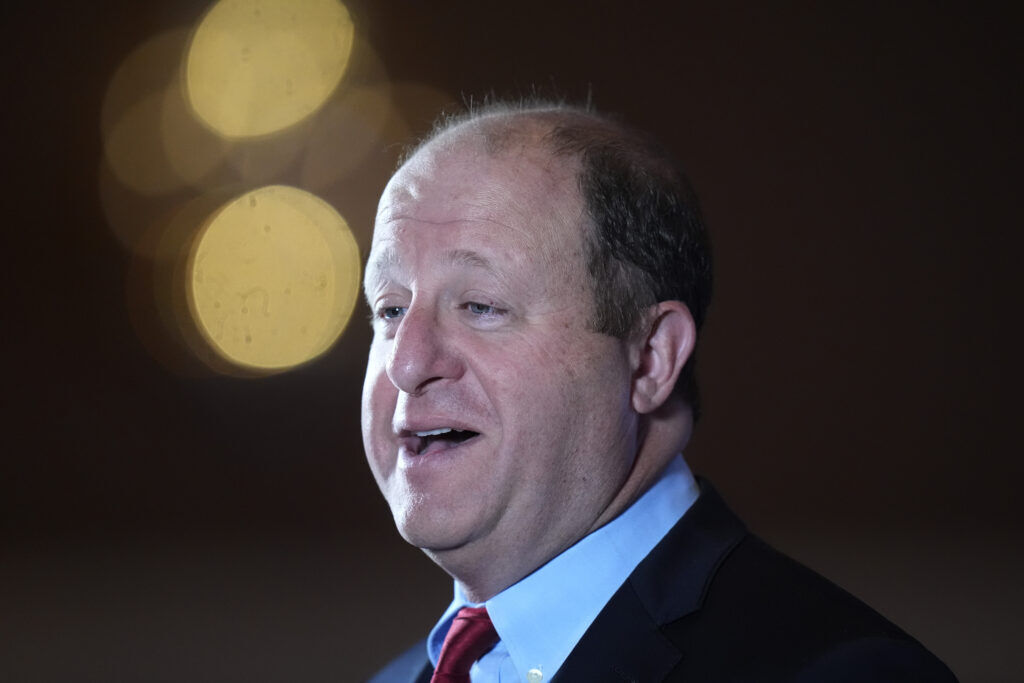 Colorado Gov. Jared Polis speaks during an interview at the 2024 summer meeting of the National Governors Association Friday, July 12, 2024, in Salt Lake City. (AP Photo/Rick Bowmer)
Among those bills was a measure that would have increased regulation on rideshare companies like Uber and Lyft. Polis said he agreed with certain aspects of the bill but ultimately believed it was too vague. He was also worried about Uber’s follow-through on its threats to leave the state should the measure become law.
The bill was sponsored by Rep. Jenny Willford, D-Northglenn, who alleged she was sexually assaulted by a man who had “borrowed” a Lyft account from another driver. She and her cosponsors criticized the veto, saying Polis’ claims that he cares about victims of sexual assault by rideshare drivers fell short and that he didn’t engage with the sponsors on the bill until three days before the end of the session.
Polis also vetoed House Bill 1004, which would have prohibited landlords from using specific rent-setting software.
In his veto letter, Polis stated that he agrees with the bill’s sponsors that landlords shouldn’t be allowed to collude to constrain rental supply and artificially increase rent. However, he said, any landlord or property management company doing that would already be committing a crime under the Colorado Antitrust Act.
He added that he is “potentially open to” supporting a bill in the future that makes a distinction between collusive and non-collusive uses of non-public competitor data, and he “enthusiastically” offered to partner on improving enforcement of the Colorado Antitrust Act.
Unintended consequences
A case involving an attempted murder in Weld County renewed debate about the state’s competency laws and public safety over the fall, after Weld County Sheriff Steve Reams posted a video on X of an alleged attack that occurred in Greeley several months before. Reams said his office had to release the man who was charged in the attack because of a 2024 law that, he said, requires individuals declared incompetent and unlikely to be restored to have their charges dropped and be released from jail.
“The state legislature and the Governor have continued to weaken the criminal justice system by handcuffing law enforcement, prosecutors and judges for the sake of criminals,” the post said. “Colorado HB24-1034 has created a crisis where hazardous individuals are being released to the street to reoffend over and over. This is the latest example.”
Sen. Judy Amabile, D-Denver, who authored the 2024 law, said jails were always required to release individuals found incompetent and unrestorable — and that her bill merely requires courts to dismiss their cases.
Colorado’s Republican delegates to Congress urged the governor to call a special session on public safety.
“This embarrassing episode is regrettably no longer unique for our citizens,” the lawmakers said. “Over the past year, our state has unfortunately become a poster child for the havoc that soft-on-crime policies cause. Whether it’s the takeover of apartments by Tren De Aragua (now a designated Foreign Terrorist Organization) or the failure to prosecute convicted sex offender Solomon Galligan for kidnapping a child in broad daylight, Colorado has time and time again drawn nationwide ire for its public safety failures.”
In response, Polis said the state has seen “double-digit reductions in crime” in auto theft, property crime, and victim crime and added he is “committed to working with local law enforcement, district attorneys, and our Congressional delegation to reduce crime further.”
Marianne Goodland contributed to this story.