
It is very important to know its mistakes to prevent them from happening again
For many years, Spain has been suffering from a black legend that has distorted its history, turning it into a caricature.
Cultural genocide? This is how Spain helped to preserve the indigenous languages of America
10 reasons to vindicate the Hispanic cultural heritage of the United States
This Black Legend has been particularly prevalent regarding episodes such as the discovery and conquest of America, as I already denounced here and here. The origin of this Black Legend dates back to Spain’s rivalry with other European powers such as England, France, and the Netherlands. Distorting the historical reality of a rival country was a very common form of propaganda. Religious conflicts between Catholics and Protestants also fueled that black legend, since Spain was one of the most important nations in the Catholic sphere.
Even today, this Black Legend continues to be fueled by the far left, which promotes an openly Hispanophobic discourse for ideological reasons, including hatred of Catholicism and the West. This hostility towards Spain leads many left-wing extremists to assert the most absurd clichés about Spain and even false accusations such as the hoax of the Spanish “genocide” in America. Fortunately, this Black Legend is increasingly losing credibility, largely due to the rigorous work carried out by many Spanish and international authors to debunk this bundle of lies, propaganda, and clichés.
Of course, the need to debunk this Black Legend doesn’t imply denying that Spaniards have made mistakes, as if Spain were a nation of virtuous beings where everything bad we find should be attributed to foreign influences. The Black Legend is just as false as the Pink Legend. Both fall into the same trap: approaching Spanish history with ideological filters that distort historical facts to fit a particular narrative, often with certain political undertones.
Spain, like other nations, had both successes and failures. Certainly, our past has achievements of which we should be proud and which we should reclaim without hesitation, but that should not prevent us from recognizing what was done wrong and avoiding certain clichés that often serve to oversimplify history, when in reality it is usually quite complex. Certainly, Spain’s role in America was highly commendable, especially compared to other nations, as is evident in the fact that in what was once Spanish America today there is a racial diversity that does not exist in the former British colonies.
However, it would be ridiculous not to acknowledge the merits of other countries. One example of this is the issue of slavery. It is true that as early as the 16th century, Spain prohibited the enslavement of indigenous people in the Americas, but it is also true that Spain was the last European country to abolish slavery in its American territories (it was abolished in 1873 in Puerto Rico and in 1886 in Cuba). The United Kingdom had declared all its slaves free in 1834 (thanks to the persistent campaign of William Wilberforce). France had definitively abolished it in 1848, and Portugal had completely eradicated it in 1869.
Another common trope is the establishment of good and bad dynasties, a narrative that many Spaniards have readily accepted, referring to the Habsburgs (known as the “Austrias” in Spain) as the good ones and the Bourbons as the bad ones. Certainly, the Spanish Golden Age coincided with the Habsburg dynasty, but things are not as simple as some portray them. Bankruptcies of the royal treasuries were a recurring phenomenon under the Spanish Habsburgs, largely due to the enormous debts generated by the frequent wars in which the Hispanic Monarchy was involved.
Despite the many criticisms it received, the Bourbon dynasty introduced significant economic and territorial reforms in Spain to modernize the country, ending old territorial privileges (with exceptions such as Navarre and the Basque provinces), establishing a more centralized and modern state, and professionalizing the Armed Forces. During this period, one figure stands out and deserves a place of honor in our history: King Charles III, one of the best monarchs Spain has ever had, whose reforms helped modernize the country, restoring its prestige, and who bequeathed to us two of our current national symbols: the flag and the anthem.
Of course, not all the Bourbons were good (or bad), just as not all the Spanish Habsburgs were good (or bad). There were kings who inherited a disastrous situation and allowed themselves to be surrounded by nefarious courtiers, and others who acted more wisely and had more fortunate circumstances.
I know there are young people reading this blog, young people who love Spain and who are fed up with so much negative narrative surrounding the Black Legend and its current twisted use for political purposes. I encourage these young people to read and study our history, comparing different sources and drawing their own conclusions, but always remembering that the Black Legend is just as false as the Pink Legend.
Every country has a history of successes and failures: we must celebrate the former and acknowledge and accept the latter to prevent them from being repeated, always remembering that being from a particular country does not make you right, and that the best way to love your country is not to justify everything that some have done or do in its name, but to be demanding of it, honoring it with your actions, avoiding using its name to cover up bad deeds and ultimately pursuing true greatness, which consists of seeking excellence for your country.
—
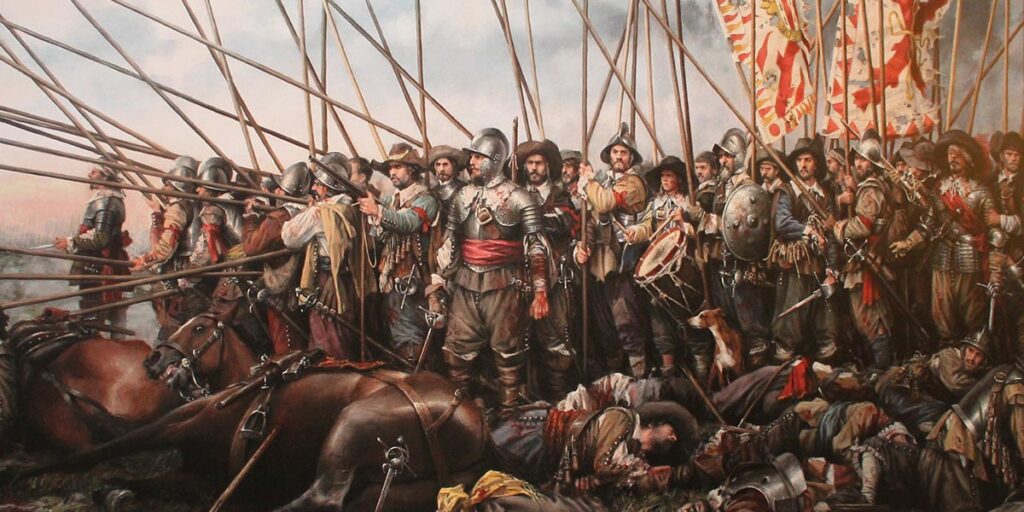
Main image: painting “Rocroi. El último tercio” by Augusto Ferrer-Dalmau.