

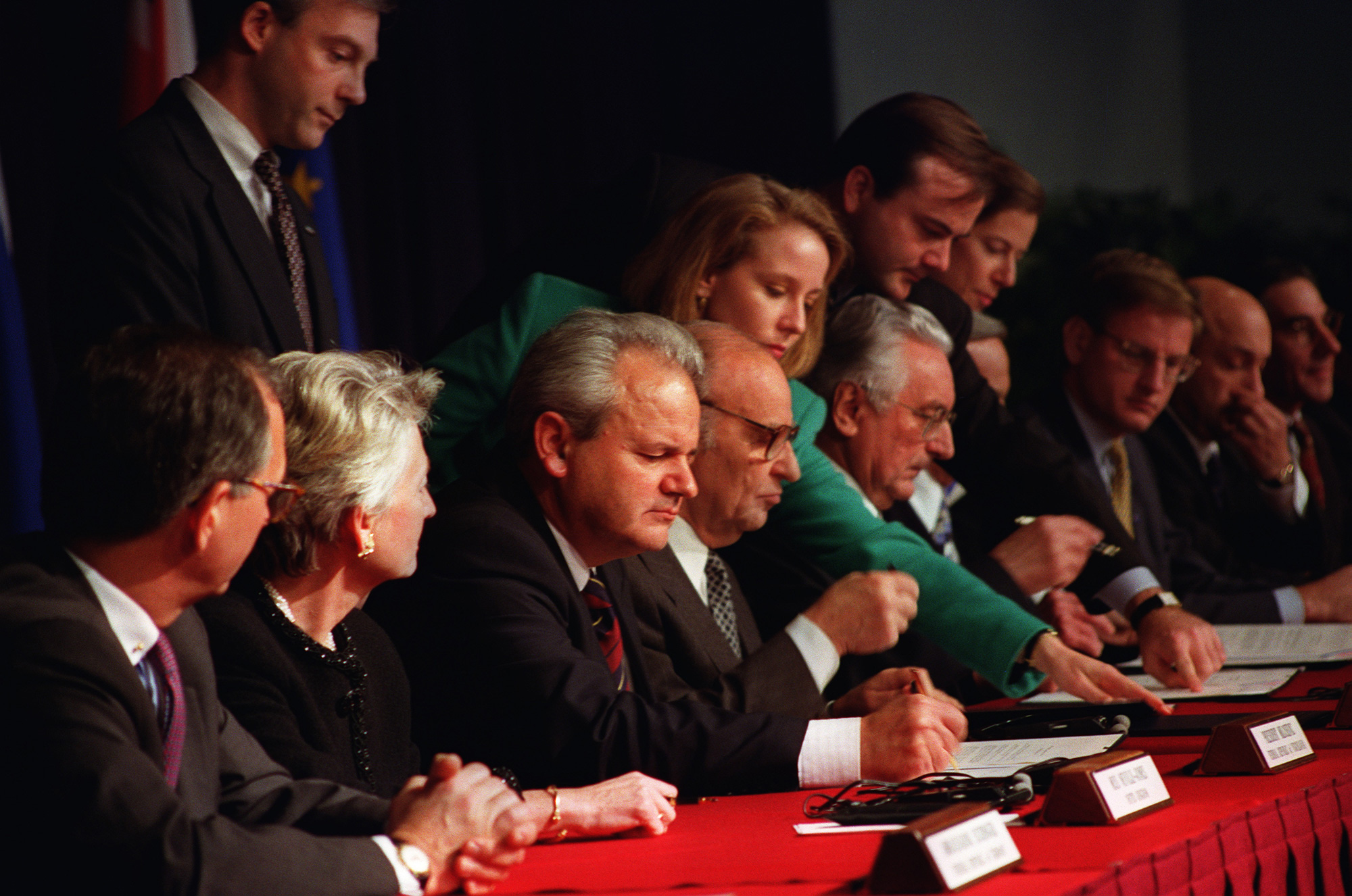
Thirty years ago, when US negotiators and Balkan leaders met at a military base in Dayton, Ohio, two key understandings were widely shared: Bosnia needed an immediate ceasefire; a genuine peace agreement that would satisfy all sides in the long run would be difficult to achieve. The General Framework Agreement for Peace in Bosnia and Herzegovina, finally signed on 21 November 1995, embodied both elements: it enforced a stable ceasefire but could not guarantee a fully functioning state.
The Dayton Agreement enshrined constitutional provisions that hinge exclusively on the three constituent peoples – Bosniaks, Croats, and Serbs – and created an asymmetrical federal state composed of two entities: a highly centralised, Serb-dominated Republika Srpska (RS), and a largely decentralised Bosniak-Croat federation made up of ten cantons, the Federation of Bosnia and Herzegovina. An autonomous district in Brčko interrupts the territorial continuity of Republika Srpska. The constitutional requirement to accommodate the needs and interests of all constituent peoples, coupled with a pyramidal system of political representation, would later become known as “the Dayton system” – a system that would soon evolve into a highly ungovernable ethnocratic state. The guarantor of the Dayton Agreement is the international community, represented by the Office of the High Representative – an institution that often reinforces the impression of Bosnia as an international protectorate.
Despite its complexity, it must be acknowledged that the Dayton Agreement effectively prevented further large-scale conflicts. Yet it also preserved the political structures that have fuelled tensions, which have persisted and even intensified over the past thirty years, particularly throughout 2025.
Nationalism, an Inescapable Way of Doing Politics
This year’s anniversary arrives after the harshest political and institutional crisis Bosnia has ever faced. Last February, the court of Bosnia and Herzegovina sentenced Bosnian-Serb leader Milorad Dodik to a one-year prison term and a six-year ban on holding public office. The sentence was confirmed in August and finally Dodik stepped back from RS presidency and converted the prison sentence into a fine of €18,600.
However, the whole institutional standoff is the best succinct illustration of the thirty-year long Bosnian struggle: on the one hand, a secessionist entity isolating itself from the central state; on the other, the institutions of that same state striving to keep the system functioning and to uphold the Dayton framework. This struggle is itself a representation of Bosnia’s paradox: a state which cannot function because of the ethnocratic system paralysing the decision-making process; but also, a state whose territorial survival is guaranteed by this very system.
The ones who profit from such a system are nationalist parties – mostly the same that led Bosnia and Herzegovina to war back in the 1990s. For them, Dayton is their lifeline. In fact, Bosnia and Herzegovina is not a country for Bosnians and Herzegovinians, who have little political representation and are effectively excluded at institutional level, with no possibility for those not identifying as either Bosniak, Croat, or Serb to run for the presidency or other high-level positions. Against this backdrop, society has been numbed. Year after year, the predominance of nationalist discourse, in all its three main forms, has increasingly overshadowed transnational movements and, most worryingly, cross-cutting and transnational identities. As Angelica Vascotto highlights , the permanence of nationalist rhetoric has obviously hampered the reconciliation process. Today, even more than thirty years ago, the political goal pursued by all the main nationalist parties is to match their electoral bodies with their respective national groups.
Political Bargaining Over Long-Term Solutions
As much as this year’s crisis encapsulates Bosnia’s struggle, so too does the way it has been resolved, at least for now. While Milorad Dodik found a way to deal with the sentence against him, what indirectly restored calm was the unexpected decision by the US Department of the Treasury to lift sanctions against him, his relatives, businesses, and aides. Coupled with the possible departure of Christian Schmidt from the Office of High Representative – at the time of writing, only a rumour – may signal an eventual behind-the-scenes agreement, for which Dodik steps temporarily back from his secessionist moves, yet he nonetheless emerges politically victorious. Moreover, the upcoming snap elections for the RS Presidency could bring to power Dodik’s close ally Sinisa Karan, and the secessionist agenda may soon be back on the table.
As Nikola Xaviereff underlines , while the election of Karan may for now have seemingly defused tensions, in the long term, aspirations for secession will remain central to the Republika Srpska policy agenda. The same kind of political bargaining driving the decision-making process was recently seen amid the adoption of the Reform Agenda under the EU’s Growth Plan. As Bojana Zoric remarks, deadlock was overcome only after ministers from Dodik’s party lifted their vetoes, finally allowing the document to be adopted – and avoiding Bosnia and Herzegovina losing 10% of the EU funds allocated.
In practice, within the ethnocratic Dayton system, back-room dealing will remain the dominant mode of politics in Bosnia, thus keeping the country hostage to nationalist agendas that undermine its stability and prospects, including the EU integration process.
International Partners and Domestic Instability
Looking at Bosnia’s dependencies, its reliance on the international community is also a cause for concern. Back in the 1990s, when interethnic conflict tore the country apart, international public opinion was shocked by reports of massacres, refugees, and concentration camps that evoked images of the Second World War. This shock pressed European and US decision makers to intervene. For US foreign policy, the Balkans represented the first post-Cold War scenario where Washington led both diplomatic negotiations and, eventually, military intervention. Both the NATO air campaign “Operation Deliberate Force” against military capabilities of the Republika Srpska Army, and the protracted diplomatic negotiations at Dayton Air Force Base crowned the role of the United States of America in the emerging new international order.
Since then, the US has remained a partner for the peace and stability of Bosnia and Herzegovina while Europe needed years to achieve as much influence as the US, becoming a political partner and a guarantor of Bosnia’s internal stability through the EU’s first major military operation – EUFOR Althea, which was recently renewed. Bosnia’s dependence on international support, like that of EUFOR Althea, aligns with the aforementioned paradox, as it signals both a weakness and a necessity. Indeed, its presence represents the inability of local institutions to stand alone, while its withdrawal may fuel escalation on the ground, too. What is concerning is that the international community is subject to political instability, too. This is more than evident in the case of the current US administration: lifting the sanctions imposed on Dodik reflects Trump’s intention to both disengage from world regions Washington does not consider vital for its national interests and to pardon leaders politically close to him.
Finally, the role of the Office of the High Representative, the institution responsible for overseeing the implementation of the peace accords, came under its strongest challenge during last year’s crisis, both at the international and domestic level. Since the start of his mandate, High Representative Christian Schmidt has been accused by Russia, a political ally of the RS leader, of lacking legitimacy, and in 2022 Moscow even suspended its financing to the Office. Russia sought to delegitimise the German diplomat to support Dodik’s secessionist agenda and, in the broader regional context, to assert its role as a destabilising geopolitical actor. As Eleonora Tafuro Ambrosetti highlights, this role is attested also by Dodik’s countless trips to Russia to meet Russian President Vladimir Putin and other Kremlin officials. At the domestic level, Dodik has repeatedly attacked Schmidt by accusing him of violating the Bosnian constitutional order without legitimacy, calling him a “fascist” and threatening him with legal repercussions. For his part, Schmidt decided to cut off public funding for Dodik’s party, further fuelling the Bosnian-Serb leader’s anger. The overall RS and Russian strategy is to leverage Schmidt’s position to their advantage. His eventual departure could work to the advantage of Dodik and support Russia’s strategy of fostering instability in the Balkans, with the indirect effect of helping show how obsolete this institution might be in promoting Bosnia’s stability.
In conclusion, post-Dayton Bosnia and Herzegovina today turns thirty with the awareness that the next institutional standoff might be just a matter of time. In a state where little has succeeded over the past three decades, there remains, half-jokingly, hope that even a multi-crisis scenario will not prevail.