
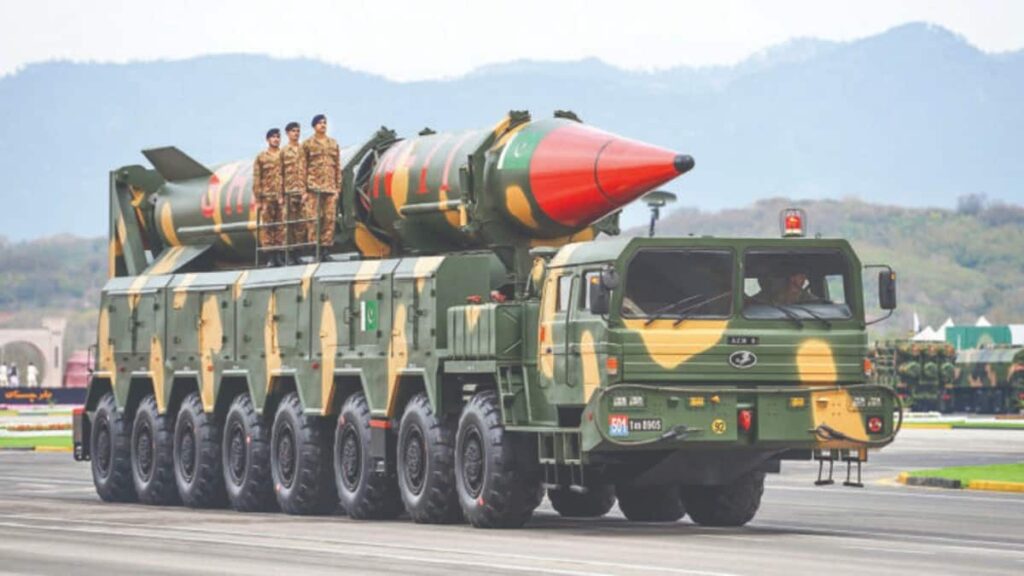
The recently declassified transcript released by the US National Security Archive, documenting a private exchange between former US President George W Bush and Russian President Vladimir Putin, exposes a reality long acknowledged in private but rarely admitted in public. In the conversation, Putin bluntly characterised Pakistan as “just a junta with nuclear weapons” and raised serious concerns about the safety and accountability of its nuclear arsenal. Bush did not dispute the description. Instead, the exchange revealed a shared unease that had existed among global leaders for years—an unease that conspicuously failed to translate into meaningful public action.
During a 2005 Oval Office discussion on nuclear proliferation, Putin noted that uranium of Pakistani origin had been detected in Iranian centrifuges. Bush responded by acknowledging Iran’s failure to disclose this material to the International Atomic Energy Agency (IAEA), calling it a violation. When Putin added that the material’s Pakistani origin made him nervous, Bush agreed, stating, “It makes us nervous, too.” This candid exchange underscores how acutely both leaders understood the risks posed by the diffusion of Pakistani nuclear technology beyond its borders.
The Making of a Nuclear Exception
The significance of this disclosure lies not in the revelation that world leaders were unaware of Pakistan’s nuclear trajectory, but in its confirmation that this trajectory was consciously tolerated. Pakistan’s nuclear programme neither emerged suddenly nor evolved in isolation. It developed incrementally over decades, beginning in the early 1970s under Prime Minister Zulfikar Ali Bhutto, shaped by strategic ambitions, regional insecurities, and an international environment that repeatedly prioritised expediency over enforcement. Bhutto’s declaration—“We will eat grass, even go hungry, but we will get the bomb”—captured a determination that was sustained, rather than obstructed, by global power politics.
From the late 1970s onwards, the global non-proliferation regime functioned selectively, guided less by universal norms than by geopolitical calculation—most notably that of the United States. By 1979, Washington possessed credible intelligence that Pakistan was pursuing nuclear weapons. Uranium enrichment at Kahuta was well documented, and assessments indicated steady movement toward weaponisation.
Under normal circumstances, such developments would have triggered sanctions and sustained diplomatic pressure. Instead, the Soviet invasion of Afghanistan transformed Pakistan into a strategic asset. As the frontline state in the US-led effort to counter Soviet expansion, Islamabad became indispensable. Its nuclear ambitions were neither halted nor seriously challenged; they were deliberately deprioritised.
This reality was later acknowledged in US congressional testimony, which admitted that Washington felt it had “no choice but to go along with the Pakistanis and look the other way at their nuclear weapons program”.
Declassified documents from the late 1970s further reveal that the Carter administration undertook secret diplomatic démarches—often coordinated with the United Kingdom—to restrict Pakistan’s access to sensitive nuclear technology. Hundreds of such démarches were issued to supplier states, urging stricter export controls. Yet enforcement remained weak. Key allies, particularly West Germany, resisted stringent measures to protect commercial interests.
Internal US assessments recognised Pakistan’s rapid progress at facilities such as Kahuta and acknowledged proliferation risks, but concluded that pressing Islamabad too hard could destabilise a crucial regional partner amid overlapping crises, including the Iranian Revolution. The outcome was not partial restraint, but full complicity—an intentional decision to tolerate and enable Pakistan’s nuclear advance in service of broader geopolitical priorities.
Former CIA and arms control expert Richard Barlow later captured this complicity succinctly: “We had huge quantities of intelligence about Pakistan’s nuclear program… The problem is that nobody was taking action in our government. They just weren’t interested.” Strategic priorities consistently outweighed non-proliferation commitments.
Institutionalisation through Legislative Manoeuvring
This selective blindness was subsequently institutionalised through legislative manoeuvring. The Pressler Amendment, often cited as evidence of US restraint, functioned in practice as a mechanism of evasion. Passed in 1985, it required annual presidential certification that Pakistan did not possess a nuclear explosive device for US assistance to continue.
Throughout the 1980s, successive administrations issued such certifications despite intelligence assessments indicating that Pakistan had crossed critical technological thresholds. By exploiting narrow definitions of “possession,” Washington preserved a legal fiction that allowed continued aid. This was not policy failure; it was deliberate policy choice.
The end of the Cold War briefly exposed this contradiction. In 1991, following the collapse of the Soviet Union, the United States declined to certify Pakistan under the Pressler Amendment, implicitly acknowledging Pakistan’s nuclear weapons capability. Yet even then, no serious effort was made to reverse or dismantle the programme. Pakistan’s nuclear infrastructure remained intact, and its strategic relevance endured.
Pakistan’s overt nuclear tests in 1998 prompted sanctions, but these were shallow and short-lived. By then, non-proliferation had already been subordinated to regional and strategic considerations. The attacks of September 11, 2001, completed this shift. Once again, Pakistan was elevated to the status of a critical ally—this time in the “war on terror”. US policy toward Pakistan’s nuclear programme transitioned decisively from prevention to risk management. Securing Pakistan’s weapons became more important than questioning their legitimacy. As State Department spokesman Richard Boucher made clear, cooperation—not non-proliferation—became the defining criterion of US engagement.
It was within this permissive environment that the Abdul Qadeer Khan proliferation network flourished. Pakistan did not merely acquire nuclear weapons; it commercialised nuclear capability. Libya received the most comprehensive illicit nuclear package ever uncovered, including complete centrifuge assemblies, weapon design blueprints, and operational manuals. When Libya abandoned its programme in 2003, Western intelligence agencies confirmed that the materials originated from Pakistan and were directly linked to the Khan network.
Iran’s nuclear programme similarly bore unmistakable Pakistani fingerprints, particularly in its early centrifuge designs. In the declassified transcript, Bush acknowledged to Putin that Iranian centrifuges contained material of Pakistani origin—a remark that contextualises Putin’s concerns. Pakistan’s transactions with North Korea followed the same pattern, trading uranium enrichment expertise for ballistic missile technology that later became central to Pakistan’s missile arsenal.
The Khan network operated through an extensive transnational supply chain, involving manufacturing hubs in Malaysia, logistics networks in the UAE, financial laundering through offshore accounts, and component sourcing from Europe and Turkey. This was not the work of a lone rogue scientist. It was a sophisticated, state-embedded proliferation enterprise that functioned for years without decisive international intervention.
Selective Non-Proliferation and Its Consequences
Despite the scale of this proliferation, Pakistan was never subjected to an independent international investigation. No intrusive inspections followed, no institutional accountability was imposed, and no sustained sanctions were enforced. AQ Khan was briefly placed under house arrest and later quietly absolved. As President Pervez Musharraf bluntly declared, “no independent investigation will take place here,” underscoring the state’s refusal to allow scrutiny of its nuclear record.
The Bush-Putin transcript thus exposes not only private fear, but public hypocrisy. Behind closed doors, global leaders acknowledged Pakistan as unstable, militarised, and dangerous. In public, they continued to treat it as a responsible nuclear power. This contradiction lies at the core of the failure of the global non-proliferation regime.
Today, Pakistan’s internal instability, entrenched civil-military imbalance, economic fragility, and radicalisation risks render those private fears more urgent than ever. A nuclear-armed state with weak civilian oversight and a documented history of commodifying nuclear technology represents a grave regional and global security threat.
If nuclear weapons are truly regarded as existential dangers, responsibility cannot rest solely with those who possess them unlawfully. It must also extend to those who knowingly enabled their spread. The burden of today’s proliferation risks does not lie with Pakistan alone but equally with a global system—led by the United States—that repeatedly chose strategic convenience over consistent enforcement, thereby normalising selective non-proliferation.
The consequences of that choice are global, enduring, and profoundly destabilising.
(The writer is a visiting research fellow at the International Centre for Peace Studies, New Delhi. Views expressed in the above piece are personal and solely those of the author. They do not necessarily reflect Firstpost’s views.)
End of Article