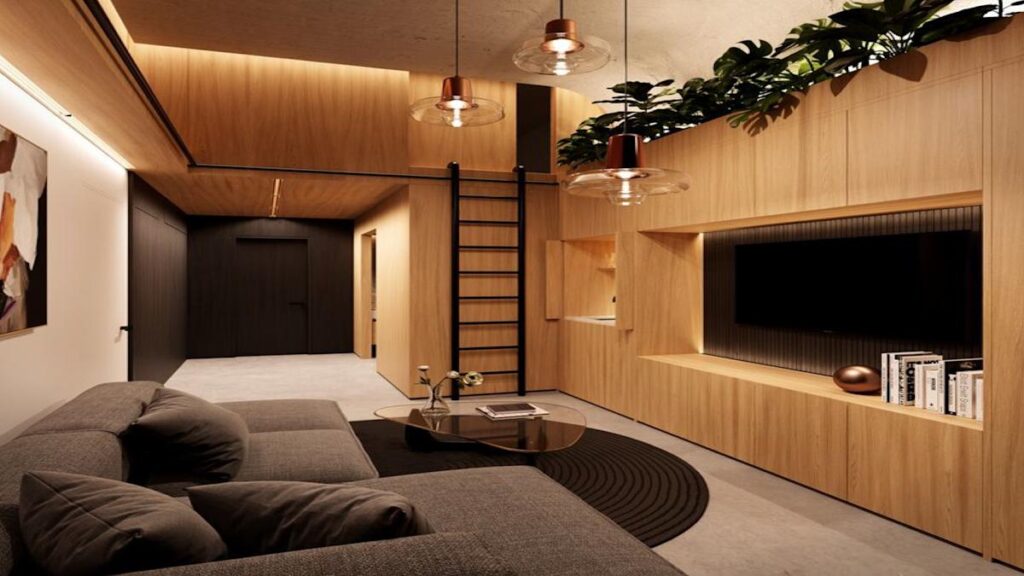
DEBERT — A former Cold War fallout shelter in rural Nova Scotia is being transformed into luxury condominiums for elite clients seeking refuge from global crises.
Project co-owner Paul Mansfield says renovation of the two-storey, underground bunker started less than a year ago, but the project has already attracted attention from several well-heeled buyers. The price range for the 50 condos is a secret — unless the vetting process determines you can afford one.
“To be honest, the bunker business is booming globally,” the Halifax-based entrepreneur said during a recent interview inside the slightly creepy, 64,000-square-foot concrete structure built in 1964.
“The climate is a big concern and …. there’s been more conflicts in the last few years than there has been in the last 25 years,” Mansfield says in a windowless room as the bunker’s ventilation systems hum in the background.
“Some people are trying to find some sort of apocalyptic insurance.”
Mansfield says about $8 million has been invested in the project so far. About 15 suites are due for completion next year and the remainder by the end of 2027. And when it isn’t being used as a cushy bomb shelter, the bunker’s suites will be part of a boutique hotel.
The existing turf-covered fortification is known as a Diefenbunker, named after John Diefenbaker, the prime minister who in 1959 ordered its construction at the Camp Debert military base, an hour’s drive north of Halifax.
The bunker was one of six identical shelters built across Canada. Each had metre-thick walls designed to withstand a five-megaton nuclear blast from two kilometres away. Advanced life-support systems could filter chemical, biological and radioactive contamination. And each building stored enough food and water to sustain 350 government and military leaders for 90 days.
In the event of a nuclear war, no family members were allowed to enter.
Decommissioned in the 1990s, most of the bunkers were sealed off or destroyed, federal officials say. One of them, however, is still being used for offices, classrooms and accommodations at Canadian Forces Base Valcartier, north of Quebec.
As well, a much larger Diefenbunker, built west of Ottawa in Carp, Ont., in 1961, now serves as “Canada’s Cold War Museum.”
As for the Nova Scotia bunker, it was opened for public tours in the late 1990s, followed by a transformation into secure data storage centre.
Its current owner, blockchain expert Jonathan Baha’i, bought the building in 2012. Aside from data storage, Baha’i started staging public events the following year, which included laser tag, e-sports and, in 2019, an elaborate escape room with a Cold War theme. But the gaming ventures were sunk by the COVID-19 pandemic.
Since 2022, much the bunker remained idle until Baha’i and Mansfield hatched their condo plan and renovations started this year.
The launch of the ambitious project prompted a high-end rebranding. The bunker’s latest incarnation is known as The Diefenbaker. The tag line on its slick brochure: “Luxury Safe Haven.”
“We’re going back to the original purpose, but for a different clientele,” Mansfield says.
The marketing is aimed at those seeking an “exclusive leadership community” committed to “protecting the promise of tomorrow.”
As was the case with the original bunker, the Diefenbaker will be equipped with self-sustaining systems providing enough energy, water and gourmet food to last six to nine months once the blast doors are sealed shut.
“Residents can maintain an elevated lifestyle no matter what happens outside,” the brochure says.
Supported by a staff of about 40, The Diefenbaker will have a spa, fitness centre, coffee shop and cigar lounge, all guarded by on-site security using thermal radar to guard the perimeter, Mansfield says.
To be sure, pricey doomsday condos are nothing new. In 2010, developer Larry Hall bought a decommissioned, 15-storey Atlas missile silo in Kansas, which he repurposed into the Survival Condo. Made from hardened concrete up to three metres thick, the underground silo now contains a collection of upscale condos with backup power systems, military-grade air filters and a five-year supply of food and water.
“When it comes to safeguarding your future, nothing even comes close,” says the Survival Condo’s website.
By 2023, Architectural Digest declared “luxury bunkers” as a real estate trend.
In his 2022 book, “Survival of the Richest: Escape Fantasies of the Tech Billionaires,” American author Douglas Rushkoff suggests that those with extreme wealth and privilege are obsessed with insulating themselves from climate change, rising sea levels, mass migration, pandemics and resource depletion.
“For them, the future of technology is about only one thing: escape from the rest of us,” he wrote.
Lars Osberg, an economics professor at Dalhousie University in Halifax, says the super-rich are known to feel somewhat paranoid and anxious about losing their wealth. “So you get this sort of social isolation and that goes along with with great wealth,” says Osberg, author of the 2018 book “The Age of Increasing Inequality: The Astonishing Rise of Canada’s 1%.”
“You also want to have some people around who validate you and make you feel good about yourself. And so you end up to talking to other rich people as much as possible.”
At the Debert bunker, Mansfield says it’s only natural that captains of industry would want to hang out with each other. “Still, we have people from all sorts of backgrounds that are interested in the project, but they are all driven. They have found a lot of success in their life by working hard and trying to make good decisions … and by being ahead of their time,” he said.
“And they tend to socialize a lot with each other …. I expect groups will be forming within the bunker to talk about what we’re going do when we get out of here and how we’re gonna exist and move forward.”
This report by The Canadian Press was first published Dec. 29, 2025.
Michael MacDonald, The Canadian Press