
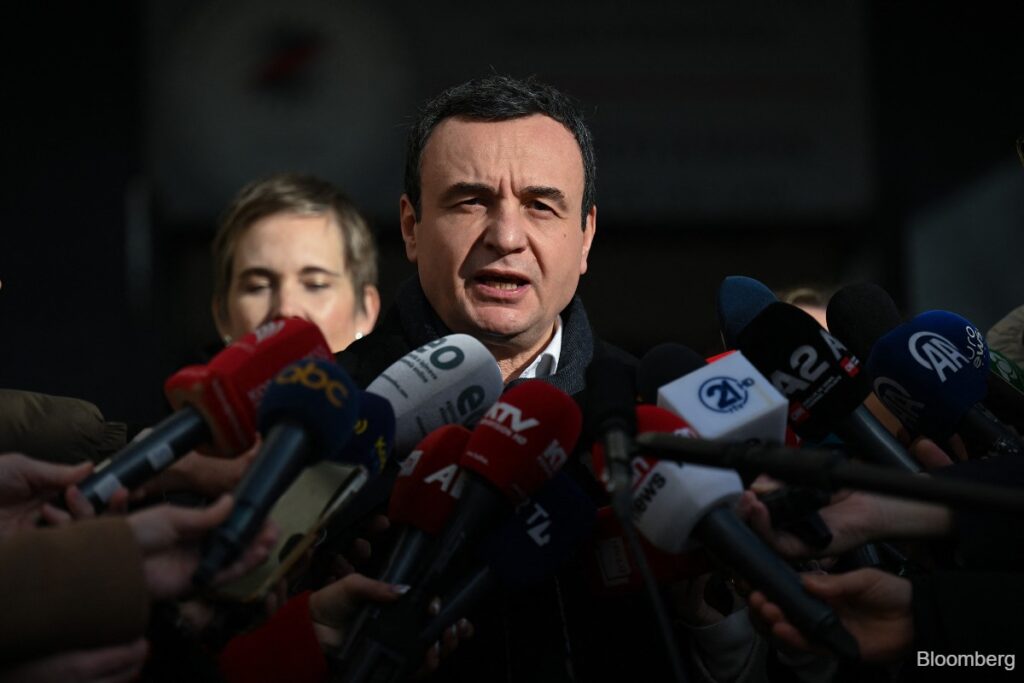
(Dec 29): Prime Minister Albin Kurti won Kosovo’s snap election as voters gave him a stronger-than-expected mandate, ending months of political deadlock.
Kurti’s Self-Determination Movement took 49.3% of the vote with nearly all votes counted, the Central Election Commission said. By gaining 56 seats in parliament and with expected backing from minority lawmakers, he’s poised to cross the 61-seat threshold to be able elect a speaker and form a government.
His fourth election victory showed a strong improvement in his popularity among Kosovars, who overlooked months of political deadlock that followed Kurti’s February election win after which he was unable to produce a governing majority.
In his first post-election appearance, Kurti urged the opposition to work with him on approving key international agreements that will unlock funds for the Balkan nation and on finding an agreement for choosing a new president in April.
“We don’t have time to lose,” Kurti, who struck a conciliatory tone, told reporters in Pristina late on Sunday. “We should move forward as fast as we can together.”
Voters gave 50-year-old Kurti backing to pursue sovereignty and swiftly integrate Serb-majority regions, even at the risk of upsetting the nation’s key allies.
Still, months of political deadlock have left the economy in limbo and hurt efforts to improve ties with allies and the Serbian minority.
With parliament unable to operate, reforms stalled and European Union-backed and donor-funded projects in energy, infrastructure, and the environment were delayed or frozen. Business groups have warned that prolonged uncertainty is hurting investor confidence and weighing on growth in one of the continent’s poorest economies.
The US, whose support has been vital to Kosovo’s nationhood, suspended a planned strategic dialog with the country in September, citing concerns over the stability of its institutions.
Tensions also persist in Kosovo’s Serb-majority north, where checkpoints and frequent patrols reflect ongoing challenges in local governance. Meanwhile, EU-brokered talks with Serbia, which doesn’t recognise Kosovo’s independence, have effectively stalled.
Still, Kurti got a boost from the EU when it said it will lift all sanctions on Kosovo by the end of January.
Lawmakers are due to elect a new president in April to replace Vjosa Osmani. Given the split of seats in parliament, cross-party support will be needed for a candidate to be selected. This makes an agreement with opposition parties unavoidable, Kurti said, adding that there was no pressure to open talks immediately.
“All of our commitments will be fulfilled,” Kurti told a cheering crowd. He urged his supporters to stay close as Kosovo moves forward “as a republic, as a people and as a society”.
Uploaded by Evelyn Chan