
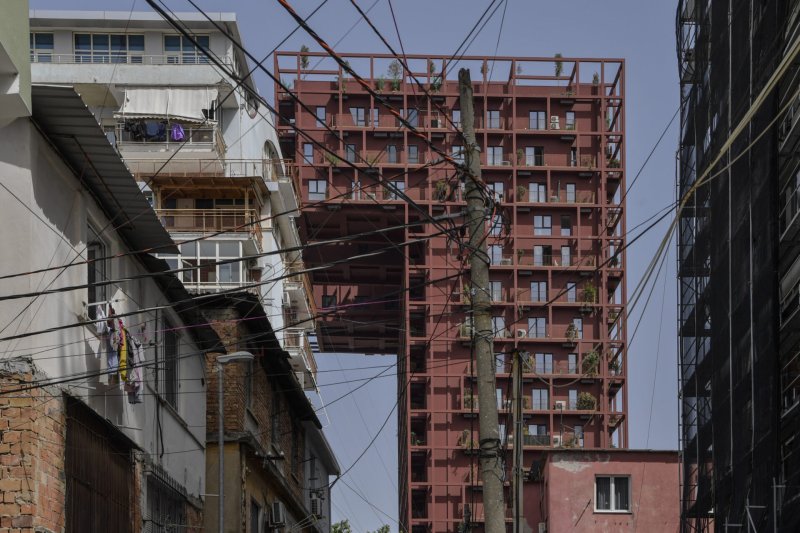
A study published by the Friedrich Ebert Foundation in September 2025 sheds light on the worrying dimensions of money laundering in the real estate sector in Albania over the last decade.
The analysis conducted by Prof. Dr. Adriatik Kotorri documents that a significant part of the construction boom in the country may have been financed from sources of dubious origin, writes factoje.al.
According to the data analyzed in the study, during the period 2015-2024, construction permits were issued in Albania for 11.48 million square meters with an average market value of Euro 16.238 billion. Of this amount, only Euro 7.108 billion were identified as being financed from legal sources, specifically Euro 5.521 billion from bank loans and Euro 1.587 billion from foreign direct investments.
The difference of at least Euro 9.13 billion raises serious questions about the origin of the funds. While part of this difference may represent unsold land or be financed by legitimate savings, researcher Kotorri argues that the most worrying indicator is related to illicit sources.
One of the most important findings of the study is related to the dramatic increase in foreign investment from countries that have been or are currently on the grey list of the Financial Action Task Force (FATF), the international organization that monitors money laundering and terrorist financing.
The case of Turkey is the first. Investments from this country have increased from 86 million Euros in 2015 to 257 million Euros in 2024. Turkey was part of the FATF grey list until June 2024, a period that coincides with the intensification of its investments in the Albanian real estate sector.
Bulgaria represents the second case in terms of relative growth. From practically zero investments in 2015, this country reached 74 million Euros in investments in 2019 and continued with 28 million Euros in investments in 2024. Bulgaria was also part of the FATF grey list until recently.
Researcher Kotorri points out that even the United Arab Emirates, another jurisdiction with historically weak financial control, has increased investments from zero to a peak of Euro 19 million in 2023.
The report argues that “these investment flows, from countries with weak financial controls, raise questions about the true nature of these investments and the potential risk they pose for money laundering in Albania.”
The study identifies several main routes through which illicit money infiltrates the construction sector, such as: Establishment of companies with questionable capacities. From 2015 to 2023, the number of construction companies increased by 40%, reaching 6,955 companies. It is worrying that 82% of new companies have only 1-4 employees and do not have the real capacities to carry out construction projects. According to the report, for the period 2017-2019, about 59% of companies that received permits for buildings over 6 floors did not have sufficient financial capacities.
Depositing funds in third countries: The method involves depositing funds in banks in countries with weak controls (such as Turkey, Bulgaria, and the UAE) and returning them to Albania as “foreign direct investment.” This scheme allows money of dubious origin to gain a “legitimate appearance” through the international banking system.
Cash payments and underpricing: The practice of declaring low values in contracts, while the rest is paid in cash, remains common. Although minimum reference prices were set in 2018, the difference between real and declared prices reaches up to 100% in elite areas.
Fragmented Deposit: Amounts are divided into small deposits to avoid automatic bank alerts (usually under 7,000 euros) and are then used for property purchases.