
From defence to détente
In the 1960s, this uneasy but stable status quo began to change. Cold War tensions re-ignited as Soviet premier Nikita Khrushchev and US President John F. Kennedy narrowly avoided conflict in Cuba, and as American involvement in Vietnam escalated. Despite this unpropitious start, by decade’s end what had been primarily a defence-based organisation came to embody a new phenomenon: détente, a relaxation of tensions between the Western and Eastern blocs driven by a grudging acceptance of the status quo.
During this decade, NATO and SHAPE unexpectedly moved to a new home. In March 1966, France announced its intention to withdraw from NATO’s integrated military command structure and requested the removal of all Allied headquarters from French territory. A new SHAPE Headquarters was established in Casteau, Belgium in March 1967, and NATO HQ moved to Brussels in October of the same year. Significantly, France remained within the Alliance and consistently emphasised its intention to stand together with its Allies in the event of hostilities. France also proved to be among the Alliance’s most valuable force contributors during later peacekeeping operations. Flexibility was always key to NATO’s success, and the French withdrawal from NATO’s integrated military command structure demonstrated that NATO, unlike the Warsaw Pact, could tolerate differing viewpoints between its members.
As a reminder of this point, in August 1968, the Soviet Union led an invasion of Czechoslovakia that put an end to a period of political liberalisation in that country known as the Prague Spring. Like a similar invasion of Hungary in 1956 and military repression in Berlin in 1953, Soviet actions demonstrated what became known as the Brezhnev Doctrine: given the choice between short-term control of Eastern European client states and long-run political and economic reform, the Soviet Union would choose to maintain short-term control. The end of this policy would await a Soviet leader willing to choose long-run reform.
Détente had many faces. West German Chancellor Willy Brandt’s Ostpolitik sought to encourage European stability through closer relations between Eastern and Western Europe. US President John F. Kennedy’s strategy of “Flexible Response” sought to replace Massive Retaliation’s absolute dichotomy of peace or total nuclear war. Adopted in the wake of the Cuban Missile Crisis, Flexible Response enhanced NATO’s conventional defence posture by offering military responses short of a full nuclear exchange in the event of conflict. Also during this time, a report entitled “The Future Tasks of the Alliance”, delivered in December 1967 to the North Atlantic Council by Belgian Foreign Minister Pierre Harmel, recommended that NATO should have a political track promoting dialogue and détente between NATO and Warsaw Pact countries. The role of NATO had become not merely to preserve the status quo, but to help change it.
The Harmel Report helped to lay the foundation for the convening of the Conference on Security and Co-operation in Europe in 1973. Two years later, the Conference led to the negotiation of the Helsinki Final Act. The Act bound its signatories – including the Soviet Union and members of the Warsaw Pact – to respect the fundamental freedom of their citizens, including the freedom of thought, conscience, religion or belief. Soviet rulers internally played down these clauses within the Act, attaching more importance to the Western recognition of the Soviet role in Eastern Europe. Eventually, however, the Soviets came to learn that they had bound themselves to powerful and potentially subversive ideas.
The Cold War revived
The 1979 Soviet invasion of Afghanistan and the Soviet deployment of SS-20 Saber ballistic missiles in Europe led to the suspension of détente. To counter the Soviet deployment, Allies made the “dual track” decision to deploy nuclear-capable Pershing II and ground-launched cruise missiles in Western Europe while continuing negotiations with the Soviets. The deployment was not scheduled to begin until 1983. In the meantime, the Allies hoped to achieve an arms control agreement that would eliminate the need for the weapons.
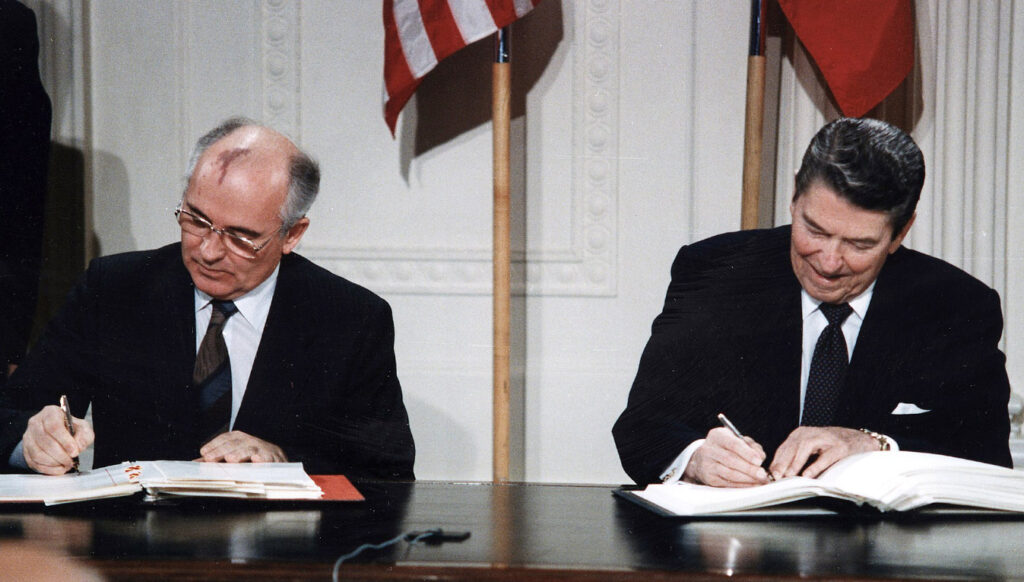
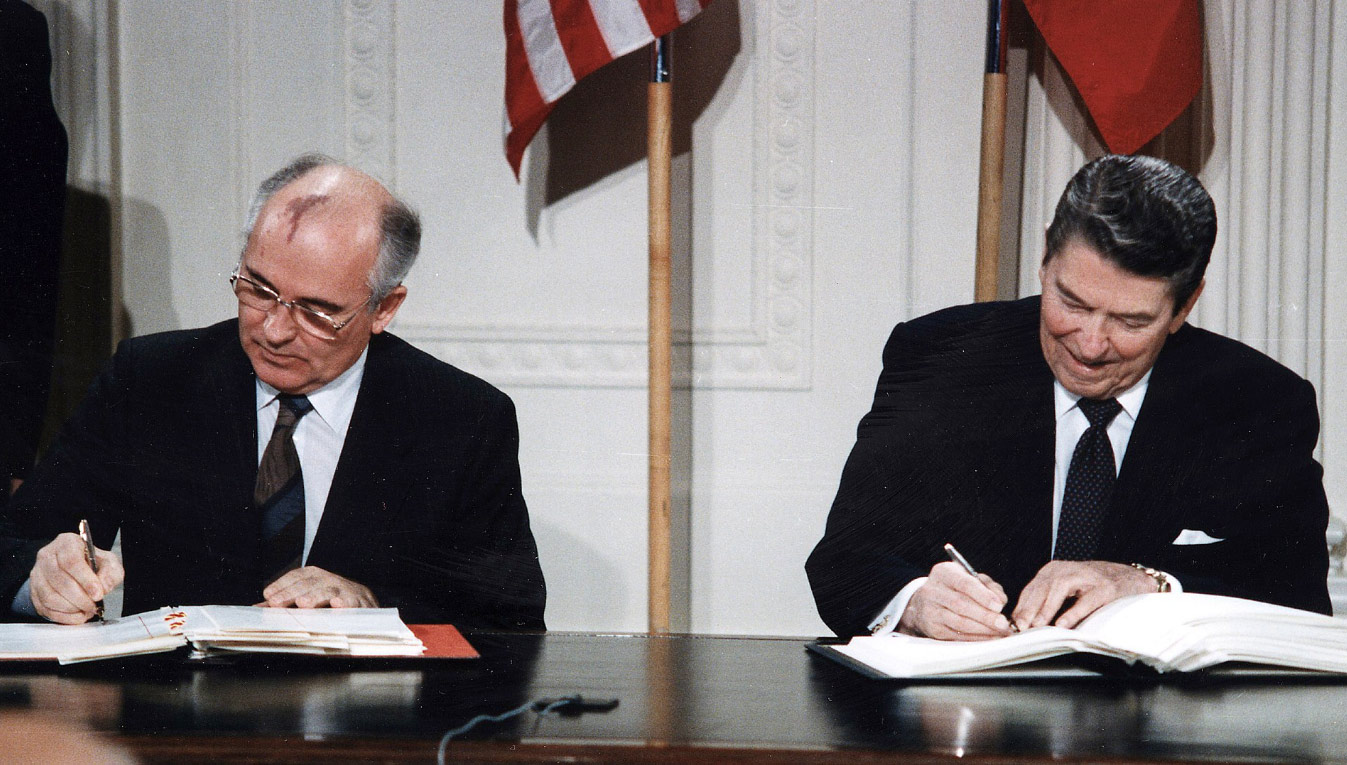
Lacking the hoped-for agreement with the Soviets, NATO members suffered internal discord when deployment began in 1983. Following the ascent of Mikhail Gorbachev as Soviet Premier in 1985, the United States and the Soviet Union signed the Intermediate-Range Nuclear Forces (INF) Treaty in 1987, eliminating all nuclear and ground-launched ballistic and cruise missiles with intermediate ranges. This is now regarded as an initial indication that the Cold War was coming to an end. The 1980s also saw the accession of NATO’s first new member since 1955. In 1982, a newly democratic Spain joined the transatlantic Alliance.
By the mid-1980s, most international observers believed that Soviet Communism had lost the intellectual battle with the West. Dissidents had dismantled the ideological supports of Communist regimes, a process aided in retrospect by the Soviet Union’s own ostensible adherence to human rights principles outlined by the Helsinki Final Act. By the late 1980s, the communist government of Poland found itself forced to negotiate with the formerly repressed independent trade union “Solidarity” and its leader, Lech Wałęsa. Soon other democratic activists in Eastern Europe and the Soviet Union itself would begin to demand those very rights.
By this time, command economies in the Warsaw Pact were disintegrating. The Soviet Union was spending three times as much as the United States on defence with an economy that was one-third the size. Mikhail Gorbachev came to power with the intention of fundamentally reforming the communist system. When the East German regime began to collapse in 1989, the Soviet Union did not intervene, reversing the Brezhnev Doctrine. This time, the Soviets chose long-run reform over a short-run control that was increasingly beyond their capabilities, setting in motion a train of events that led to the break-up of the Warsaw Pact.