
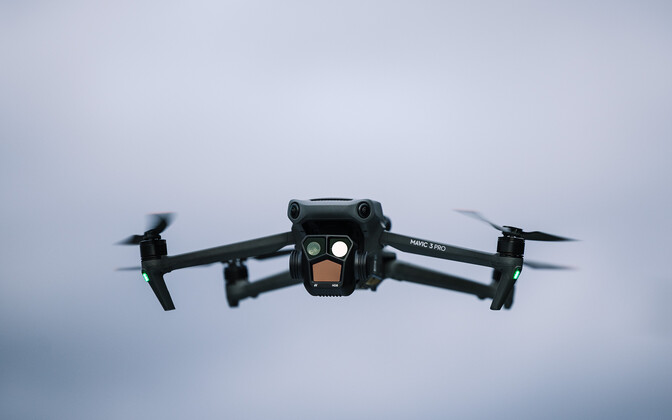
The United States has banned the import of all new drones and communications equipment made in foreign countries, including products from Chinese manufacturers DJI and Autel Robotics, citing security concerns over the potential for Chinese authorities to access data collected by the drones.
Simon Berner, an analyst at the Estonian Information System Authority’s (RIA) analysis and prevention department, told ERR that Estonia shares the U.S. concerns and agrees the risk is real.
“The risk isn’t so much based on public evidence that the Chinese government has conducted espionage using drones from these manufacturers, but rather on the structural and legal framework in which these devices operate,” Berner explained.
He said Chinese companies are subject to national security laws that allow the state to demand access to data managed by those companies. This doesn’t necessarily imply malicious intent on the part of the manufacturers — legal obligation alone is enough.
“This means that Chinese intelligence services could theoretically gain access to data collected by Chinese-made drones in use abroad and such data can sometimes be highly sensitive, such as geocoordinates, images, flight logs and similar material,” Berner said.
He added that if a drone’s data exchange or software updates are routed through servers located in China or under Chinese jurisdiction, neither the user nor the state operating the drone can fully control what data is collected, how it’s processed or who legally has access to it.
Drone seller: No alternative to DJI
DJI drones are the most widely used in the world and in the United States, DJI controls about 80 percent of the drone market.
Eduard Vainu, development manager at Meridein Group, which operates Estonian drone retailer Droon.ee, said DJI holds a similar market share in Estonia and nearly everywhere else, as the company produces for a very broad customer base and its software development is so far ahead that no one has managed to catch up.
“When you look at the volume and scale of their global sales, that also drives the price point. That’s why they’ve had no real competitors,” Vainu said.
The Estonian drone seller hopes that Europe and other regions won’t follow the U.S. example, arguing that there simply is no alternative offering comparable price and quality. He also sees the U.S. move primarily as a way to protect its own market, but one that, in his view, takes the country a step backward in terms of development.
“There are one or two unmanned aviation companies in the U.S. that have spent billions on lobbying,” Vainu said. “It’s as simple as this — if you want to sell a product with ten-year-old functionality while calling it a revolutionary innovation, the only way to do that is to ban the competition.”
He added that the U.S. has not presented evidence to justify labeling these drones as a security threat.
DJI drones are used globally in defense and law enforcement. According to Vainu, all drones available on the global market have been tested and adapted for use in Estonia and if data collection is suspected, there are ways to counteract it. Buying from other manufacturers, he said, would mean taxpayers end up with fewer and lower-quality drones for the same money.
Nemo Vunk, owner and CEO of Meridein Group, noted that political pressure against the DJI brand has been building for nearly five years, yet no other company has matched it in terms of quality or price.
“This isn’t a love letter to DJI — it’s just the harsh reality,” said Vunk, who added that as an importer, they would be happy if there were another brand as strong as DJI.
He acknowledged that DJI holds a monopolistic position in the drone sector, which is indeed problematic, but said it is also not fair to ban the product and claim security concerns without providing more concrete evidence.
Ordinary users less interested in drones
Flying drones is subject to specific regulations in Estonia. Drone owners whose devices weigh more than 250 grams or are equipped with a camera are required to register as operators with the Transport Administration and obtain remote pilot certification. The Transport Administration also recommends that even those using drones below these thresholds earn remote pilot certification to stay informed about the rules.
However, the agency does not take a position on the potential security risks associated with Chinese-made drones.
“We do not monitor security threats or issue bans based on them. The Transport Administration does not have such authority,” said Priit Rifk, head of the agency’s unmanned aviation department.
According to Meridein Group, public interest in recreational drone use has declined. The “wow factor” peaked around 2020, following a few years of brisk sales.
The war in Ukraine did temporarily boost drone sales in 2022, but since then it has become difficult to distinguish how many are sold to hobbyists, as many individuals and organizations now purchase drones specifically to donate them to Ukraine.
“In the private sector, we’re seeing growing use of drones for industrial purposes — for example, inspecting solar farms, power plants and so on,” said Nemo Vunk. “In those areas, drone technology is already smart enough to reduce the need for human labor. That sector is growing, but the consumer market is stable at best, if not declining.”
An entry-level consumer drone can cost around €100, but the types of drones used in Ukraine for reconnaissance start at around €1,500. According to Vunk, at that price point, DJI is the only brand offering drones with the required capabilities and there are no signs that comparable alternatives will emerge in the near future.
French drones five times more expensive
Vainu noted that Ukraine uses around 20,000 DJI reconnaissance drones daily for pre-monitoring and similar tasks, while the share of drones from other manufacturers remains negligible.
“So far, there isn’t a single strong manufacturer in Europe capable of competing,” Vainu said. “Autel has emerged in China and is now second worldwide. The French company Parrot offers mixed quality at five times the price and the U.S.-made Skydio drone is probably ten times more expensive — but its quality, unfortunately, is well below standard. That’s the reality — we’ve tested them all; we have all the samples.”
Vunk said the company has met with various manufacturers at trade shows in Israel, China and the United States. Of these, the U.S. fair was by far the most underwhelming in terms of drone offerings. He attributed this to the U.S. focusing more on large-scale military systems like missiles and aircraft carriers where there is less demand for small drones.
“The expertise coming out of the U.S. today is the weakest in this field. China is clearly very smart and highly advanced, but our best partner has been Israel,” he said. “It’s a country many times smaller than Estonia, yet they’ve managed to combine every component and the best possible solutions in a very clever way.”
As an example, Vunk pointed to Israel’s conflict with Iran where Iranian forces used Russian-made equipment, which Israel was able to successfully repel.
“In other words, the truth may lie not with the U.S. or China, but somewhere in between. You need to combine resources, find the best price-to-quality ratio and use it wisely. That’s what Israel is doing and Estonia could do the same, relying on expert knowledge and real product testing because that’s the only way to determine the truth,” Vunk said.
—