
According to the Eurobarometer, climate change still ranks as only the eighth most important concern for Estonians. What we do seem to care about, however, is whether we’ll have a white or green Christmas. If the planet does, in fact, warm by nearly three degrees Celsius by the end of the century, do we know how much more rarely we’ll be able to ski?
The climate has already changed. There’s less snow and the snow cover period is shorter — something people have likely noticed themselves, whether related to skiing or just daily life. Permanent snow cover now melts 10 to 30 days earlier depending on the region. And with less light due to snowless landscapes, we can see how it affects people’s moods during winter. If global temperatures rise by nearly three degrees Celsius, Estonian winters will be about six degrees warmer and winters with long-lasting snow cover will become increasingly rare.
Depending on people’s predispositions and beliefs, they might just as well claim that their childhood Christmases were often snowless or that they were always able to go ice skating. To what extent can we actually trust our memories in such cases and how should we approach a probabilistic worldview?
It’s clear that human perception is far from a perfect source of information. But personal experience is still important, especially when we’re talking about the impact of extreme weather or climate change. After all, what we’re most interested in is how climate change affects people. That’s why connecting climate change to people’s own lived experiences is undoubtedly meaningful.
In my own research, I focus on refining our understanding of the extent of human impact on the climate. But when I engage with the public, I often have to start with the basics — showing evidence that the world has clearly gotten warmer and explaining how we know that climate change is human-induced. Still, it’s just as important to talk about today’s research questions: how far climate change will go and how sensitive Earth’s climate is to human-caused emissions.
Your newly funded research project focuses on how much air pollution particles slow down climate warming. Even if the impact of a single factory may be lost in the noise of natural weather variability, what kind of magnitudes are we talking about overall?
In addition to greenhouse gases, which warm the climate, burning fossil fuels also produces air pollution particles — known as aerosols — that cool the climate. This cooling effect comes from the fact that more sunlight is scattered back into space. While the warming effect of greenhouse gases is very precisely known, the strength of the cooling effect from aerosols is not. That uncertainty also affects our ability to forecast future climate scenarios.
The greatest uncertainty comes from not knowing exactly how aerosols influence clouds. Both clouds and air pollution are affected by changing weather: under certain weather conditions, pollution levels are higher and clouds exhibit particular characteristics and vice versa. It’s difficult to separate the direct impact of human-made aerosols on cloud properties from the broader variability caused by weather itself.
Our approach treats individual large factories as natural experiments. We study the properties of clouds in areas polluted by factory emissions compared to cleaner areas. Since pollution levels vary between areas close to and farther from the factory, while weather conditions remain the same, we can determine the causal impact of air pollution particles on cloud formation.
How do air pollution particles affect clouds?
Different particles have different effects. Air pollution particles produced by burning various fossil fuels vary in composition and their properties depend in part on the chemical makeup of the fuel. Sulfur compounds are largely responsible for the cooling effect on the climate. These compounds generate particles that cause cloud water to be distributed among more droplets, making each droplet smaller. As a result, the total surface area of the droplets increases and more sunlight is scattered back into space.
Water clouds can dissipate in two ways: through precipitation or evaporation. If either of these processes changes, the thickness and quantity of clouds can also change. The extent of such changes remains uncertain. The climate-cooling effect of air pollution particles, by increasing the number and thickness of clouds, could be much stronger than the most likely current estimates suggest.
Ice clouds, on the other hand, require different types of air pollution particles to form. Without particles, ice crystals in the atmosphere typically form from supercooled water droplets only at around -40°C. Both natural dust and certain man-made pollution particles help ice crystals form at warmer temperatures. Because of human-made pollution, more water may fall as snow and fewer clouds may remain. That allows more sunlight to reach the Earth’s surface, which could have a warming effect on the climate.
Can we already say whether the overall effect of air pollution particles on the climate is cooling or warming?
The net effect of air pollution particles is cooling. The Intergovernmental Panel on Climate Change (IPCC) compiles key evidence in its assessment reports every six to seven years. Based on current knowledge, the cooling effect of air pollution particles most likely offsets about one-third of the warming caused by human-generated greenhouse gases.
However, there is a small possibility that, through their role in making clouds thicker and more widespread, these particles could offset slightly more than half of the warming effect of greenhouse gases.
We chose to investigate the potential for air pollution particles to have a strong cooling effect on the climate because it’s an area that has been understudied but carries significant risk. If we have underestimated the strength of this cooling effect, it would mean that Earth’s climate is more sensitive to human-generated greenhouse gases than previously thought and that the planet could warm faster in the future than current projections suggest.
Our hypotheses are not in conflict with today’s best scientific assessments, but they do fall on one end of the current range of estimates.
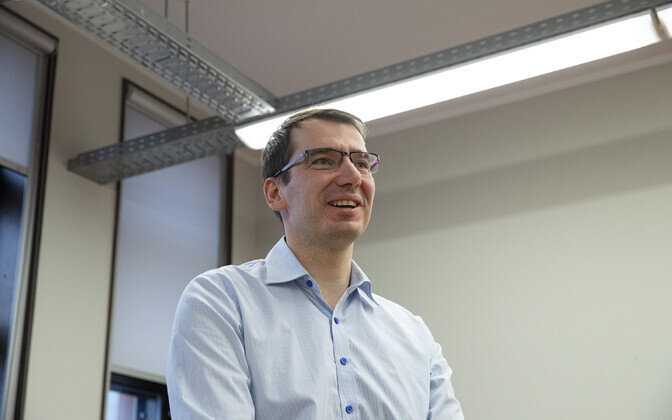 Velle Toll. Source: Airika Harrik/ERR
How should people make sense of these probabilities? Personally, I wouldn’t buy a lottery ticket if the chance of winning were 5 percent, though of course some people are more willing to take risks.
Climate projections are a cornerstone of climate policy and they have significant socioeconomic value. Scientifically, it’s very clear that over 90 percent of the warming we’ve already seen is human-induced. At the same time, we still don’t know exactly how extensive future climate change will be, even under specific levels of human-caused greenhouse gas emissions. For a given level of fossil fuel use, we can’t say precisely how much warming it will trigger; what we can say is the likely range in which that warming will fall.
If we continue on our current path, the global climate is projected to warm by about three degrees Celsius by the end of the century. But it’s more accurate to say that, with about 90 percent probability, warming will fall somewhere between two and four degrees.
You’re trying to reduce this kind of uncertainty by analyzing millions of factory-related data points, roughly three orders of magnitude more than in your previous studies. What methods and techniques are you using to do this?
Honestly, up to now it’s largely been painstaking manual work. We’ve been using NASA satellite data, which is freely available thanks to U.S. taxpayers and has long been a cornerstone of climate research. Now, we’re increasingly using measurements from European satellites as well.
Put simply, we analyzed satellite cloud images that reveal information invisible to the human eye. We’ve manually marked instances where we see anomalies near factories. Now, we’re moving toward automating these processes.
First, we have high-quality wind data that allows us to calculate where pollution is being carried. Then, using various algorithms, we determine whether the clouds in those areas have different properties compared to nearby cleaner regions. Since the human eye can detect disturbances in cloud characteristics near smokestacks, we’ve also started using machine learning methods. The databases we’ve previously built will serve as training data for machine learning models to identify millions of similar cloud images where human activity has caused anomalies.
At the risk of being provocative, what kind of computing power does this require and how guilty do you feel about the CO₂ emissions that come from it?
The computing power needed to process big data is indeed substantial. For example, the dataset from just one NASA satellite reaches into the petabytes, which means the electricity consumption for analyzing it is also quite significant.
What makes our project unique, however, is that we’re not using a brute-force approach to sift through the data. Instead, we use the same Amazon cloud platform where the data is stored. That way, we’re not moving petabytes of data around; we rent computing power right next to the data and read only the small subset we need at any given time.
Still, we do need to consider the environmental footprint. That’s an unavoidable part of working with big data — just like laboratory work has to take into account the impact of its equipment and infrastructure.
Scientists who reviewed your grant application, as well as you yourself, have emphasized that open science plays a central role in this project. What exactly does that involve?
The use of individual factories and ships as natural experiments is becoming an entirely new and independent line of research in climate science. After our initial discoveries, other research groups also began moving in the same direction.
We’re working to create a platform for this emerging research community that brings together software tools, data and methodologies so that researchers in this field can collaborate more easily.
New groups would be able to join within days or even hours instead of weeks or months. This would be as open as science gets: a platform where the community itself contributes and grows through collaboration.
These are noble goals. But how much do you think about the fact that the datasets and analyses generated through these experiments have dual-use potential — that they could one day be used to justify deliberate climate intervention? Media reactions to controlled experiments suggest that public sentiment is often skeptical or even hostile.
Our results are indirectly important for assessing the feasibility of climate engineering and the intentional cooling of the climate. Since our ambition is to practice open science, everything we do is public. How these results are used ultimately depends on the ethics and decisions of those who use them.
Our own research does not focus on intentional climate cooling — we’re working to refine our understanding of the magnitude of human impact on the climate.
Climate engineering raises a number of ethical issues. Internationally, there are those who see such studies as absolutely necessary and others who argue that conducting the research itself is already risky. Most ethical dilemmas boil down to this: even if we manage to cool the climate intentionally, doing so could distract from the urgent need to rapidly reduce greenhouse gas emissions. In addition, intentional climate cooling could bring about unwanted side effects, such as changes in precipitation patterns or atmospheric circulation.
For example, it’s been shown that brightening clouds over certain parts of the Atlantic Ocean could lead to large-scale dieback in the Amazon rainforest. In Estonia, these topics have received little public discussion so far, but in reality, both the ethical and scientific dimensions of climate engineering deserve deeper examination.
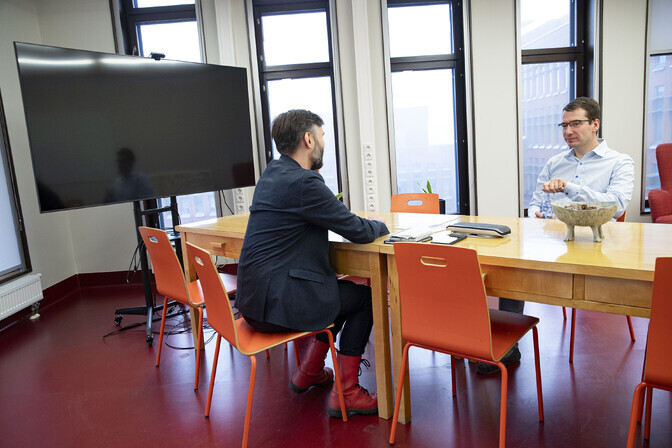 Jaan-Juhan Oidermaa and Velle Toll. Source: Airika Harrik/ERR
Once again, we arrive at the realization that the climate is an incredibly complex system. But from your perspective, the measures needed to mitigate climate change seem fairly straightforward, such as insulating buildings or reducing consumption. Is tackling climate change still a scientific question or should we now see it more as a socioeconomic issue?
Solving climate change requires interdisciplinary collaboration. Scientists have proposed a range of technological and socioeconomic solutions, but we haven’t been very successful at reaching international agreements on their implementation. Much of the challenge lies in effectively communicating knowledge to decision-makers — that it’s more beneficial to start reducing emissions rapidly today rather than later.
That said, the need for technological development shouldn’t be underestimated. For example, as we transition to renewable energy, we also need scalable solutions.
To stop climate change, we have to bring greenhouse gas emissions down to zero, phase out fossil fuel use and then learn to live in the changed climate that follows. Scientists are in strong agreement: if we want people in many parts of the world to have a good quality of life in the future, we need to cut emissions significantly faster than we are now.
Primary energy production and consumption cannot continue growing in the same way. Compared to global scenarios that maximize fossil fuel use, this means lower economic growth, but only if we ignore the negative economic impacts of more severe warming. When the economic effects of climate change are taken into account, studies have shown that it is significantly more beneficial — even economically — to invest in reducing emissions.
The real issue lies in the conflict between short-term election cycles and the long-term decisions that would bring the greatest benefit.
Looking at the results of COP30, there weren’t many new binding commitments and the world still appears to be on a path toward three degrees of warming. As a climate scientist, how do you see this: are you still optimistic, starting to lose hope or do you simply continue your work and trust that the facts will eventually speak for themselves?
As a person, I’m deeply concerned about the current trajectory of climate change and what it means for humanity’s future. One option for reducing human-caused greenhouse gas emissions that has been discussed is a universal carbon tax, but it hasn’t gained broad support. On the international level, countries have instead agreed on policies based on nationally determined contributions.
That approach has been effective to some extent — emission growth has slowed and hopefully we’ll soon reach a plateau followed by an actual decline in emissions. But climate change will continue to worsen until human activity stops adding greenhouse gases to the atmosphere — in other words, until we reach net zero.
Right now, we’re not seeing a fast enough global decline in emissions. This means the global average temperature could rise by nearly three degrees Celsius by the end of the century. In many regions, such a level of warming would make it difficult or even impossible to live successfully. Even regions less directly affected by the most harmful impacts of climate change, such as Estonia, will increasingly have to factor it into their planning and adapt accordingly. Beyond adjusting to local climate changes, we also need to think globally: if some regions become uninhabitable, that will affect us as well.
To reduce the harmful effects of climate change, we need to start preparing today for the changes ahead. The infrastructure we build now will be used in the climate of the future, not the past. Raising our level of ambition for emission reductions is more important than ever. At the same time, we need to be realistic and invest in climate adaptation too. This challenge should be sobering and motivating, not discouraging.
What is the relationship like between climate scientists and policymakers in Estonia? At the municipal level, there’s growing awareness — for example, that stormwater systems need to be scaled up or that rain gardens should be built. But at the national level, is expert knowledge reaching the right places, especially when we look at the debates around LULUCF?
Scientists are increasingly being invited to the table and the process of engagement has begun. However, I sense that the involvement of scientists hasn’t been substantial enough. The first step has been taken, but there’s still room for improvement to ensure that the engagement becomes more meaningful, both in terms of how input is sought and how it’s actually taken into account.
How deep is the bench of climate scientists in Estonia, really? As journalists covering climate and weather-related news, we can usually rely on about five experts — two of whom, given their age, seem to stay engaged more out of sheer personal passion than anything else.
Climate research is still an emerging field in Estonia and there simply aren’t enough people working in it yet. Until recently, the impact of human activity on the climate hadn’t really been studied here. I did my postdoctoral work at the University of Reading in the UK, which is one of the world’s leading centers for climate research, and there I had the opportunity to learn from scientists with a wide range of expertise.
In Estonia, there’s a clear shortage of economists and social scientists who specialize in climate research. Yet when it comes to both climate change mitigation and adaptation, there are countless research questions from a social science perspective. The state could do more to support the rapid development of strategically important research areas like this.
Given how urgent the societal need already is, it won’t be enough if the necessary expertise only emerges 10 to 15 years from now. We also need to collaborate more with international researchers and experts.
You were recently elected to the Estonian Young Academy of Sciences, even though it’s been about a decade since you defended your PhD. As an established researcher, how well do you still relate to what matters to younger scientists or where they’re feeling the pressure?
It’s true — I defended my PhD in 2016. But in the academic career model, the transition from early-career researcher to established scientist is quite difficult. For example, in the ERC grant system, there’s an intermediate step in the form of the Consolidator Grant. But in Estonia, the personal research grants offered by the Estonian Research Council don’t have that kind of in-between stage.
The project-based funding system requires younger researchers to compete with more experienced colleagues fairly early on and that doesn’t support a strong pipeline of new talent. In addition to the national research funding model, university career structures and institutional support for early-career researchers are also critical for ensuring continuity.
It’s the younger generation that will carry the biggest responsibilities 5 to 15 years from now. Early-career researchers spend a lot of time solving practical problems as they try to establish their own research groups and lines of inquiry. They have tremendous energy and motivation, but that can be undermined if their voices aren’t heard or are dismissed as immature.
Yet it’s often early-career researchers who bring recent international experience and help develop the academic culture. The situation is already improving, but I hope the voices of young scientists will be increasingly taken into account and that support for establishing their own research groups and agendas will continue to grow.
Where do you see yourself in five years and what do you think will have happened in the field of climate science in Estonia more broadly?
The ERC project provides financial stability, which allows me to focus on ambitious hypotheses and contribute to the development of a globally relevant research topic. Another key priority is strengthening climate research at the University of Tartu and in Estonia more broadly.
The goal is for climate science in Estonia to become robust enough that it no longer relies on the energy of just a few individuals. We need to lay a strong foundation to ensure that climate research here is sustainable in the long term.
 Velle Toll. Source: Airika Harrik/ERR
—