
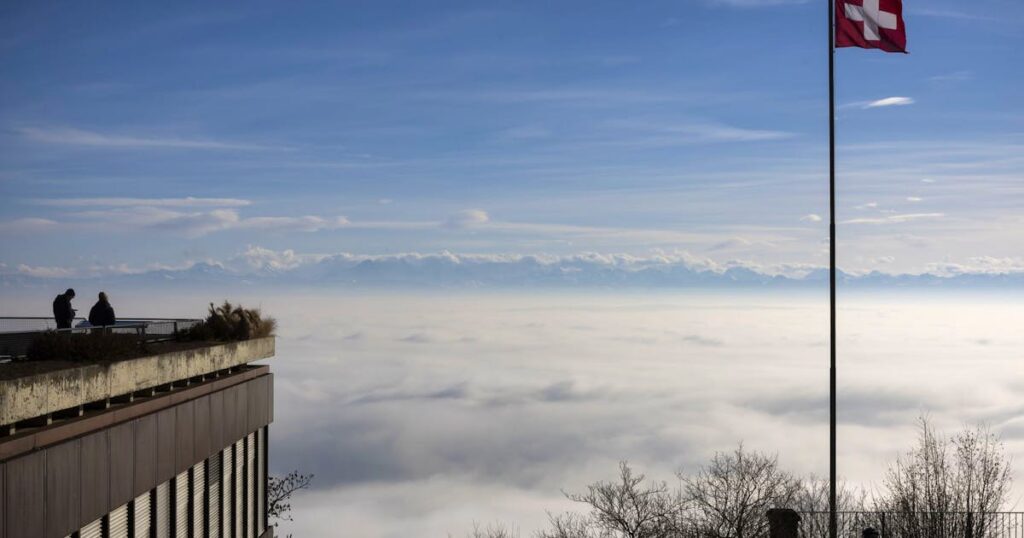
It felt like the lowlands were permanently covered in fog over Christmas: hours of sunshine were few and far between. And yet the statistics show that the number of foggy days in Switzerland is decreasing.
- Persistent high fog: In December, there were places in the lowlands that barely got ten hours of sunshine.
- However, statistics show that the number of foggy days has decreased significantly over the last 30 years.
- There are many reasons for this, but it probably has to do with better air quality and increased overbuilding.
The fog persisted in the Swiss lowlands in December. In some places, there were not even ten hours of sunshine over the entire month.
Over the past thirty years, however, the number of foggy days in Switzerland has decreased, according to data from the Federal Office of Meteorology and Climatology (MeteoSwiss).
At the Zurich-Kloten measurement site, the average from 1971 to 1980 was around 50 foggy days per year. Between 2010 and 2020, there was fog on an average of 38 days.
A foggy day is defined as one in which fog prevailed on one of the three daily observation dates in the morning, midday or evening. Therefore, a day on which the fog clears in the early morning and the sun shines afterwards is also included in the statistics as a foggy day.
Fog soup needs two ingredients
In physical terms, fog is nothing more than a cloud near the ground. It consists of tiny water droplets in the air. These droplets scatter the incident sunlight in all directions. Due to this scattering, the fog appears to observers as a white or gray mass.
For fog to form, water vapor must condense from the air. This requires two ingredients: Firstly, the air must be saturated. This means that the humidity must already be 100 percent so that the air cannot absorb any more water. The excess water in the air then condenses into water droplets.
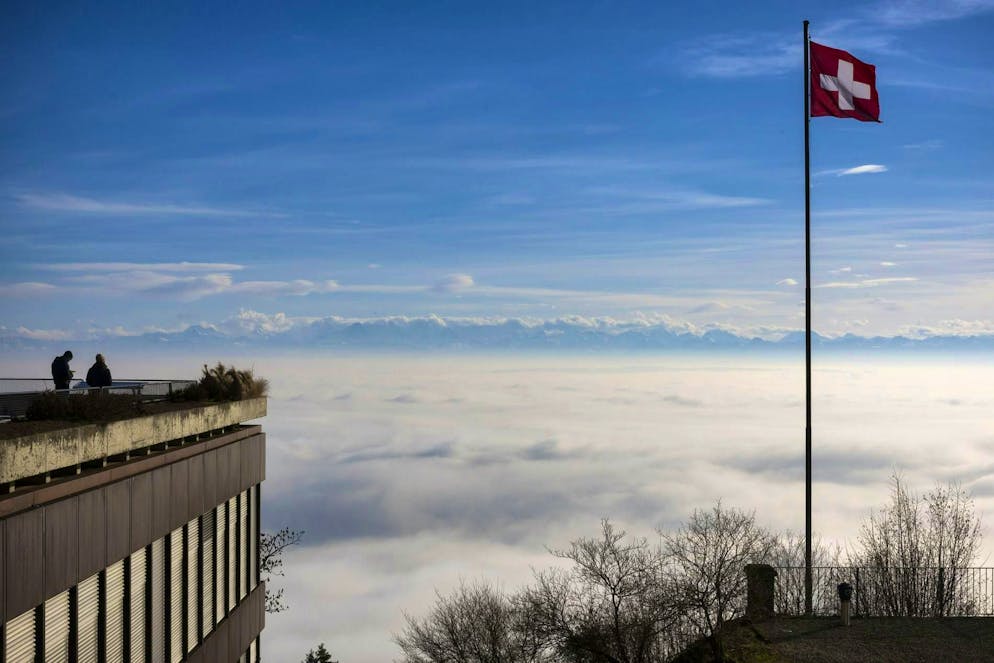
View from Magglingen over the sea of fog to the mountains in the Bernese Oberland on December 21.
KEYSTONE
Secondly, a so-called condensation nucleus is needed. This is a particle in the air on which the water can condense. Pollen, dust, pollutant particles or other small solid particles in the atmosphere can serve as condensation nuclei.
The Central Plateau offers ideal fog conditions
When the air is saturated depends on the temperature. Cold air can absorb significantly less water vapor than warm air. In fall and winter, fog therefore often forms when warm, moist air on the ground cools down during the long nights.
In addition, the wind must not be too strong for fog to form. This is usually the case in high-pressure weather conditions. The moist air must also be able to collect in a kind of basin.
This requirement is particularly well met on the Central Plateau between the Alps and the Jura. Moist air near bodies of water such as lakes and rivers can favor the formation of fog.
According to MeteoSwiss, fog is therefore most common in Switzerland on the Central Plateau along the Aare from Biel eastwards with a “hotspot” in the Aargau moated castle, in the Reuss valley below Lucerne, in the Wigger, Suhre and Wynental valleys in Aargau, in the region around Lake Hallwil and Lake Baldegg, in the Freiamt in Aargau, and between Zurich and St. Gallen in the Limmat and Glatt valleys.
Reason for the decline
But why are there fewer and fewer of them now? Meteorologists see various reasons for this. In a study published in the International Journal of Climatology over ten years ago, researchers from MeteoSwiss demonstrated that fluctuations in the frequency of fog go hand in hand with the frequency of certain weather conditions.
This indicates that the main driver of fog variability is weather conditions. This is also the reason why there can be many foggy days in some years despite a general decrease.
Scientists also cite an improvement in air quality as a reason for the observed decrease in foggy days. Because the air contains fewer pollutant particles such as sulphur oxide, there are fewer condensation nuclei on which the water vapor could condense.
Increasing overbuilding could also play a role in the decline in foggy days. In built-up areas, the air is drier due to the lack of vegetation, which makes it more difficult for fog to form.