
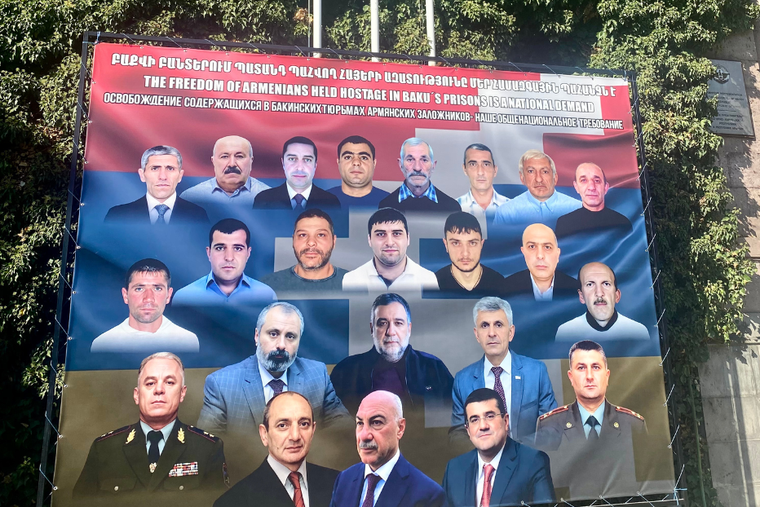
Expressing their ‘deep concern’ for their ‘Armenian Christian brothers’ currently in captivity in Azerbaijan, the authors stated that ‘their faith, and their dignity as human persons, are being crushed.’
Editor’s Note: The Register’s Europe correspondent visited Armenia Sept. 20-26, 2025, with the U.S. advocacy organization, Save Armenia, as part of a delegation working to highlight the existential challenges facing the world’s oldest Christian nation. This series examines how Armenia, still reeling from its recent war with Azerbaijan and caught between regional instability and expansionist pressures, struggles to secure its survival and spiritual heritage.
The Christmas season and the related festivities in the West often tend to overshadow the suffering of persecuted Christians elsewhere in the world. In this context, a coalition of Catholic and Armenian leaders has sought to ensure that the fate of Armenian prisoners held in Azerbaijan is not forgotten. In a direct appeal to Pope Leo XIV, they urged him to use the Holy See’s moral authority — and its diplomatic channels — to press Baku, the capital of Azerbaijan, to release Armenian prisoners still in custody.
The appeal focuses on at least 23 Armenian prisoners of war captured during the September 2023 fall of Nagorno‑Karabakh. These detainees are among roughly 80 Armenians still missing or unaccounted for after Azerbaijan’s military takeover, which forced more than 120,000 Armenians to flee the region known to Armenians as Artsakh.
Signed by some 15 religious figures — among them Cardinal Timothy Dolan, archbishop emeritus of New York; Archbishop Anoushavan Tanielian, prelate of the Eastern Prelacy of the Armenian Apostolic Church of America; and the primate of the Eastern Diocese of the Armenian Church of North America, Bishop Mesrop Parsamyan — alongside Catholic editors and Christian advocacy leaders, the letter, sent ahead of Christmas and read by the Register, calls on the Pope to make a public appeal for the prisoners’ release, arguing that such an intervention would carry unique moral weight. It also frames the prisoners’ detention as a blatant violation of human dignity.
Their Dignity and Faith ‘Are Being Crushed’
Expressing their “deep concern” for their “Armenian Christian brothers” currently in captivity in Azerbaijan, the authors stated that “their faith, and their dignity as human persons, are being crushed.”
They warned that the prisoners’ situation has grown more precarious as communication with families has deteriorated and humanitarian access has significantly narrowed after the Red Cross was expelled from the country last year.
The signatories further argued that the prisoners’ fate is a manifestation of a broader campaign of repression that has followed Azerbaijan’s consolidation of control over Nagorno‑Karabakh. Such a campaign, they contend, includes the systematic destruction of Christian heritage in the region. Churches, monasteries and cemeteries — some dating back more than a millennium — have reportedly been damaged or erased, contributing to what the letter describes as the attempted removal of nearly 2,000 years of Christian civilization from this Caucasus region.
The letter situates its plea within the context of Pope Leo’s recent canonization of St. Ignatius Maloyan, an Armenian Catholic bishop martyred in the early 20th century. While honoring those who gave their lives for the faith, the coalition argued, Christians today are also called to act for those whose lives can still be saved.
Erasure From the International Agenda
The letter’s warning against silence mirrors accounts from the Permanent Mission of the Republic of Artsakh in Yerevan. The central fear is not only displacement, but erasure — given by the sense that the international community is gradually closing the Artsakh file, particularly in light of the current geopolitical context and the war in Ukraine, which has worked to Azerbaijan’s advantage by reshaping diplomatic priorities, energy dependencies and security calculations across Europe.
Representatives of Artsakh operating in exile in Yerevan have repeatedly warned that the prisoners’ plight is a symptom of the broader erasure of Artsakh from the international agenda. “The No. 1 problem for us is being ignored, at all levels,” Artak Beglaryan, a senior representative, stressed during a Sept. 25 private meeting with the Save Armenia organization in Yerevan, attended by the Register.
The release of prisoners, he added, remains the most feasible near-term humanitarian objective — one he described as “low-hanging fruit” because it would show a sign of goodwill without requiring solving the region’s entire geopolitical dispute.
The fate of those detained in Baku is linked to the wider humanitarian fallout of the 2023 offensive: mass displacement, unresolved cases of missing persons and severe socioeconomic pressure on refugees now living in Armenia. According to figures collected on the ground, between 30% and 40% of displaced families live below the poverty line, with limited access to stable employment and housing.
In this context, the prisoners have come to be seen as the most immediate and tangible test of international resolve. Their release would signal that the tragic consequences of the Nagorno‑Karabakh takeover are not yet being taken fully into account.
By invoking Pope Leo’s own words about Armenians “carving the cross into stone as a sign of their firm and enduring faith,” the authors of the Christmas letter sought to translate a strong spiritual symbol into concrete action. Concluding that the plight of Armenian Christians forgotten in Azerbaijani jails “is the suffering suof the entire Body of Christ,” they insisted that the Holy See’s diplomatic relationships — including its channels with Baku — give the Vatican a distinctive capacity to advocate for justice where all political negotiations seem to have stalled.
Whether such an appeal is be delivered publicly or pursued through quiet diplomacy, as it is often the case with Pope Leo, his voice, the coalition believes, can still move the needle — if only by reminding the international community that this is not a closed chapter.