
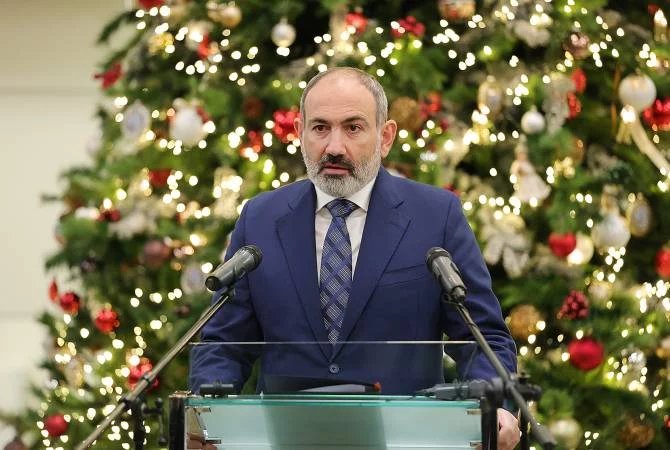
In his New Year address, Pashinyan said Armenia had entered a new phase of stability, noting that there have been no fatal or non-fatal shooting incidents along the Armenian-Azerbaijani border for nearly two years, News.Az reports, citing Armenian media.
“Since 1991, 2025 became the first calendar year in which there were no killed or wounded as a result of shootings with Azerbaijan,” he said. “There have been no casualties on the Armenian-Azerbaijani border since March 2024 — for more than 22 months.”
He attributed this to what he described as the government’s “Real Armenia” ideology, under which the country is redefining its political direction around sovereignty and statehood.
“Our goal was not to change Armenia’s past history, but to shape the future,” Pashinyan said. “Our identity is our state. The state is our identity.”
According to the prime minister, Armenia has repositioned itself internationally as “a fully independent and sovereign state that does not need guardianship,” highlighting a series of high-level meetings with world leaders over the past year, including those of the United States, Russia, China, France, Iran, and Türkiye.
“We achieved this goal,” he said, referring to what he described as progress in strengthening Armenia’s independence and international standing.
Pashinyan also pointed to developments in relations with Azerbaijan, including the restoration of cargo rail transit and emerging bilateral trade, calling the process “a new history — the history of peace.”
He said a key milestone was reached on August 8, 2025, when Armenia and Azerbaijan signed a declaration at a White House summit initiated by US President Donald Trump. He added that the foreign ministers of both countries had also initialed the text of a peace agreement, whose wording had been agreed earlier in March 2025.
“This is the first bilateral signed and ratified document between Armenia and Azerbaijan… which became the cornerstone of peace,” Pashinyan said, adding that it recognizes the territorial integrity and sovereignty of both countries and formalizes border demarcation based on the 1991 Almaty Declaration.
Turning to domestic issues, Pashinyan said Armenia’s economy continued to grow, claiming that “after the 2018 Velvet Revolution, Armenia’s economy has grown by more than 50 percent,” while “in 2025, tax revenues of the state budget are 30 percent higher than all budget revenues of 2017.”
He announced further social and infrastructure initiatives, including the introduction of comprehensive health insurance, expanded school and kindergarten construction, and continued work on the “Academic City” project.
“On any issue, the government has three solutions: first — education, second — education, third — education,” he said.
Looking ahead, Pashinyan said Armenia will host major international events in 2026, including the European Political Community summit and COP17 on biodiversity. He predicted increased investment activity linked to what he described as the “Trump Route for International Peace and Prosperity.”
Concluding his address, Pashinyan said Armenia’s next parliamentary elections would be decisive for the country’s future.
“The elections will be free, fair, democratic, and the people will win, the Republic of Armenia will win, and the future, which is already here, today and now, will win,” he said.