
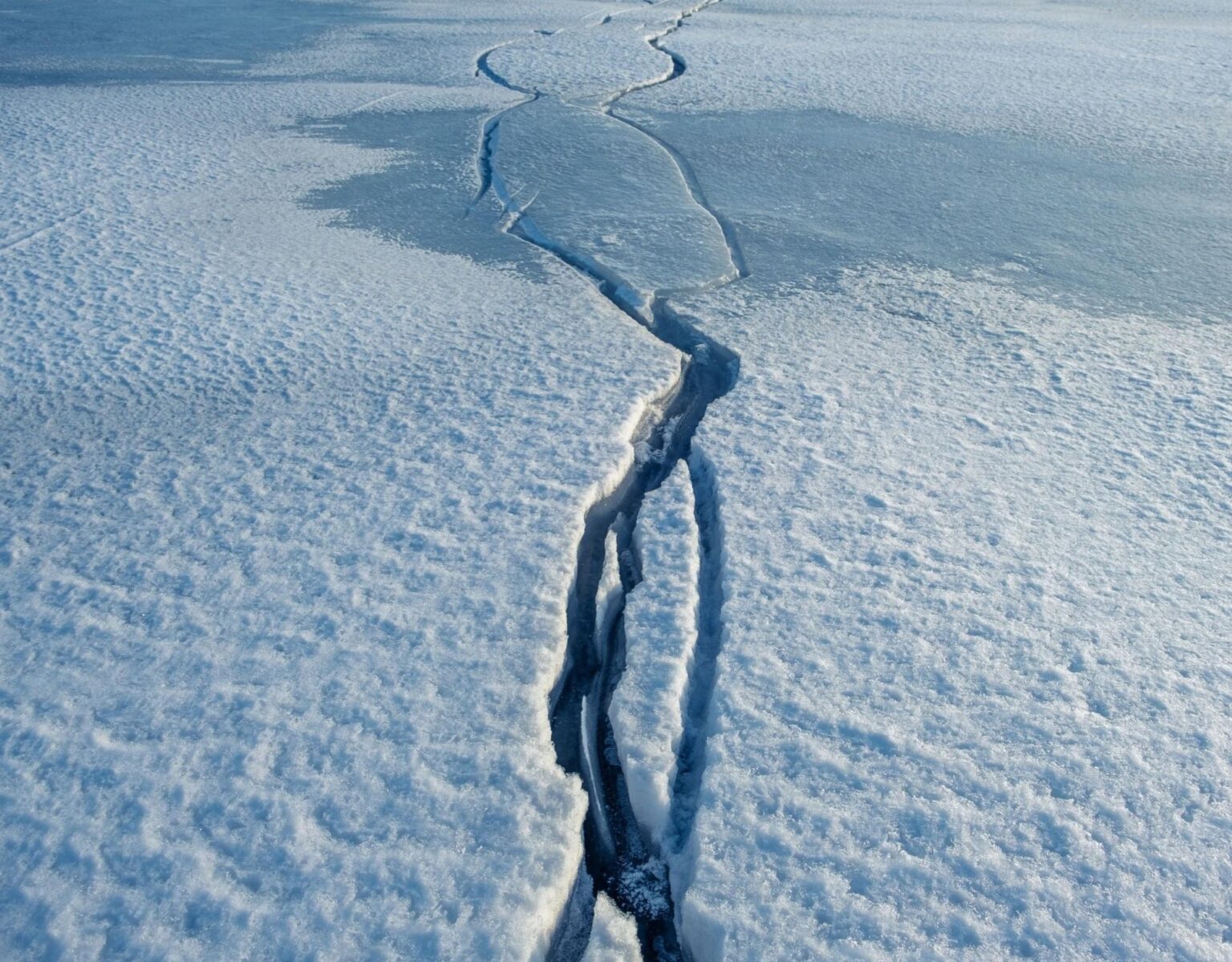
Cracks in Arctic sea ice may look minor, but new research shows they can have major climate effects.
A new study reveals that open water in the ice and pollution from nearby oil fields can interact, triggering chemical reactions and cloud changes that speed up sea ice loss.

During research flights near Alaska’s North Slope, scientists recorded nitrogen dioxide levels of 60-70 parts per billion, nearing U.S. health limits in a region often seen as pristine.
The measurements were collected from February to April 2022 during the CHACHA campaign, which flew two aircraft over the Beaufort and Chukchi Seas.
Led by Dr. Jose Fuentes of Pennsylvania State University, the study explores how ice, clouds, and pollution combine during the Arctic spring, when small shifts can quickly amplify warming.
Fog rises from Arctic ice cracks
Springtime leads – long cracks of open water between sea ice that can stretch from a few feet to several miles wide – release heat and water vapor into the Arctic air.
That warmer, moist air rises into colder layers above, where cloud droplets can form. These openings played a central role in the CHACHA observations, which linked sea-ice leads, pollution, and faster sea ice loss.
One of the first cloud types the aircraft encountered was sea smoke, fog-like plumes that rise from evaporation over open leads.
When extremely cold, dry air flows across warmer water, evaporation quickly saturates the air, causing water vapor to condense into droplets.
These low clouds can brighten the surface by reflecting sunlight, while also slowing heat loss from the ocean on calm days.
Heat moves through open water
The boundary layer, the lowest air directly shaped by the surface, stayed stable over ice but turned turbulent over leads.
Over open water, the convective boundary layer reached 820-2,790 feet (250-850 meters), with updrafts and downdrafts reshaping moisture profiles.
Warm plumes from leads raised nearby air temperatures by about 18°F (10°C), a change that can encourage more cracking.
Ice cracks feed clouds
Sea-spray aerosols, tiny particles or droplets that float in the air, rose from leads and mixed into low clouds.
As plumes climbed hundreds of feet, they carried water vapor and reactive chemicals upward, giving clouds more material to grow.
More cloud seeds can change how clouds reflect light and hold heat, so even small plumes can matter regionally.
Spring sun sparks reactions
Sunlight activates halogens, reactive elements including bromine, chlorine, and iodine, within Arctic air that sits close to snow and ice.
In early spring sunlight, halogen molecules split and form fast-reacting atoms, and those atoms rapidly start new chemical chains.
“This field campaign is an unprecedented opportunity to explore chemical changes in the boundary layer,” said Dr. Fuentes.
Salty snow drives ozone loss
Along Arctic coastlines, saline snowpacks – snow layered with sea salt – released bromine gases when oil-field emissions mixed into cold air.
Once airborne, bromine atoms reacted with ozone and broke it apart, allowing more sunlight to reach the snow and thinning sea ice. The added sunlight warmed the surface, which in turn drove even more bromine release during clear spring conditions.
Measurements near Utqiaġvik captured the effects close to the ground. Monitors recorded ozone depletion events, sharp drops in near-surface ozone, during spring flights.
Air profiles showed reactive bromine strongest near the surface, fading within the lowest 1,000 feet (300 meters), where depleted layers formed.
These low-ozone periods shift the balance of oxidants, meaning pollution can age and spread differently in the Arctic than it does at lower latitudes.
Pollution pools over Arctic ice
Near the Prudhoe Bay oil and gas fields, industrial plumes altered nitrogen oxides (NOx), gases that drive smog chemistry.
Emissions from extraction reacted in the lower atmosphere, increasing acidity and forming NOx-rich smog that can irritate lungs and dull Arctic skies.
In unusually stable polar air, these plumes can linger close to the surface, reshaping chemical pathways well beyond the facilities themselves.
That chemistry does not stay put. Halogen reactions inside mixed plumes produced free radicals, short-lived molecules that react rapidly above the oil fields.
Some of those radicals transformed into more stable compounds, which winds then carried along with NOx downwind across the Arctic.
This long-range transport shows that pollution chemistry is not confined to oil pads, even when emissions begin at a single location.
Feedback loops speed warming
Interactions between sea-ice leads and oil-field pollution formed a feedback loop, where one change sets off the next.
Open water and altered chemistry shaped cloud cover and sunlight, influencing surface heating and helping open even more water.
This loop peaks during spring breakup, then weakens when winds disperse pollution plumes or when sea ice remains solid.
These findings highlight why models need to capture local chemistry more accurately. Climate models often smooth over small-scale ice cracks and narrow pollution plumes, which can cause key Arctic chemical processes to be underrepresented.
Improved parameterizations – simplified rules that represent complex processes – can draw on campaign measurements of clouds and gases.
As those rules improve, projections of sea ice loss and regional warming become more reliable for planners and Arctic residents.
Linking clouds, ice, and pollution
Arctic warming has surged far ahead of global averages in recent decades, making future trends harder to predict with confidence.
The campaign’s detailed vertical profiles give modelers a rare chance to test when clouds thicken, when atmospheric chemistry flips, and how pollution plumes spread through the polar air.
With stronger inputs like these, forecasts of Arctic sea ice, air quality, and local climate impacts can better guide shipping routes, infrastructure planning, and community decisions.
At the same time, the findings reveal important limits and next steps. Ice cracks, coastal snow chemistry, and industrial plumes can interact in feedback loops that accelerate warming in ways models are only beginning to capture.
Repeating these measurements across seasons and in other Arctic regions will help researchers determine how widespread these processes are and where they matter most.
The study is published in the journal Bulletin of the American Meteorological Society.
—–
Like what you read? Subscribe to our newsletter for engaging articles, exclusive content, and the latest updates.
Check us out on EarthSnap, a free app brought to you by Eric Ralls and Earth.com.
—–