
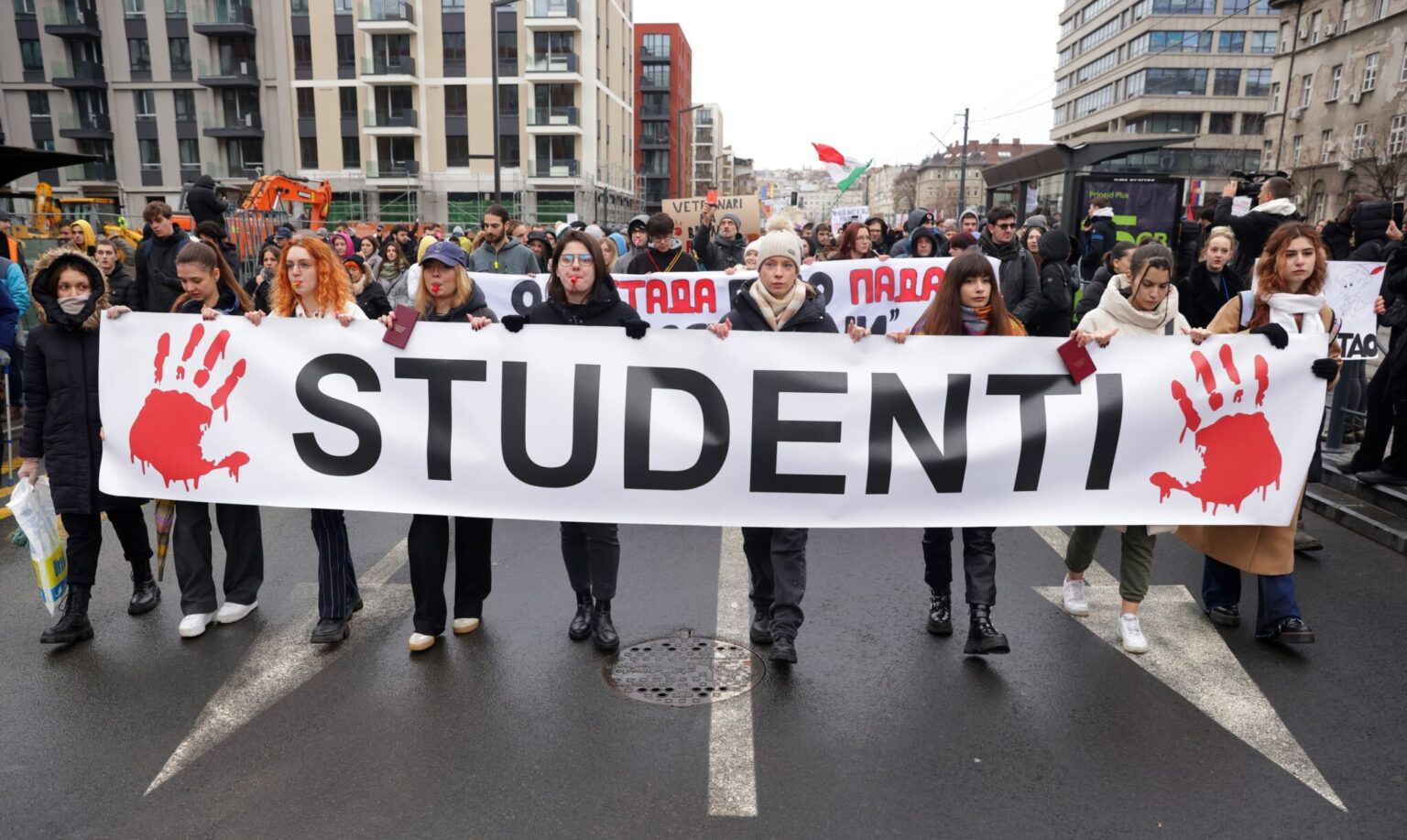
More than a year has passed since the collapse of the canopy at the Novi Sad railway station on November 1, 2024, killing 16 people.
For many, the tragedy epitomised the corner-cutting, graft and ineptitude of public institutions in Serbia after more than 13 years of rule by the SNS and Aleksandar Vucic, currently Serbia’s president.
Protests were held, but the momentum only began to build when students occupied their faculty buildings and took to the streets, demanding transparency and accountability. When they didn’t come, they began calling for a change of government.
From the start, the students spurned any hierarchy, rotating media duties, taking decisions by plenum, and eschewing any affiliation with Serbia’s largely discredited opposition parties. But in January, they also distanced themselves from the civil society sector, saying no NGO representative had the right to speak in their name.
“We clearly and unequivocally distance ourselves from all activist groups and NGOs and their activities,” protesting students from the Faculty of Law at the University of Belgrade said in an Instagram post on behalf of the student movement.
This was a big decision.
Some in Serbian civil society have decades of experience in promoting democracy, good governance, rule of law, media freedom and human rights, dating to the 1990s when Yugoslavia was unravelling in war, and power in Serbia was concentrated in the hands of Slobodan Milosevic.
They were largely funded by money from the West, however, and still today many NGOs rely on grants from European states or foundations dedicated to promoting Western liberal values. Not all young people in Serbia share such values, or trust that such donors have Serbia’s best interests at heart. The SNS and Vucic have fuelled such misgivings by portraying NGOs as fronts for Western interests.
“The civil sector, like the opposition during the 1990s, was criticised as traitorous and subordinated to the West,” said Dusan Spasojevic, professor of Political Sociology at the Faculty of Political Sciences, where Pongracic is a student.
“Serbian nationalists… rejected all issues related to human rights and democracy as ‘non-Serbian’, ‘imported’, and ‘imposed’, and this narrative was preserved even after the fall of Milosevic.”
After Milosevic fell in 2000, those who came to replace him were reluctant to get to grips with issues such as war crimes or minority rights, and so left civil society to deal with them.
“Simply put, the set of issues addressed by civil society was perceived as ideological (and therefore open to criticism), rather than as a matter of democratic standards, in which case attacking non-governmental organisations would have been much more difficult,” Spasojevic told BIRN.
Today, he said, some students see little real difference between civil society and political parties.
What he described as an “anti-politics” narrative has spread throughout Serbian society, he said, “and shapes the attitudes of many generations, including those who are not voters of the ruling parties”.
“Students feel a strong distrust toward all forms of political organising, including distrust toward their own organisational structures, and at the same time they do not see any important difference between civil society organisations and political parties.”
Pongracic said: “The long-term campaign by the authorities and pro-government media, in which civil society organisations are labeled as ‘foreign mercenaries’, ‘traitors’, or ‘an extended arm of the West’, has left a deep mark on society.”
‘Unacceptable interference’
Ana, a student at Belgrade’s Faculty of Agriculture and an active participant in the protest movement, cited practical reasons for the students’ decision to distance themselves from civil society.
It began, she said, when “students from certain NGOs subordinated their activities to the narrowly defined interests and ideological direction of the organisations they belong to”.
This was not in accordance with the students’ practice of taking decisions in plenums, said Ana, who spoke on condition that her surname not be published.
As an example of “unacceptable interference”, Ana cited the appearance of NGO activists at public events who claim to speak on behalf of the student movement, but denied the civil sector is “stigmatised” within the movement or that its members are prohibited from taking part in plenums or working groups.
She also stressed that the students “have not distanced themselves from the NGO sector” itself, but “only from the so-called GONGO [Government-Organised Non-Governmental Organisation] sector”, in reference to groups portraying themselves as grassroots activists but which in fact take direction and funding from the authorities.
This would appear to contradict the original student announcement from January, and may point to what some say is a symptom of the movement’s rejection of hierarchy – a lack of coherence in public messaging. Others say it is simply inevitable in what aims to be a broad, inclusive movement in which differences of opinion are welcome.
Sofija Todorovic, director of the Youth Initiative for Human Rights, said the government had demonised the NGO sector, but argued that this was not the only issue.
“Of course, the demonisation by the government and the authorities contributed to this, but beyond that I think there is also a great deal of ignorance present within one part of the student movement,” Todorovic told BIRN.
“That lack of knowledge can often stand in our way and actually become an obstacle to achieving certain objectives,” she said. “I therefore believe that there is a significant lack of knowledge and understanding within one part of the student movement.”
She stressed, nevertheless, that some in the student movement remain in contact with civil society groups and are “well-informed about the work of the civil sector”.
Spasojevic also questioned the level of awareness within the movement about the achievements of civil society.
“The fact that students have remained silent in response to attacks by the authorities on civil society also shows that they do not understand that many freedoms and many resources in their struggle exist because of the long-term work of civil society,” he said.
Civil society is not the only sector to be given the cold-shoulder by the students. “From the very beginning we see asymmetric distancing from liberal, civic and pro-European actors, while distancing from other ideological positions is very rare,” Spasojevic noted.
EU flags have been noticeably absent from student protests, but Russian flags have been seen, as have ‘No surrender’ banners alluding to the independence of Serbia’s former southern province, Kosovo.
“Viewed in a broader context, the distancing almost always targeted pro-EU forces, and this also reflects a strengthening of the anti-political narrative, as NGOs and activists from this value-based sphere are most frequently attacked, while activists from right-wing, nationalist and anti-system actors are not perceived as part of politics, even when they have formally participated in elections,” said Spasojevic.
Calls for a broad front