
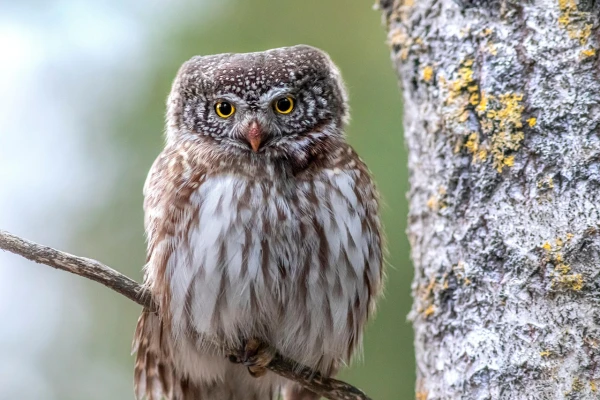

The Eurasian Pygmy Owl has been declared the Bird of the Year 2026 — the smallest owl in Latvia
Although the population of the Eurasian pygmy owl remains stable across Europe, and even increases in some countries, the monitoring of raptors conducted by the Latvian Ornithological Society (LOS) indicates a decline in this species. Over the past 20 years, the number of pygmy owls in Latvia has decreased by 45%, leading to its recognition as endangered at the national level and its inclusion in the Red Book of Latvia.
As noted by the chairman of the LOS, Viesturs Kers, the Eurasian pygmy owl finds itself in a difficult situation: in the long term, it, like many northern species, may be affected by climate change, but currently, the main threat is the loss and degradation of habitat — particularly the logging of old forests, which, according to him, is sometimes unjustifiably justified by the desire to mitigate the effects of climate change.
The Eurasian pygmy owl, which has a body length of 16–17 cm and a wingspan of about 35 cm, inhabits mixed and coniferous forests. The spruce is especially important for it, creating shady areas suitable for shelter and hunting. Owl nests are most often found in aspen hollows. The most favorable habitat for it consists of old, continuous forest areas. Additionally, this species is sensitive to disturbance during the nesting period, the LOS emphasizes.
In Latvia, the creation of micro-reserves for the protection of the Eurasian pygmy owl is allowed; however, according to the LOS, most of its habitats currently lack adequate protection.
The organization also points out that the maximum allowable area for a micro-reserve — 10 hectares — is insufficient even to protect the nesting territory of a single pair. Nevertheless, even such small areas play an important role in preserving old-growth forests.
Considering the specific habitat requirements of the species and the weak protection of such biotopes, the LOS identifies the existing forestry practices — the logging of old forests, their fragmentation through clear-cutting, and logging during the nesting season — as the main threat to the Eurasian pygmy owl, which not only disturbs the birds but also destroys their nests.
Therefore, in 2026, the organization will focus on the protection of the Eurasian pygmy owl and other species associated with old forests — both through initiatives to improve legislation and regulation in forestry and through proposals for the protection of specific, particularly valuable natural areas.
The Eurasian pygmy owl is a resident species; however, outside the breeding season, it may move beyond its territory and even venture outside the forest. Since its preferred prey is small birds, it can sometimes be seen at bird feeders. If you are lucky enough to encounter a Eurasian pygmy owl in the wild, the LOS encourages you to register your observation on the Dabasdati.lv portal.
In the near future, the society will announce a drawing competition dedicated to the Bird of the Year 2026.
The “Bird of the Year” campaign, initiated by the LOS in 1996, is now being held for the 31st time.