
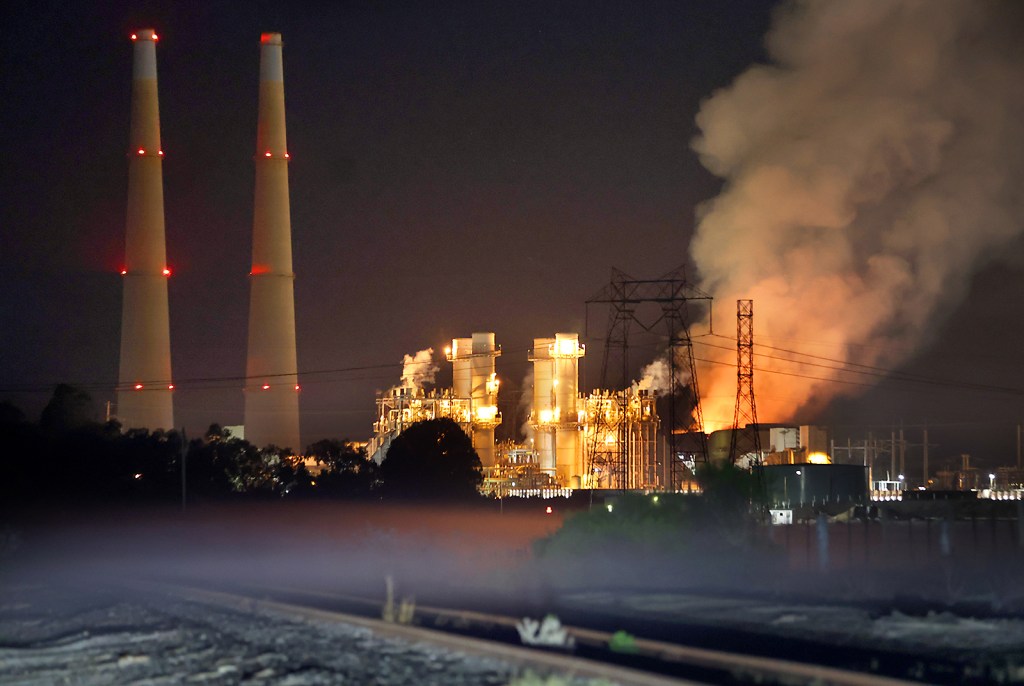
Santa Cruz County residents have been on edge since January’s battery fire in Moss Landing prompted uncertainty about the safety of battery energy storage systems.
On Jan. 16, a battery energy storage system run by Texas-based energy company Vistra in Moss Landing caught fire. In the aftermath, many Santa Cruz County residents spoke out in opposition to battery energy storage systems, particularly one proposed facility on Minto Road, outside Watsonville.
Additionally, Santa Cruz and Monterey County residents were left with questions about how the fire affected human health and the environment around the Vistra facility, which includes agricultural fields and protected areas. Many were concerned that toxic metals or other chemicals could have penetrated the soil or water, or that breathing in the fire’s fumes could have adverse effects. Though most test results in the months after the fire came up relatively clean, earlier this month, a study from San Jose State University revealed that the fire released around 55,000 pounds of metals over the surrounding area.
Now, the Santa Cruz County Board of Supervisors is set to review a draft battery energy storage ordinance in January. The ordinance includes parameters beyond those in state Sen. John Laird’s Senate Bill 283, which was signed into state law earlier this year. If the ordinance is reviewed in time, New Leaf Energy, the developers of the proposed Minto Road facility, plans to design its system according to the local ordinance, rather than taking the so-called “state route.”
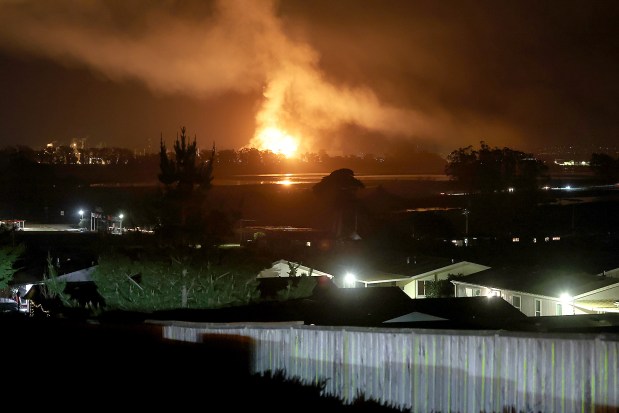 Fire blazed on January 16 at the Vistra power plant’s battery storage facility in Moss Landing in northern Monterey County. Highway 1 was closed and evacuations were ordered in Moss Landing and the Elkhorn Slough area. (Shmuel Thaler – Santa Cruz Sentinel)
Immediate aftermath
The fire at Vistra’s Moss Landing facility broke out in January and burned for two days, forcing the closure of Highway 1 and the evacuation of 1,200 people. The fire burned around 55% of the 100,000 battery modules that made up what was, at the time, the world’s largest battery energy storage system. The disaster drew international attention and raised countless questions about how to better safeguard the technology. Many nearby residents filed lawsuits against Vistra. The suits alleged that the batteries’ materials were prone to thermal runaway and that the building’s fire suppression system was insufficient.
Aside from the fierce debate over battery storage, many residents of Monterey and Santa Cruz counties became concerned that the fire may have released harmful metals or other chemicals into the air and the surrounding environment. Groups, including Never Again Moss Landing, formed, discussing the health symptoms they felt during and after the fire. A survey by Monterey County found that 83% of respondents experienced symptoms after the fire, including headache, sore throat and cough.
Agencies including the Monterey County Health Bureau, the Environmental Protection Agency, the California Department of Toxic Substances Control and Santa Cruz County Environmental Health conducted environmental testing in the areas surrounding the fire to understand whether metals had made their way into the environment. The results are available on Monterey County’s emergency, readiness, response and recovery website. In Santa Cruz County, environmental metal levels were much lower than in the areas closer to the Vistra plant, Santa Cruz County reported in February.
Shortly after the fire, a researcher from San Jose State University’s Moss Landing Marine Laboratory, Ivano Aiello, reported that he had detected high concentrations of nickel, manganese and cobalt in marsh soils at Elkhorn Slough Reserve. In December, a study by Aiello found that the fire dumped 55,000 pounds of metals over the surrounding environment.
“All fires are bad,” said Jason Hoppin, Santa Cruz County’s public information officer. “It’s no surprise that underneath the fire and right next to the fire, he found the stuff that was in the fire.”
Hoppin noted that all fires can release chemicals, smoke and ash that can be harmful to the environment and human health. He also said that Aiello’s study didn’t suggest that the metal “dust” penetrated deeply into the soil or water. In fact, only a month after the fire, concentrations of nickel, manganese and cobalt had already fallen significantly, according to the study. Testing conducted by other agencies in the weeks and months after the disaster haven’t revealed anything that poses an obvious threat to the environment or to human health.
Finally, Hoppin said that a facility like Vistra’s in Moss Landing “could not be built today and would not be built today.” The system’s setup, as well as the chemistry of its batteries, was out of date, and new facilities will need to have different fire suppression systems in place.
Battery storage projects persist
After the substantial public outcry following the Moss Landing fire, some Santa Cruz County residents began to voice opposition to the construction of any new battery energy storage systems. A proposed facility at 90 Minto Road, outside Watsonville, has been at the center of the debate.
Despite public opposition to the project, experts and county officials maintained that increasing California’s battery storage capacity is essential to meet the state’s clean energy goals. Battery energy storage systems, like the one proposed at Minto Road, store energy created by renewable sources such as wind or solar to be used later. The technology allows renewable energy to be used at a larger scale.
“The question, I think, that we have to deal with is, what do we want to do with our green energy future?” Hoppin said.
The proposed Minto Road project, known as the Seahawk Energy Project, is being developed by New Leaf Energy. The facility has several characteristics that make it different from Vistra’s Moss Landing facility. The Vistra facility consisted of 100,000 battery modules all clustered together inside of a structure. Fire suppression consisted mostly of overhead sprinklers.
The Minto Road facility will consist of 200 individual containers, each containing 40 batteries. Each container will have its own heat monitoring and fire suppression systems. Even if one group of batteries does ignite, the fire is less likely to spread to adjacent containers.
Hoppin emphasized the differences between the Vistra facility and the New Leaf project, calling the two “apples and oranges.”
Now, the Santa Cruz County Board of Supervisors is set to review a draft ordinance outlining regulations for battery storage. The ordinance began development in August 2024, years after New Leaf approached the county with its proposal. However, after the fire and the heated debate across the community, the board’s review of the ordinance was repeatedly delayed, and the regulations themselves were amended.
Since the Moss Landing fire, state law around battery storage has been updated. A bill penned by Laird was signed by Gov. Gavin Newsom in October. But Santa Cruz County’s draft ordinance has some additional restrictions that would give the county more control over future facilities. The guidelines include 1,000-foot setbacks from schools and residential care facilities, restricted use of nickel manganese cobalt battery chemistry, continuous monitoring and alarms and more.
The board hopes to bring the draft ordinance back at its next meeting in January. New Leaf has stated that if the review is delayed past then, the company may have to go forward with planning in accordance with state law, rather than the county ordinance.
Hoppin is hopeful that the ordinance will be reviewed in January, as scheduled, allowing New Leaf to maintain its development timeline. Once the draft ordinance is approved, there will still be a long road to construction of the Minto Road facility. Construction is slated to begin in 2028, after more planning, including environmental reviews, has been completed. Before the facility begins its operations, New Leaf also plans to do extensive testing of its safety systems.