
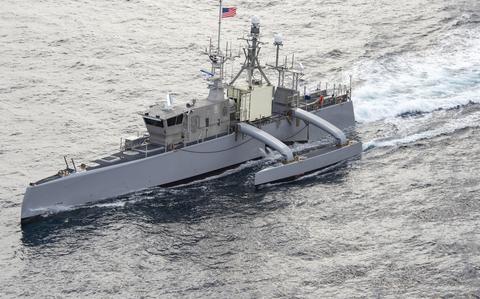
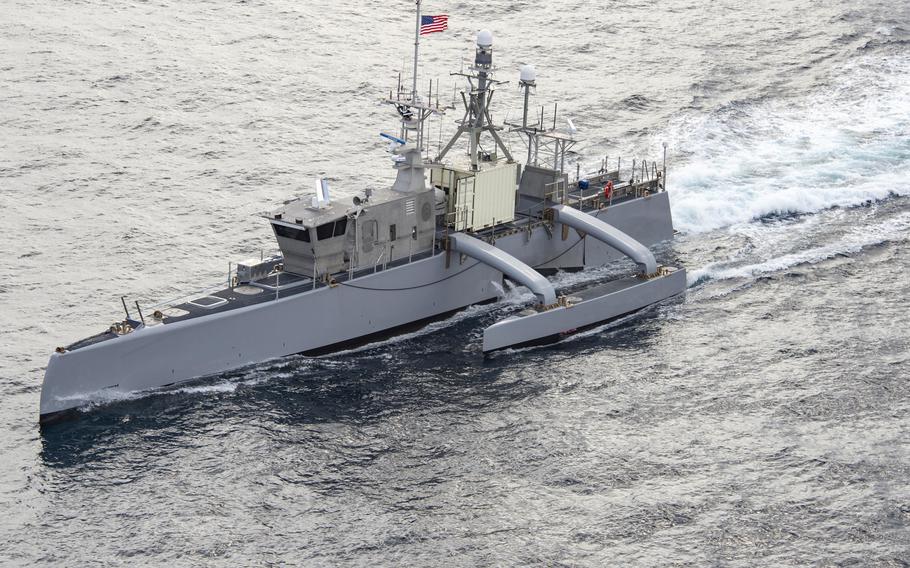
A U.S. Navy sea drone transits the Pacific Ocean on June 22, 2022. A new report urges NATO to develop unmanned systems for use in the air, on the ground and in the sea to monitor Russian military activity in the High North. (Tyler Fraser/U.S. Navy)
NATO should build a fleet of polar-hardened drones to keep closer tabs on Russian submarines and military maneuvers in the Arctic, says a recent report that calls for a strategy of “deterrence by detection” in the region.
A wide range of aerial, ground-based and undersea unmanned systems is urgently needed to give allies an edge in the hotly contested High North, the Center for European Policy Analysis said.
To deter Russian aggression, NATO must be able to identify threats as they are gathering, the authors of the Dec. 16 report said.
“This means being able to track Russian submarine patrols leaving the Kola Peninsula, monitor aircraft flights across the Barents and Bering Seas, identify changes in Russia’s Arctic force posture and infrastructure, and detect potential surface and subsurface threats to critical infrastructure,” the report said.
Over the past decade, Russia has steadily been strengthening its position in the Arctic, adding military capabilities and expanding bases. China also has its eye on the region after declaring itself a “near-Arctic” state in 2018.
The melting of sea ice has opened the possibility for new sea routes, increased commercial activity and, with it, more military competition.
The United States and other NATO members also have stepped up in the region, with more drills focused on challenges related to operating in polar conditions.
U.S. naval deployments in the Arctic aimed at boosting situational awareness and deterring potential Russian aggression also have increased. Still, gaps persist, according to CEPA.
“To begin with, NATO doesn’t have a formal Arctic strategy,” the report said. “While this is a sensitive policy matter, the lack of a dedicated strategic framework for the region risks diluting resourcing and cooperation between regional allies on various levels.”
Procurement of Arctic-capable drones across NATO remains “fragmented, slow, and risk-averse,” the report said.
Most allies also treat Arctic-specific drone requirements as secondary modifications rather than purpose-built characteristics, which means limited numbers of reliable Arctic-ready drones, according to the think tank.
NATO should accelerate procurement of systems that consider the technical requirements for operating in the Arctic, the authors urged.
In addition, the alliance ought to establish new drone units with specialized training, which would free up manned aircraft and ships for other tasks, according to the report.
“The next decade is a decisive window of opportunity,” the report stated, adding that those fastest to adapt to the challenges of the harsh High North terrain “will shape a future Arctic security architecture capable of deterring and defeating emerging threats.”