
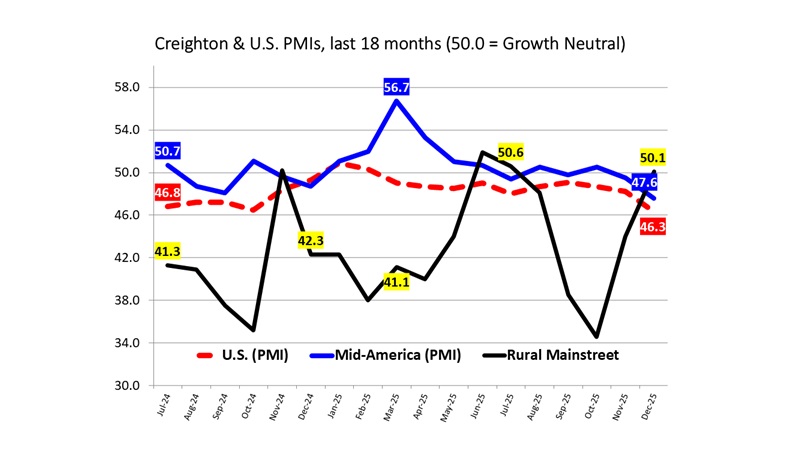
The Creighton Mid-America Business Conditions Index sank to 47.6 this past December, the lowest level of 2025 as the regional manufacturing sector shed jobs for the 9th straight month.
In his final Mid-America Business Conditions Index survey of 2025, Creighton University Economics Professor Ernie Goss, PhD, recapped the year, saying it ended with a strong Gross Domestic Product (GPD) but a weak labor market.
He also described the economy as being K-shaped, saying “We’re talking about a K-shaped economy (that) continued. Think of the capital K — the upper end, or slope, represents those doing well. It is driven by asset prices: stock market prices, bond markets, investments, housing and so on. The bottom half is not doing well. I shouldn’t say half — it’s 80%. I’ll call it the 80/20. The 20% is doing pretty well, that’s the upper part of the K-shaped economy, the 80%, the down part, not so well.”
Tariffs continue to impact manufacturers with smaller firms and rural areas being more negatively impacted than larger firms and urban areas. 25 percent of survey participants said that tariffs are pushing up prices more than 15 percent. 37.5 percent do not support the Trump tariffs. “What we’re seeing is increasing resistance to the tariffs of the Trump administration,” Goss said.
Hiring remains a struggle in the Mid-America economy. December was the ninth straight month the hiring index was below growth neutral. Goss said many companies are currently not hiring or firing employees. “We asked what about survey participants expect in terms of wages. The average wage expected when they come up for evaluation is 3% going forward, a 3% pay raise. If you look at inflation, that’s about the same. In other words, net, you’re talking about no raise. That’s the bottom part of that K-shaped economy.”
Goss noted the country is seeing the lowest inflation reading since December 2024, before tariffs began, but since that number remains above the Federal Reserve’s target, he anticipates a reduction in interest rates this month. “Jay Powell indicated he and the Federal Open Market Committee, they set interest rates, stand ready to bailout anything and everything. Since 2008, that’s where the Fed has been. What that means is higher inflationary pressures.”
In the new year, Goss expects the economy to move slightly up to sideways in the first six months of 2026, followed by a rebound.