
Show summary Hide summary
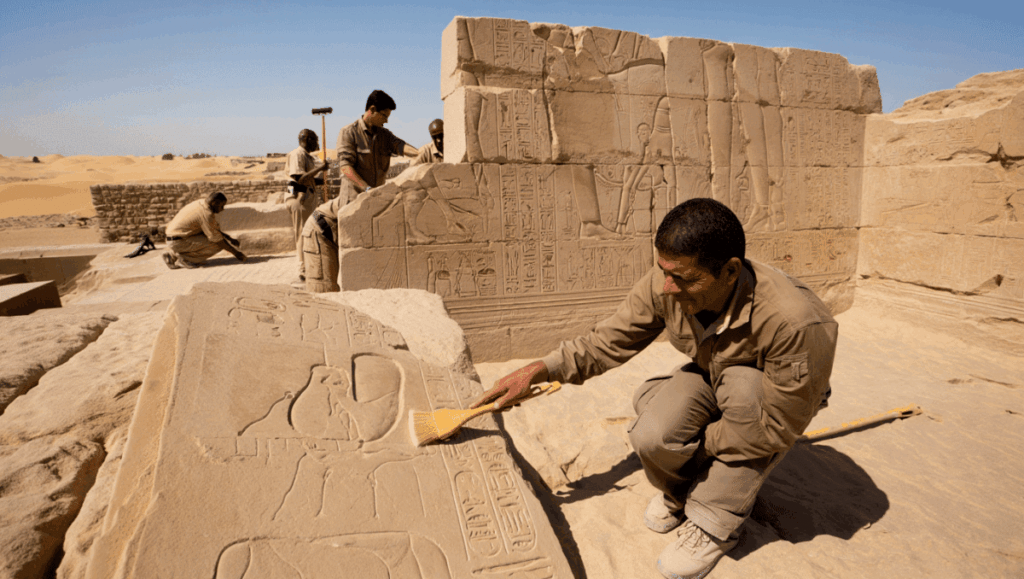
Archaeologists working in the Abusir necropolis have begun revealing what appears to be a rare temple dedicated to sun worship, a structure that lay hidden beneath Nile silt for millennia. The discovery, now attributed to a ruler of Egypt’s Fifth Dynasty, offers a fresh window into royal religious practices from roughly 4,500 years ago.
The newly exposed complex is being slowly brought to light by an Italian‑Egyptian team, and early results suggest the building is one of only a handful of definitively identified sun temples from ancient Egypt. Initial work has already uncovered architectural features and everyday objects that hint at how the site was used and how its role changed over time.
What the excavation revealed: architecture, artifacts, and ancient pathways
Excavators from the universities of Turin and Naples — led by Massimiliano Nuzzolo and Rossana Perilli — have cleared away layers of Nile-deposited silt to expose about half of the site’s footprint, estimating the exposed area at roughly 1,000 square meters. Their work revealed the temple’s original entrance buried under nearly a meter of alluvial sediment, along with sections of the ancient floor and structural remains.
- Foundations and supports: limestone pillar bases that once carried a portico, and several granite doorframes still set in their original alignments.
- Circulation features: a sloping ramp likely providing access to the river or an ancient branch of the Nile, and traces of an internal staircase that led up to the roof.
- Everyday objects: a wooden board and game pieces used for Senet, an ancient pastime, and pottery ranging across multiple periods.
These elements together suggest a building that combined formal ritual space with practical connections to river traffic and daily life, and they give archaeologists concrete clues about how the temple was laid out and used.
Link to a famous king: Nyuserre and the Fifth Dynasty context
Scholars link the temple to the reign of King Nyuserre, traditionally counted as the sixth ruler of the Fifth Dynasty. Estimates of his reign vary between about 24 and 36 years, but most agree he ruled roughly 4,500 years ago during a period when solar worship became a central royal concern.
Why a sun temple matters
Structures dedicated to the sun god were distinct from ordinary temples and often formed part of a king’s broader funerary and cultic landscape. If confirmed, this temple strengthens our understanding of how Fifth Dynasty kings promoted the sun cult and integrated it with temple building around their pyramid complexes.
History of discovery: from early reports to a modern dig
The site in Abusir was first noted more than a century ago by German Egyptologist Ludwig Borchardt, who observed traces of a sun temple in 1901. At that time, high groundwater and Nile inundation made any serious excavation impossible, so the find remained unexcavated and largely unstudied for generations.
Modern techniques and a renewed field season have allowed archaeologists to finally tackle the challenging waterlogged deposits. Mohamed Ismail Khaled, Secretary‑General of Egypt’s Supreme Council of Antiquities, described the project as a major step forward in Fifth Dynasty research, underscoring the importance of the discovery for both national heritage and international scholarship.
Artifacts paint a picture of changing use through time
Material culture pulled from the site shows the temple did not remain static. Pottery from different eras indicates the complex eventually lost its exclusively religious function and was repurposed as habitation during later periods, particularly the Intermediate Period.
- Ritual evidence: architectural layout and orientation consistent with other royal solar complexes.
- Domestic reuse: ceramics and small finds that point to everyday living in spaces once reserved for cultic activity.
- Leisure items: the Senet board and pieces suggest the presence of social or ritualized gaming.
These stratified finds allow archaeologists to trace a lifecycle for the temple — from sacred place to reused occupation site — revealing cultural shifts over centuries.
Next steps: continued digging and research plans
Field teams plan additional excavation seasons to extend the exposed areas, determine the full northern reach of the complex, and better understand the temple’s original religious functions. Early reports note that the site’s orientation and layout may align with other Fifth Dynasty royal structures, such as the valley temples associated with kings who preceded Nyuserre.
As investigators open more rooms and clear deeper deposits, they expect to recover further architectural details and small finds that will refine interpretations of how the temple fit into the wider landscape of Old Kingdom Egypt.
You might also like:

Michael Thompson is an experienced journalist covering U.S. and global news. With ten years on the front lines, he breaks down political and economic stories that matter. His precise writing and keen attention to detail help you grasp the real‑world impact of every event.
★★★★★
Be the first to rate this post
or leave a detailed review