

New, high-tech methods might be an option for yield grading beef, a change that companies like Agri-Beef say will provide greater consistency while reducing the need for human labor.
Dan Genho, Director of Quality and Continuous Improvement for Agri-Beef, advocated for a new beef yield grading system that pays producers for “Red Meat Yield” (RMY) instead of hanging weight on the rail. RMY would use computer technology like CT scans, 3D cameras and Artificial Intelligence (AI) to determine component values of muscle subprimals, trim fat, and bone to determine overall carcass worth.
“If we make changes like paying on Red Meat Yield, we can pay the producer based on that metric and the seedstock guy can start making those changes,” he said at the recent Montana Stock Growers’ Association convention. “With RMY, producers would be paid commensurate with performance, therefore allowing them to control their payout via their genetics.”
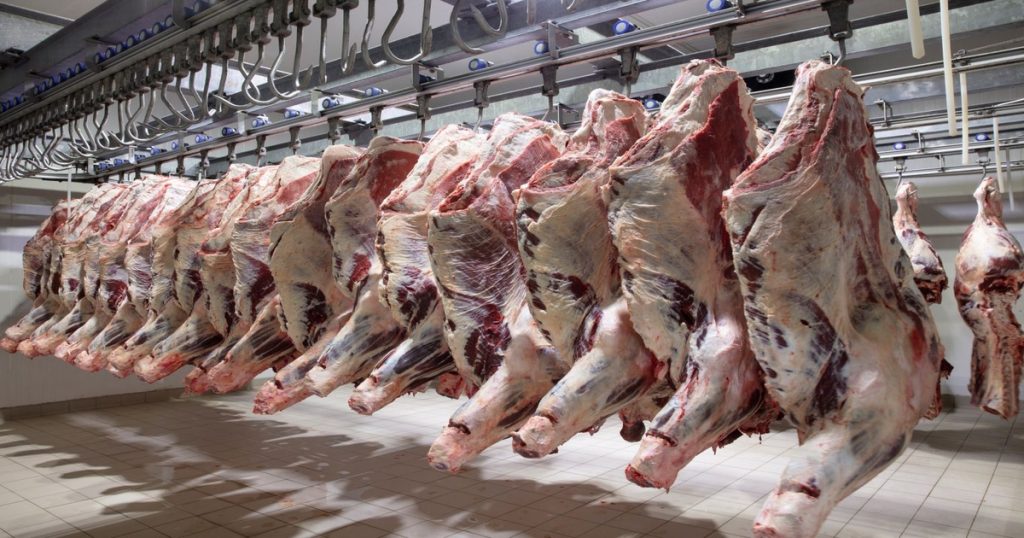 Beef packers like Agri Beef say they want an updated tech-focused beef yield grading system that would pay producers based on “Red Meat Yield” and remove human USDA graders from the assessment process.beef-carcass
Producers who choose to sell to packers on the rail are currently paid on hanging weight plus incentives and discounts based on yield grade. The amount offered per carcass varies by company with JBS, Cargill and AgriBeef being regular buyers, Genho noted.
Genho said a change in assessing carcass value is needed, as the current beef yield grading system was developed in the 1960s for a different kind of cattle.
“The current yield grade system was developed when some carcasses were hanging out at 800 pounds, but the bulk of carcasses were only 600 pounds,” he said. “That’s not the makeup of our cattle anymore. Cattle today are getting bigger and fatter and dressing more with the average hanging weight being 889 pounds nationally. It’s time to start thinking about this differently. We need to fix the whole system.”
The yield grading system created by C.E. Murphey in 1960 focused on fat thickness, ribeye area, kidney, pelvic and heart fat as well as hot carcass weight. The system was adopted by the USDA as the Beef Yield Grade system to estimate the quantity of lean, boneless retail cuts (chuck, rib, loin, round) from a carcass. Yield Grade 1 has the highest yield (most meat, least fat) and Yield Grade 5 the lowest, based on Murphey’s formula.
When camera yield grading started in 2009, grading began to include incentives and discounts based on camera imaging in addition to the use of human graders.
By switching to a tech-based RMY system, meat packers would have greater consistency in yield grading without variable human judgement, Genho said.
“We are helping to develop a system that uses 3D cameras to take a picture of a carcass and build a correlation between that and a library of CT scans that would become the baseline for what we are trying to do,” he said.
Proponents of RMY, including the National Cattlemen’s Beef Association, aim to make the CT scan technology the “gold standard” for Red Meat Yield (RMY) grading by 2030.
“We want an objective, tech advanced beef yield grading system that is overseen by the U.S. Department of Agriculture with remote audits to ensure accuracy and consistency that is better than a human grader walking up and down the line,” Genho explained.
Implementing this new system will help to solve a problem that USDA, who provides the human graders to packing facilities, warns is coming.
“The average age of graders right now is high and young people are not coming in,” Genho noted. “We don’t have a pool of young graders and the USDA has told us that at some point they are not going to be able to provide this service.”
Genho said the changes will help to modernize beef processing at a time when consumer demand continues to rise.
“There is more demand, the consumer index is rising and people want more beef,” he said.