
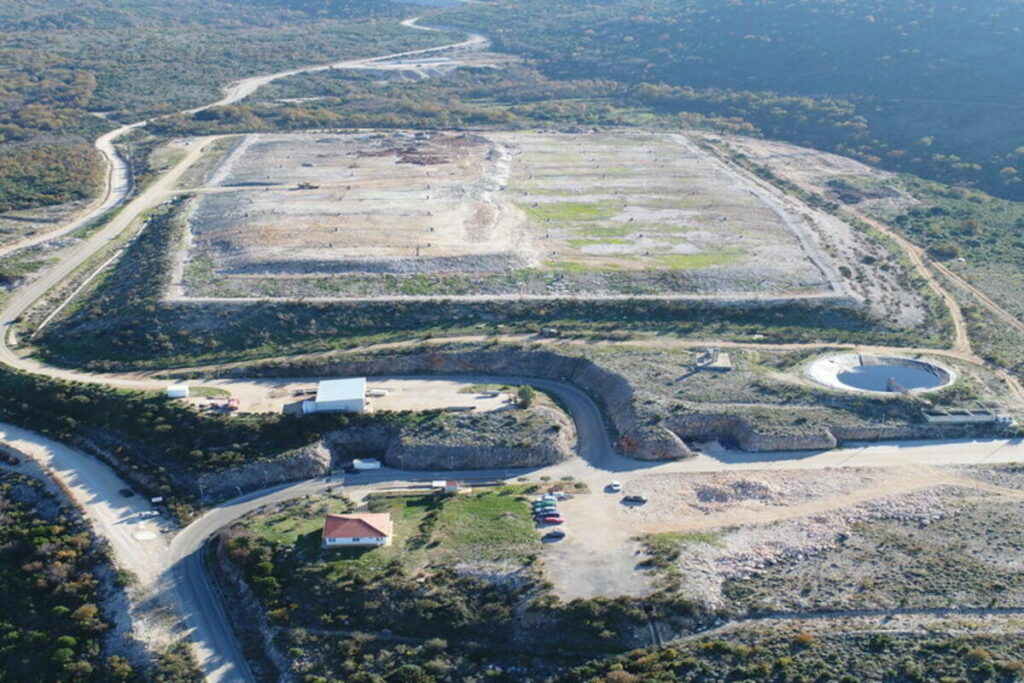
Montenegro has received the first landfill gas power plant in the region, an environmental project at the municipal waste landfill “Možura” near Bar, which will reduce emissions and the impact of the landfill on the environment, better control of landfill gas and additional local electricity production. The expected total value of the investment is 1,8 million euros.
Director of “Možura” Senad Arabelović He told “Vijesti” that the plant is technically ready for commissioning and that the necessary approvals from the Montenegrin Electricity Distribution System (CEDIS) have been obtained.
“The power plant was put into trial operation at the end of last year. After the trial period, the power plant will transition to commercial operation. Our expectation is that the plant will operate stably and at full capacity, and that it will provide additional quantities of stable electricity to the Montenegrin energy system, while simultaneously achieving the primary goal of significant environmental improvement through the control and utilization of landfill gas,” said Arabelović.
He pointed out that this is the first environmental project of this kind in Montenegro and the region, because it shows that waste can be treated as a resource, not a problem.
“For Bar, this means reducing emissions and the impact of the landfill on the environment, better control of landfill gas and additional local electricity production. For the state, the project is important because it brings a modern example of a circular economy, obtaining new value from waste, with a real reduction in greenhouse gas emissions and environmental protection,” said Arabelović.
The power plant at Možura, he explained, will operate by collecting landfill gas generated by the decomposition of waste in sanitary vats. This gas is “captured” through a system of bio-wells and pipelines (aspiration network) and brought to the plant, where it is used as fuel for a gas engine that then powers a generator.
“The plant is based on modern Jenbacher brand technology and is largely automated, which enables stable operation, constant monitoring of parameters and high operational safety. The installed capacity of the plant is 0,99 megawatts. The plan is for the power plant to operate 95% of the annual hours, i.e. around 8.350 hours, and the estimated annual production at full capacity will be approximately 7,5 GWh of electricity. Such an operating mode makes the plant a reliable source of stable energy, because landfill gas is produced continuously, unlike some other renewable sources that depend on weather conditions,” explained Arabelović.
Ecological and economic benefits
According to him, the 2022 feasibility study confirmed that the quality of landfill gas is good and that it can be used properly and in the long term as a fuel for a power plant. The key finding is that thanks to a quality gas collection network in sanitary vats and efficient aspiration, there is a real possibility of “capturing” about 50% of the gas generated in sanitary vats.
“A particularly important piece of information is the composition of the gas, where methane makes up about 50%, with constant quality, which was a crucial prerequisite for the project to even enter the implementation phase. What the study predicted was later confirmed through the development of the main design of the facility. The study also indicates that landfill gas can be generated up to 30 years after the closure of the sanitary vats, which means that the project has a long-term perspective and a stable “fuel” base for the coming decades,” emphasized Arabelović.
When it comes to environmental benefits, the “Vijesti” interlocutor points out that this is a project that directly contributes to reducing CO2-equivalent emissions, because methane gas, with a strong greenhouse effect, is collected in a controlled manner and used for energy, instead of being released into the atmosphere in an uncontrolled manner.
“It is precisely because of this importance that the project won first place in the Energy Scouts program, organized by the Chamber of Commerce of Montenegro and Germany, and as such was presented in Berlin last year. When it comes to the economic side, the study and financial projections indicate a positive effect, with an expected return on investment in a period of 5 to 6 years, which is very competitive for this type of infrastructure. The project is still in the implementation phase. The installation of the SCADA system remains at the beginning of 2026, which will further improve management and supervision. The expected total value of the investment is around 1,8 million euros,” said Arabelović.
Finance
Financing of this project was provided primarily from the money of the “Možure” landfill as the project implementation leader, the Eco Fund of Montenegro, which financed the development and revision of the main project, as well as the environmental impact assessment study, and the Slovenian partner CMSR (Center for International Cooperation and Development) participated with a donation of 631.800 euros, which relates to the implementation of all phases of the power plant construction.
“The cooperation was established at the initiative of the Eco Fund of Montenegro, and I would like to emphasize my gratitude to the management of the Eco Fund, because it was precisely this institutional support that was crucial for the partnership to be opened and formalized. The Eco Fund, in addition to financial assistance in preparing project documentation, also provided support in establishing cooperation with the Slovenian partner CMSR. ‘Možura’ prepared and submitted an application for project financing in 2023. After consideration and evaluation by CMSR, we received confirmation that the project was approved, after which the implementation continued in synergy between ‘Možura’ and CMSR, from planning to execution of works,” explained Arabelović.
He added that the support of the Republic of Slovenia is not only financial, but also an important part is the professional exchange of experiences.
“During the phase of preparing the project documentation, representatives of ‘Možura’ had the opportunity to visit similar facilities in Slovenia, in Ljubljana and Celje, where we saw from practice how such systems are best designed and operated in real operating conditions. These experiences significantly contributed to raising the solutions at Možura to the level of modern European standards,” said Arabelović.
There could be enough electricity for 400 households
Arabelović said that the electricity produced in this plant will primarily cover its own needs – the operation of the generator and consumption within the “Možura” system. The remaining part will be placed in the electricity grid.
“It is estimated that the amount of energy delivered to the grid may be sufficient to provide annual supply for up to 400 households, which gives the project a clear local energy value,” said Arabelović.

News