
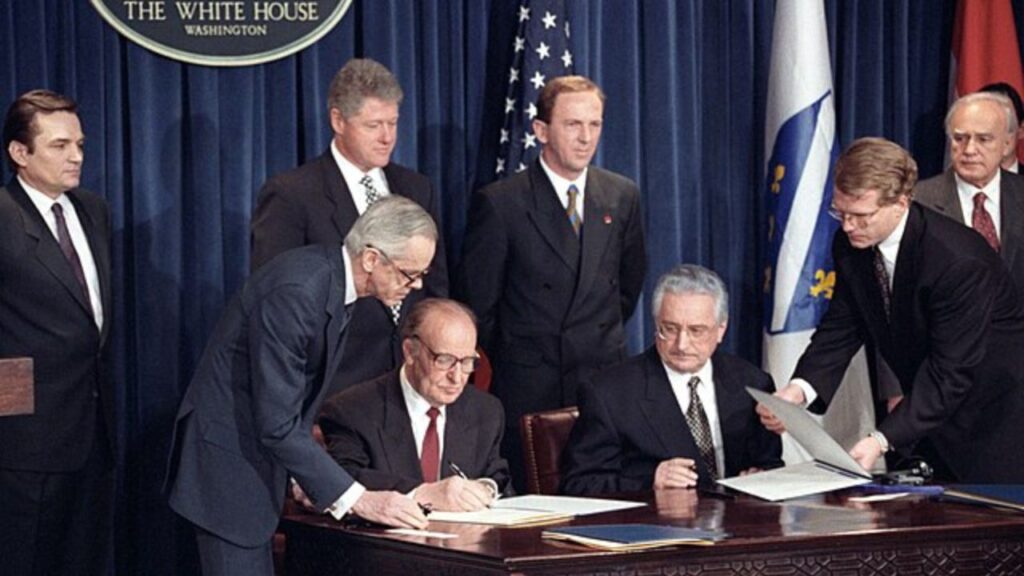
As Bosnia recently commemorated thirty years since the Dayton Peace Agreement, ending a bloody ethnic conflict which left some 100,000 mostly Muslims dead, Bosniaks today still wrestle with the complex effects of Dayton, as ethnic divisions and corruption persist.
On 21 November, a couple of days before Bosnia and Herzegovina joyfully celebrated its national Statehood Day, a bittersweet day was also commemorated, thirty years since the signing of the Dayton Peace Agreement.
After over three years of warfare following Bosnia declaring independence from the increasingly Serb-dominated nationalist Yugoslavia, 1,425 days of siege in Sarajevo, and a genocide in Srebrenica that left close to 9,000 Muslims slaughtered, the war officially ended.
The leaders of Bosnia, Croatia and the Federal Republic of Yugoslavia (today Serbia and Montenegro) signed the Dayton Peace Agreement on 14 December in Paris, 1995, after it came into effect on 21 November that same year.
The day was most certainly one of celebration for the Bosnians who had suffered immensely during the war; the end, which seemed impossible to fathom in the midst of constant shelling and displacement, had indeed arrived.
But thirty years later, the optimism which many Bosnians may have felt in that December of 1995 has since faded, as Bosnia and Herzegovina remains bitterly divided along ethnic lines, with the country’s two republics barely holding on by a weak, dysfunctional government.
 SARAJEVO, BOSNIA AND HERZEGOVINA – NOVEMBER 22: Snowfall blankets Sarajevo,with a sign in the background commemorating the Dayton agreement. ( Samır Jordamovıc – Anadolu Agency )
Not to mention that hundreds of thousands of young people are estimated to have left in search of better prospects abroad, a common issue for much of the Balkans.
Subscribe to our newsletter and stay updated on the latest news and updates from around the Muslim world!
Dayton served one purpose and one purpose only: to end the war. Everything else that has come since then has proved to be a hindrance for the development of the country, even as young people abandon the hatreds that persist from their parents’ generation.
Many foreign policy analysts both within Bosnia and the wider Balkan region, have been saying for decades that the country cannot function in the way that it is today.
Bosnian politics after Dayton
The Dayton accords, named after the city in Ohio, US, where they were drafted, split Bosnia into two autonomous regions, with entirely independent political systems, aspirations, laws and militaries.
One of the regions, the Federation of Bosnia and Herzegovina, holding 51% of the country’s territory, is shared by self-identified Catholic “Croats” and Muslim Bosniaks, where Bosniaks are the majority.
 Green territory shows the Federation of Bosnia and Herzegovina. Red shows the Serb dominated Serb Republic. Dark green are Muslim majority areas whereas light green are Croat majority areas. Via public archives.
The other region is the Serb-dominated Serb Republic (Republika Srpska), which has proved to be the greatest self-imposed barrier in Bosnia’s path to peace and stability, even to this day.
Bosnia currently functions (barely) under a tripartite presidency, with representatives for each ethno-religious group mentioned above. But still, this presidency in practice holds very little actual power.
This political system is often referred to as one of “the most complicated political systems in the world”, with a multi-layered and inefficient government with conflicting nationalist aspirations.
The agreement has kept the peace, despite various renewed crises through the last three decades which came close to shattering it.
An enduring peace
Today, Bosnia is also being considered for EU membership – an unthinkable thought in the 1990s and early 2000s when the country was still in rubble, covered by mass graves and minefields.
Despite this, and limited yet consistent economic growth in the post-war period, unofficial reports claim that 600,000 people have left the country in the last 12 years.
However, there is a lot to be said about how the Dayton agreement still stands to this day, a sign which many consider a clear mark of success by the US.
The most important signature in the signing of the agreement was that of Bill Clinton, the then President of the United States.
The US played a key role in the post-Yugoslavia wars in Bosnia, as they bombed positions of Republika Srpska’s army (VRS) on the hills of Sarajevo, which essentially forced the then leadership of the Serb Republic, most of whom are serving life sentences for war crimes today, to sit at the table, resulting in the Dayton negotiations.
The sorting of ethno-territories
Perhaps one of the largest barriers to Bosnia’s democratic, economic and social progress lies in the leadership of Republika Srpska, the Serb-dominated autonomous region.
Bosnia was once a proudly multicultural country, whose capital was described throughout history as the “Jerusalem of Europe” for its tolerant religious diversity, where one can see a minaret, an Orthodox church, a Catholic church and a synagogue within a few minutes walk.
Whilst echoes of this multicultural heritage can certainly be seen and felt today, the current division of Bosnia has been threatened multiple times by Bosnian Serb leader Milorad Dodik, who has called for independence referendums multiple times, to cede Republika Srpska to Serbia, or for independence.
 Former President of Republika Srpska Milorad Dodik in the Presidential Executive office of Russia, Moscow. Via Public archives.
Earlier this month at his party’s conference in Serb-dominated East Sarajevo, Dodik, the man who has threatened the security of Bosnia many times with calls for independence and rejecting the authority of Bosnia’s central courts, accused Muslim Bosniaks, “Turks” (used in a derogatory way to label Bosniaks), of “lies”, saying there is a conflict between Islam and Christianity on the global arena.
Republika Srpska has increasingly looked to Moscow for support since President Putin invaded Ukraine, flooding the country with Russian propaganda and in recent months to fringe figures in US President Trump’s administration.
Whilst the peace has endured, and many Bosnians are thankful for this, beneath the surface ethnonationalism and corrupt politicians are keeping Bosnia divided.