
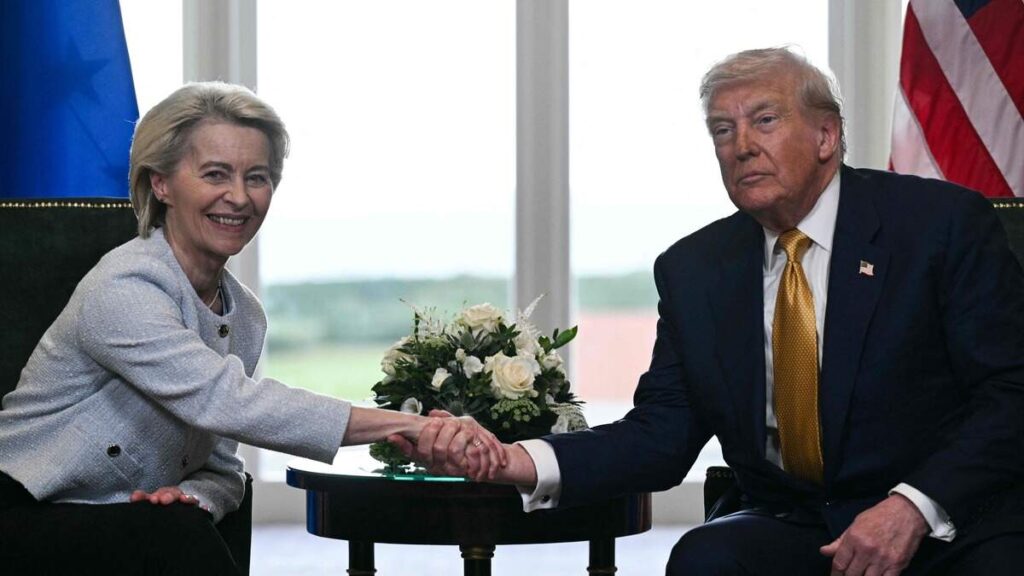
US President Donald Trump will continue to dominate headlines around the world in 2026, and his influence in Europe is unprecedented. But he may have to shift his focus to the domestic economy as November’s mid-term elections begin to loom on the horizon.
The end of 2025 was marked by two significant moments in EU-US relations: the publication of the United States’ National Security Strategy (NSS) and the naming of Donald Trump by news organisation Politico as Europe’s most powerful player.
The policies outlined in the National Security Strategy, as well as the language used by its authors, should be a final wake up call to European leaders that they immediately need to significantly reduce their reliance on America, says Josip Glaurdić, head of the University of Luxembourg’s political science department.
“The strategically correct decision is to emancipate ourselves from the United States,” Glaurdić told the Luxembourg Times in an interview. “That is, in the short term, probably politically and economically problematic. But it is strategically sensible.”
Josip Glaurdić says there is an ideological coherence to Trump’s worldview © Photo credit: Claude Piscitelli
The NSS’s rhetoric attacking “the activities of the European Union and other transnational bodies” for undermining political liberty and sovereignty, sparked panic among political elites in many of America’s traditional European allies. But the content of the document came as no surprise to Glaurdić.
“There is an ideological coherence to Trump’s worldview, and he has stayed true to it throughout,” the professor said.
It should be noted that the US security strategy refers to Europe as an ally; therefore, we also need to act as allies
Xavier Bettel
Luxembourg Foreign Minister
“It should be noted that the US security strategy refers to Europe as an ally; therefore, we also need to act as allies,” Luxembourg’s foreign minister Xavier Bettel told the Luxembourg Times. “This includes respecting democratic life and domestic political choices, as was rightly stated by European Council President António Costa.”
Speaking in Paris just days after the NSS was published, Costa said that allies do not threaten to interfere in the democratic life or the domestic political choices of their fellow allies. “They respect each other’s sovereignty,” he stated.
Glaurdić also thinks it is credible that there exists a longer draft of the security strategy, allegedly seen by Washington-based digital media platform Defense One, suggesting the US should lure Italy, Austria, Poland and Hungary away from the EU.
“The official version looks like a document that’s not complete,” he said. “That’s not how the NSS usually concludes, with this look at the different regions. There is more [than the official document], there’s no question about it.”
Also read:Strong Europe is good for the world: new US ambassador to Luxembourg
The Trump administration begs to differ, of course. New US ambassador to Luxembourg Stacey Feinberg said just days after the publication of the NSS that the United States is closer to Europe than it had ever been since World War Two. “President Trump would like to make Europe the best that it can be. He wants the continent to be as powerful as possible,” she said.
America’s insistence that Europe take the lead in its own security is “like telling your kids, eat your vegetables, exercise, get sleep,” she said.
Significant advances in security posture
Bettel thinks that EU member states have made significant advances in recent years in strengthening their own security and defence posture. “These efforts are part of Nato, which remains the primary military defence for Euro-Atlantic security,” he said. “The Security Strategy confirms that Europe needs to continue in this vein.”
The foreign minister is, as things stand, dismissive of the suggestion in the security strategy paper that Europe should prioritise “strategic stability with Russia” since it was Russia that launched the full-scale invasion of Ukraine in February 2022. “Unless the aggressor, Russia, decides to end the war and engages in a process that ensures accountability and justice, there is no basis to assume that ‘strategic stability with Russia’ can be achieved,” Bettel said.
Bettel and Feinberg, after some initial tension over remarks she made during her confirmation hearings, both have the professionalism to be diplomatic and genuinely welcoming and appear to have hit it off on a personal level, according to their respective social media posts.
The Luxembourg Times interview with Feinberg was conducted on the same day that Trump was saying that EU leaders’ desire to be so politically correct made them “weak”. In a flagship interview with Politico, he said: “Europe doesn’t know what to do.”
All this talk of, you know, preserving European civilization… this is fascism
Josip Glaurdić
Head, University of Luxembourg political science department
That reference, more specifically to European migration policy is consistent with the rhetoric used in the NSS, which Glaurdić unhesitatingly denunciates. “All this talk of, you know, preserving European civilization… this is fascism,” he said.
However, so far Europe’s leaders have shown little willingness to make the hard choices required to disengage with America, according to Glaurdić. He thinks there is a lot of wishful thinking that “some sort of deus ex machina” is going to come and change Trump’s attitude.
In the week before Christmas Trump did focus sharply on the American economy in an address to the nation, as voters became more and more disenchanted with cost-of-living increases. But even as mid-terms loom into view later in 2026, the president is unlikely to resist the temptation to stay out of global politics.
Glaurdić is perplexed as to why European leaders – and not just those in the EU – continue to ingratiate themselves with Trump. “Do they not see that this is toxic, that this is tarnishing. Because if they are willing to cosy up to such a malignant force, then people are likely to say ‘well, all bets are off, let’s burn the whole fucking thing down’.”
He reckons that Europeans are more rational and more willing and able to deal with emancipation from America than the elites give them credit for.
“It is so easily marketable, politically. It could revitalise Starmer’s government, for example,” the political scientist said. Stepping away from Trump could revitalise Macron and Merz, and political centres throughout the continent, Glaurdić believes. “Because Trump is so unpopular throughout Europe. And they genuinely hate Putin.”
Even some right-wing parties in Europe that are gearing up to fight elections in the next two years, such as the National Rally in France, are reportedly wary and have said they would distance themselves from any Trump endorsement.
Chilling effect on tourism
On a more pragmatic level, many Europeans will be planning to visit the United States next June as it hosts the World Cup, alongside Mexico and Canada. Stacey Feinberg has also said that she would be pushing for a direct flight between Luxembourg and the United States – the last such flight was over 25 years ago – and has already held talks with Mobility Minister Yuriko Backes on the subject.
Also read:Someone should take a punt on direct Luxembourg-US flights
But that was before Trump announced that tourists from countries that had visa waiver agreements with America – which includes Luxembourg as well as neighbours France, Germany and Belgium – would have to submit their last five years of social media activity along with their Electronic System for Travel Authorization (ESTA) application.
The US Travel Association has already issued a warning that the policy, which is due to come into effect in February, “could have a chilling effect on travel to the United States.” When even tourism is under threat, it is clear that relationships between the US and the old continent in 2026 may not be, as Feinberg put it, at their best but perhaps at their most strained since World War Two.