
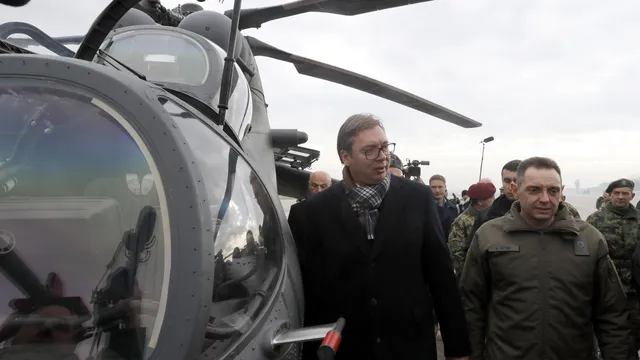
Serwer argued that Vučić is unlikely to repeat the mistake of former Serbian strongman Slobodan Milošević.
Student protests could lead to change in Serbia, but it is unclear whether that will actually happen, said prominent US scholar Prof. Daniel Serwer of Johns Hopkins University in an interview with the daily Danas, reported by BGNES. According to him, President Aleksandar Vučić is a master at manipulating popular protests by replacing a minister here and there or calling early elections, without putting his own grip on power at serious risk.
Serwer argued that Vučić is unlikely to repeat the mistake of former Serbian strongman Slobodan Milošević, who believed he could win relatively free and fair elections. “Vučić will be even more careful to guarantee the outcome. All of this is part of ensuring zero risk to his own power,” he said.
Asked why the European Union is not openly siding with the students, Serwer replied that no one should expect the EU to “take the students’ side.” Instead, he said, the EU should stand by its own values, which run counter to Serbia’s growing autocracy. “The desire for lithium, dependence on ‘stability,’ and even opposition to Russian influence are secondary to restoring the rule of law and democracy in Serbia. That is what European values and interests require,” he stressed.
Commenting on Vučić’s attempt to sell the former General Staff headquarters building in Belgrade to Donald Trump’s son-in-law Jared Kushner, and Kushner’s subsequent withdrawal from the deal, Serwer said he was not familiar with Kushner’s thinking. “Vučić seems to have offended the Trump administration in some way, which I actually see as a good thing. It means that, at least for now, Belgrade and Washington cannot trade away the rule of law and democracy the way Washington has already done in much of the rest of the world,” he noted.
On the concept of the “Serbian World” and Belgrade’s interference in Montenegro and Bosnia and Herzegovina through Republika Srpska, Serwer was blunt: “The ‘Serbian World’ is simply a modernized version of ‘Greater Serbia.’ It would mean death and destruction across much of the Balkans today, just as it did in the 1990s. It would also put an end to Serbia’s hopes of joining the EU. Belgrade is jeopardizing the prosperity and security of its own citizens in order to expand its influence over neighboring countries. That is not an ambition that will end well.”
Serwer said he expects continued stagnation in regional relations. “The greatest hope for progress lies in Montenegro, Albania and North Macedonia joining the EU. Serbia has chosen a slow path,” he added.
Asked what defined 2025 in terms of foreign policy, Serwer said the key event for him was the Trump administration’s decision to side with Russia against Ukraine and to stop advocating for democracy and the rule of law globally. “The United States is now governed by a deeply corrupt administration that demands bribes, including for the pockets of the president and his family. None of us has fully come to terms with this dramatic shift,” he said.
He expects Ukrainians to continue resisting Russia’s ongoing occupation and aggression. In his view, the only quick end to the war would be a Ukrainian victory in Donbas and Crimea — a scenario he considers unlikely given the lack of US support. | BGNES