
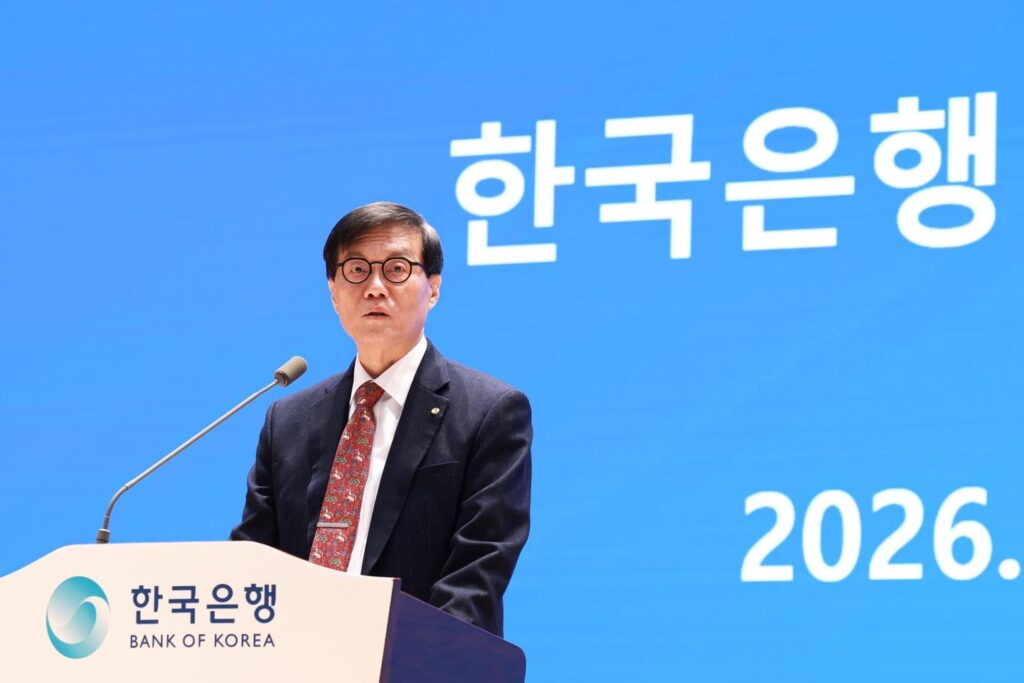
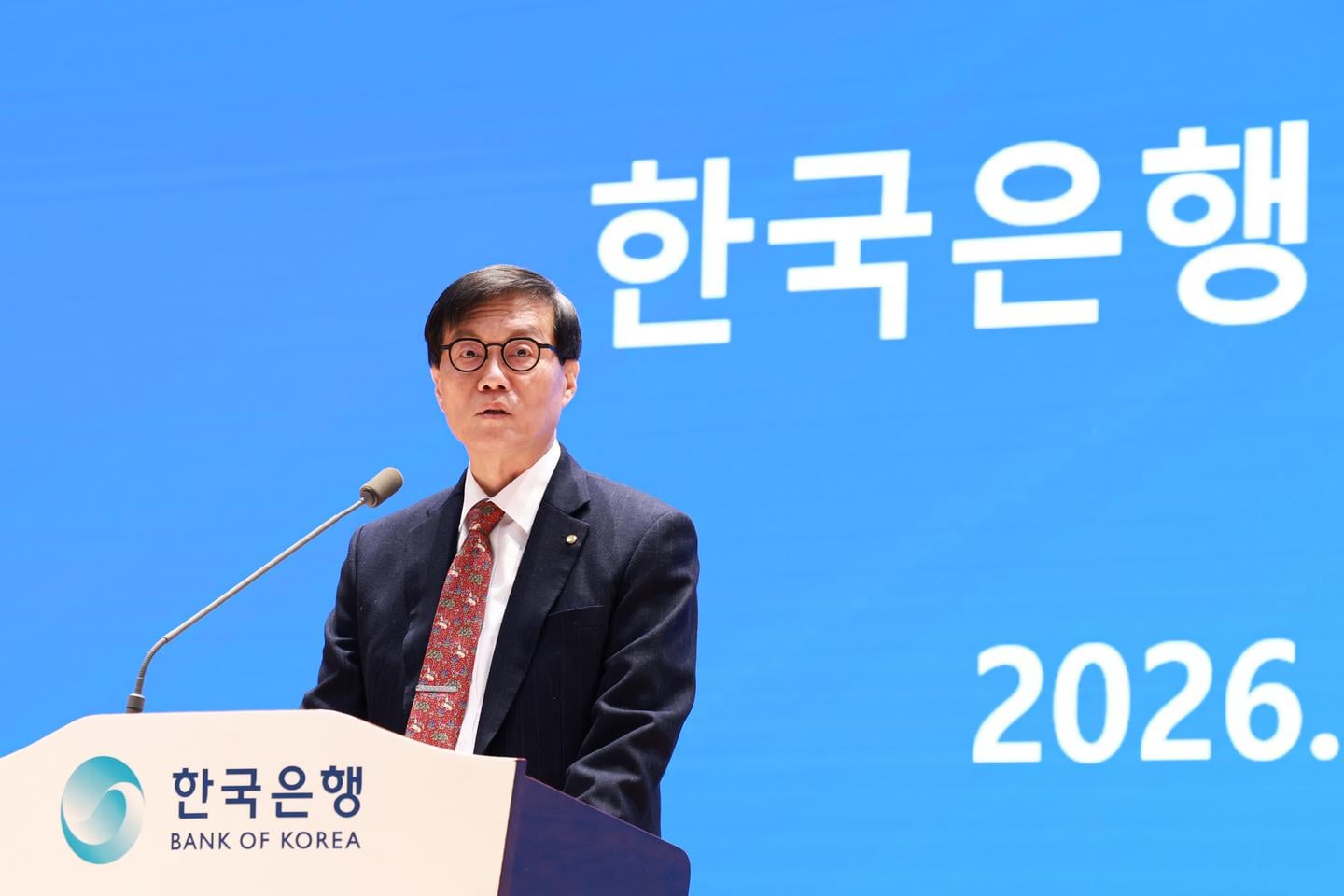
Bank of Korea (BOK) Gov. Rhee Chang-yong expressed concern on Friday about a “K-shaped recovery” in the economy while warning that growth outside of certain sectors like semiconductors remains sluggish, as he invoked a term for a polarized economic recovery in which industries or regions grow at different speeds or even in opposite directions.
“While this year’s growth rate is projected to reach 1.8 percent, close to the potential growth rate, excluding the information technology sector — which is expected to lead growth thanks to the semiconductor cycle — the rate falls to just 1.4 percent, creating a significant gap between perceived and actual economic conditions,” said Rhee in his New Year’s message released Friday.
He pointed to the limitations of the divergent recovery trend.
“We must continue efforts toward structural transformation, including nurturing new industries to diversify the foundation for growth,” Rhee said. “We should avoid repeating growth or recovery patterns that are concentrated in specific sectors.”
Regarding the recent weakness of the won, he noted, “An exchange rate in the upper 1,400 won range diverges significantly from Korea’s economic fundamentals.”
He warned that a rising exchange rate — meaning a weakening won — could increase inflationary pressure and negatively impact domestic-oriented firms, thereby exacerbating economic polarization.
The central banker cited several causes behind the weak local currency, including the growth and interest rate gap between Korea and the United States and what is often referred to as the “Korea discount,” or the undervaluation of shares of Korean companies.
“While investment decisions by economic actors are based on rational expectations and judgment, it is now time to comprehensively assess the macroeconomic impact of sustained overseas investment on economic growth and the domestic capital market,” Rhee said on the increase in Korean residents looking to overseas markets.
He also addressed the overseas investment activity of the National Pension Service.
“As the pension fund plays an increasingly influential role in the foreign exchange market, we must reassess the overall impact of overseas investment on the Korean economy, while safeguarding the fund’s long-term returns,” Rhee said.
However, the governor drew a clear line between the current situation and past currency crises, stressing that comparisons to previous foreign exchange crises are not appropriate given Korea’s sound external position as a net external creditor.
“Foreign investment banks believe that an exchange rate of 1,480 won is too high,” said Rhee, speaking to reporters at the BOK headquarters Friday morning. “Most of their reports forecast the rate to be in the low 1,400 won range, yet only Korean YouTubers are saying the won will soon become worthless paper.”
Meanwhile, the heads of Korea’s major financial holding groups — KB, Shinhan, Hana and Woori — identified a shift to AI systems and productive finance as their core strategies for the year.
“KB must demonstrate that it can deliver optimal products and balanced growth based on AI-driven technological innovation,” said KB Financial Group Chairman Yang Jong-hee in his New Year’s message.
Shinhan Financial Group Chairman Jin Ok-dong stressed the urgency of transformation.
“AX, or an AI transformation, and DX, or a digital transformation, are now survival imperatives,” Jin said. “We need fundamental innovation across work processes and customer interfaces. If we do not move forward, we will fall behind. Remaining stuck in old habits will leave us unfit to survive on the future financial battlefield.”
“There are securities firms earning more than banks now, and household lending has reached its growth limit,” said Hana Financial Group Chairman Ham Young-joo. “This is a crisis for banks, which have played the role of the groups’ pillars.”
On the topic of stablecoins pegged to the won, Ham added, “We must proactively design and pre-emptively build a complete ecosystem covering issuance, distribution, usage and redemption.”
Woori Financial Group Chairman Yim Jong-yong also emphasized “productive finance, leadership in AI transformation and synergy creation” as core pillars for the year.
“Productive finance is an area where Woori, with its strong corporate finance capabilities, can lead with both confidence and competence,” Yim said.
https://koreajoongangdaily.joins.com/news/2026-01-02/business/economy/BOK-chief-warns-of-imbalanced-recovery-with-outsize-growth-of-chips-/2491825
Posted by Substantial-Owl8342