
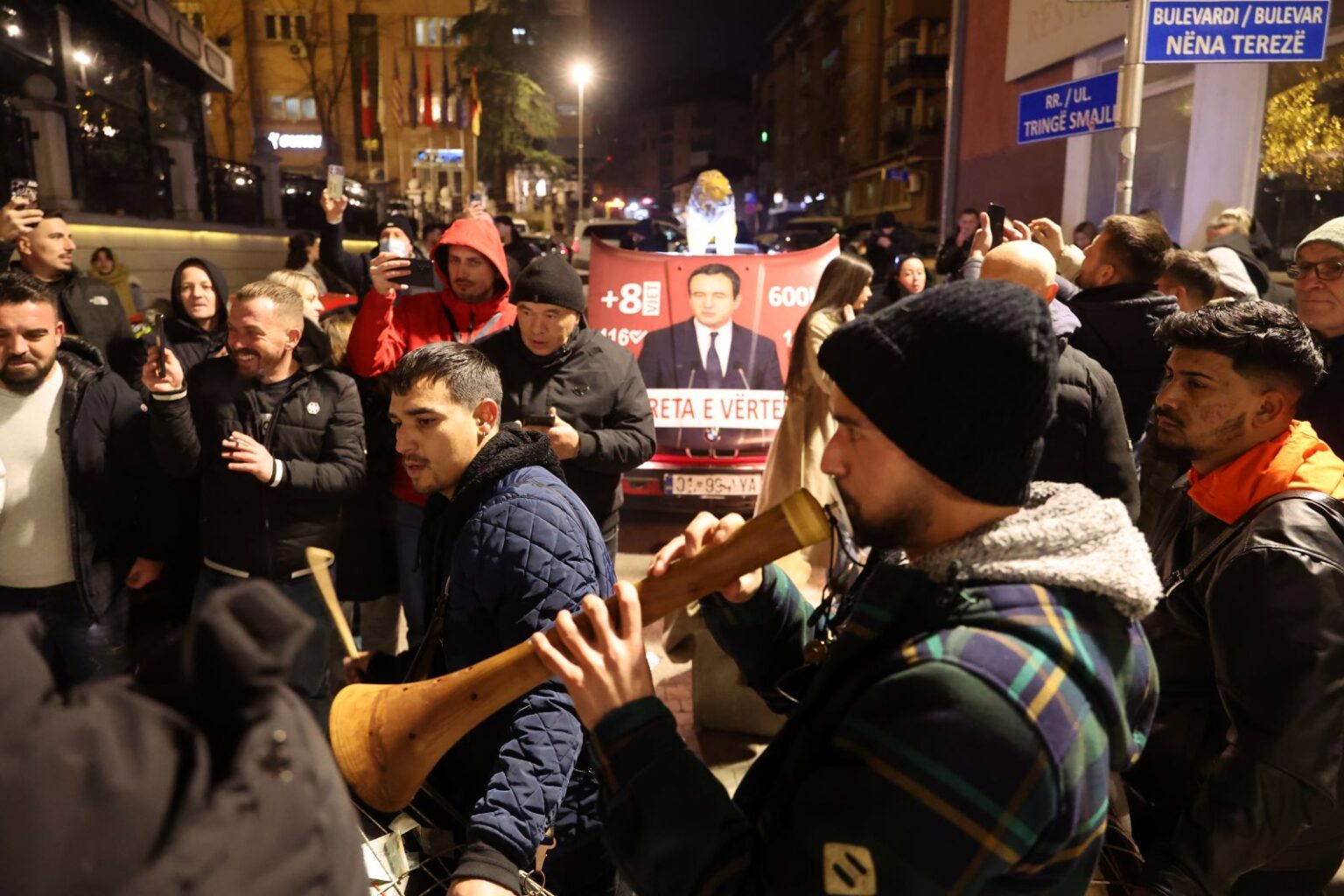

Supporters of the Vetevendosje (LVV) party celebrate in Pristina, Kosovo, 28 December 2025. Photo: EPA/GEORGI LICOVSKI
Preliminary results from Kosovo’s early parliamentary elections show the ruling Vetevendosje, LVV, party well in the lead, under its leader Albin Kurti, securing around 50 per cent of the votes, which means he can likely form a government without coalition agreements with other parties and so end a ten-month-long institutional deadlock.
With 96 per cent of the ballots counted, the Central Election Commission, CEC, reported that Kurti’s LVV had secured 49.8 per cent of the votes. The Democratic Party of Kosovo, PDK, led by Bedri Hamza, followed with 21 per cent.
The Democratic League of Kosovo, LDK, under Lumir Abdixhiku, came third with 13.8 per cent, while the Alliance for the Future of Kosovo, AAK, led by Ramush Haradinaj, received 5.7 per cent of the votes.
Kurti had yet to comment by the time of publication but Vetevendosje supporters started celebrations in some municipalities as soon as the first exit polls emerged after the polling stations closed at 7 p.m.
Abdixhiku said he would take responsibility for the result and call a party convention and address all the issues. “I have not managed to take the LDK to where I have thought it should be,” Abdixhiku said. “This is an unexpected result,” he added.
AAK leader Haradinaj, whose party looks set to cross the 5-per-cent threshold, said he was satisfied with the initial results. “This result makes us proud of our work,” he stated, adding that he expects the PDK and LDK to reach an agreement to form a new government because “the political deadlock was caused by LVV”.
Meanwhile, the Belgrade-backed Srpska Lista aims to secure all ten seats reserved for Kosovo Serb parties, but current results suggest they are on nine, with the tenth projected to go to Nenad Rasic’s party, For Liberty, Justice and Survival.
To form a government, a party or coalition must hold at least 61 seats in the 120-seat Assembly. Kurti failed to form a simple majority following the February elections, creating a political stalemate that lasted ten months.
Out of 1,999,024 eligible voters, turnout was approximately 45 per cent, or about 900,000 voters, not including diaspora votes cast abroad. Turnout in the February elections stood at 871,662 voters.
The election observers network Democracy in Action, DnV, stated that the electoral process was “free and that citizens had the opportunity to exercise their right to vote”.
Ismet Kryeziu from DnV said that the entire voting process “took place in a calm atmosphere, with some irregularities mainly of a procedural and technical nature”.
CEC Chair Kreshnik Radoniqi said that “no incidents had been recorded that would undermine the integrity of the electoral process”.
Radoniqi also reported brief power outages at three polling centres in Rahovec, Dragash, and Hani i Elezit, noting that the issue was resolved immediately.
The State Prosecutor’s Office said it had initiated five cases related to alleged electoral violations, but no one has been detained for crimes related to voting. “The cases were reported in Ranillug, Zhegër, Prizren, Drenas, and Suharekë, and involved offenses such as interference with the free exercise of the right to vote, obstruction of the voting process, destruction of voting materials, and violation of ballot secrecy,” it said.
Kosovo Police said the electoral process “was calm and passed without serious incidents”.
A total of 24 political entities competed in the elections, including 18 political parties, three pre-election coalitions, two civic initiatives, and one independent candidate.
Members of the Kosovo diaspora also took part in the elections. Many travelled to Kosovo to vote, while others cast their ballots a day earlier at Kosovo’s diplomatic missions abroad.