
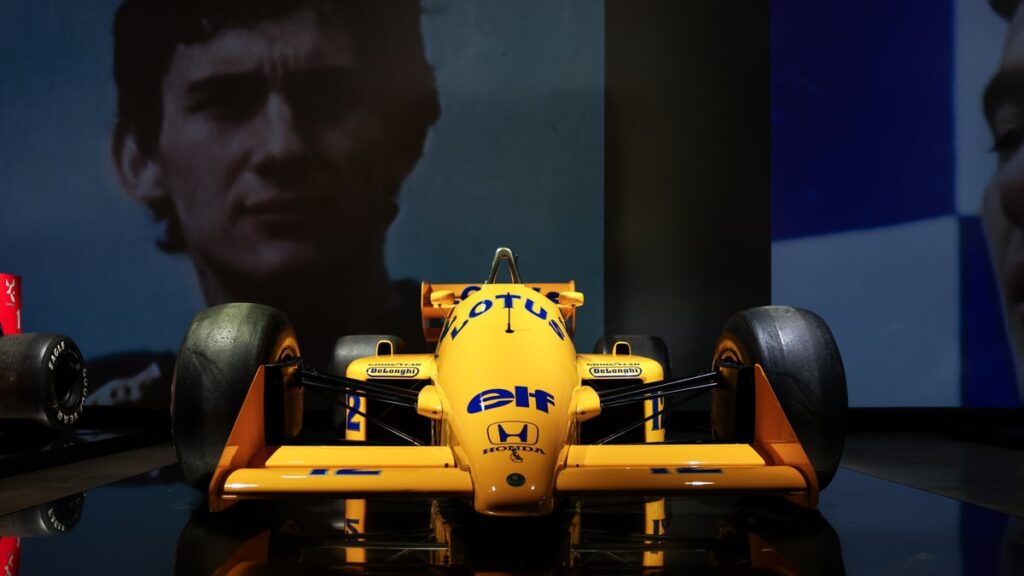
More than three decades after his tragic death, Ayrton Senna continues to captivate racing fans. The exhibition Ayrton Senna Forever at GridX in Wickrange highlights his enduring legacy.
In collaboration with the Museo Nazionale dell’Automobile in Turin (Mauto), the exhibit features original race cars, helmets, suits and documents, offering a comprehensive look at the career of this exceptional driver.
The news of Ayrton Senna’s death spread like wildfire on the early evening of 1 May 1994, causing grief and shock far beyond motorsport circles. Just hours earlier, the 34-year-old Brazilian driver had crashed into the barrier at the Tamburello corner of the San Marino Grand Prix in Imola at around 220 km/h. Senna suffered catastrophic head injuries and did not survive.
Three days of national mourning were declared in Brazil. The death of the national hero plunged the entire country into deep grief. In Brazil, Senna, with his immense driving talent, was revered even more than football legend Pelé. The three-time world champion and 41-time Grand Prix winner had already become a legend and a myth during his lifetime.
Ayrton Senna, front, his teammate Gerhard Berger, right, and the McLaren team at the 1990 Mexican Grand Prix. © Photo credit: Getty Images
For the opening here, we immediately wanted to bring something special, a real sensation.
Thomas Berns
Head of automotive at GRIDX
“We created this exhibition together with our partner Mauto. This exhibition has already taken place in a slightly different form at the museum in Turin,” explained Thomas Berns, head of automotive at GridX.
“For the opening here, we immediately wanted to bring something special, a real hit. So we decided to change last year’s exhibition slightly and present new cars,” he said.
Memories forever
While GridX provided the exhibition space, Mauto, which is also the organiser of the exhibition, made contact with the various owners of the racing cars and the objects on display.
Berns’ passion for historic motorsport is personal as well as professional. For him, Senna represents an absolute reference point. Similar to events like the fall of the Berlin Wall, 9/11 or the death of Queen Elizabeth II, many people remember exactly where they were when they learned of Senna’s passing.
Although Berns was too young to remember the event personally, he knows the details from his family. “I was only one year old when Ayrton Senna died. My father always tells me we were in Knokke on the Belgian coast, and I know exactly which hotel we stayed in.”
Thomas Berns next to two exhibited racing cars that Ayrton Senna once drove. © Photo credit: Jean-Marie Resch
The exhibition not only provides insight into Senna’s career but also shows how Formula 1 car design evolved over the decade of his career.
The white and blue Toleman-Hart from his debut year 1984, which brought him attention with the legendary rain race in Monaco, looks chunky and unusual, with a rear spoiler both in front of and behind the rear axle.
The Lotus-Renault, in which he won his first Grand Prix in 1985 at Estoril – another rain-affected race – appears much sleeker, enhanced by its iconic black and gold livery.
Ayrton Senna in the black and gold Renault at the 1986 Spa-Francorchamps Grand Prix. © Photo credit: Getty Images
When the turbo era ended in 1988 and high-capacity naturally aspirated engines were introduced, the cars became slimmer and more aerodynamic.
For drivers, however, cockpits became narrower and more uncomfortable, leaving their heads and shoulders increasingly exposed.
This contributed to Senna’s fatal accident. The Williams-Renault on display – the last car he raced – offers a stark comparison with today’s Formula 1 vehicles.
(This article has first been published by Luxemburger Wort. Translated using AI, edited by Lucrezia Reale.)