
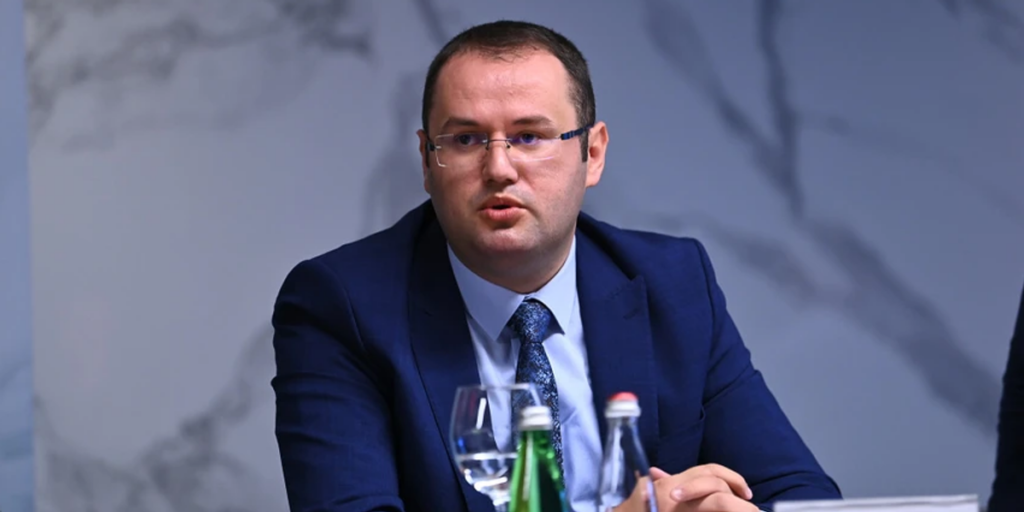
The Governor of the Central Bank of Kosovo (CBK), Ahmet Ismaili, in an interview with the Ekonomia Online News Agency, said that delays in the promulgation of three laws contested in the Constitutional Court are making it impossible for Kosovo to apply for membership in the Single Euro Payments Area (SEPA), causing the economy considerable financial losses.
According to him, from high transfer costs alone, Kosovo businesses and citizens are losing around 55 million euros per year.
Ismaili stressed that the CBK has fulfilled all technical and legal preparations for the application, but the process has been blocked for procedural reasons, leaving Kosovo out of a system that would significantly reduce the cost and time of payments with the European Union, the country’s main trading partner.
Ismaili also said that preparations for SEPA membership have been completed in record time and with the support of the World Bank, while informal comments have also been received from the European Commission, which have been addressed. He explained that once the laws are announced, the CBK will immediately proceed with the final application, with the expectation that approval could come during 2026.
“One of the next challenges for 2026 remains the issue of membership in the Single Euro Payments Area – SEPA, as mentioned, we have completed all preparations regarding the three laws that have been approved by the Parliament but have been contested in the procedure, in the Constitutional Court which have not yet been announced and for this reason we have not been able to make the final application for SEPA. However, we have completed the pre-planning in December 2024, and we have received informal comments from the European Commission which we have also addressed. We expect that as soon as the laws are announced we will be able to proceed with the final application which in the optimistic case when the laws are announced and assumed at the beginning of next year, then we will be able to apply during the summer and receive the application, or approval in 2026. This would be the last case, because unfortunately for unjustifiable reasons, these laws were included in the package of laws that went to Constitutional Court, and consequently they prevented us from benefiting from the financial system with the European Union, which is the SEPA Zone, together with Albania, Montenegro and other countries in the region,” he said.
According to the governor, integration into SEPA is not just a financial issue, but a direct step towards integrating Kosovo’s financial system with that of the European Union, without going through the political process of enlargement.
“Integration into SEPA, in addition to financial integration, initially has the aspect of integration with the European Union’s payment area. This is a special case where we are being enabled to integrate into the EU financial system without the enlargement process, as a political process. This is a process in itself and it is a very good case for us to connect our payment systems with the EU, which is Kosovo’s largest trading partner. Where our diaspora is, where our businesses have the most exchanges. This would enable citizens and businesses to make payments at very low cost, with high speed and efficiency and in this way would enable, in addition to cost, to reduce time. You know that especially for businesses, the time of carrying out a transaction is very important. Based on an assessment that we have commissioned and that was made by the group of German economists, “German EconomicTeam”, the value of the benefit, excluding commission and transfer fees today would be around 55 million euros per year for our businesses and economy. It is unfortunate to lose this opportunity to be a member and today our economy would receive benefits. It is important because our trade activity is with the EU, our diaspora as well, and our direct investments are dominated by EU countries, plus being a eurozone country, that is, a country with the euro, this represented a very big benefit. That is why it has been a focus, a priority for us, therefore in a record time that has not happened in any other Central Bank, we have managed to send the application for membership in advance”, he said.
He estimated that SEPA would enable citizens and businesses to make faster, more secure payments at significantly lower costs, given that currently Kosovo citizens pay an average of about 6 percent in transfer costs, while this would fall below 2 percent.
Ismaili stressed that about 40 percent of the annual benefit of 55 million euros would be direct savings for citizens, while the rest would positively impact businesses and the economy in general. He added that the loss of this opportunity is particularly harmful considering that Kosovo’s trade activity, diaspora and direct investments are mainly linked to EU countries.
“The estimate that I referred to, 55 million euros per year, contains both components. Both the benefit is for businesses and the benefit for individuals. Currently, according to a study by the World Bank that is relatively old, the citizens of Kosovo have paid what the EU average has been, about 6 percent of the transfer amount as transaction costs, this is expected to decrease relatively much to less than 2 percent. So, the impact of this 55 million would be probably about 40 percent, it would be a contribution that would go as savings for citizens when sending transfers within the country, although over the years the financial system and the instruments that have emerged from digitalization and the reforms that are being undertaken in digitalization in financial services, this cost has been freed up over the years. However, SEPA is uncompetitive, a better solution and we have also made all the preparations together with the financial sector, the banking sector so that whenever the membership process is finalized as a process of reconciliation of formal and legal conditions, infrastructure “to be developed so that we can benefit from the benefits as soon as possible. Other countries needed about 6 to 9 months from the moment they received the approval to be accepted into SEPA to start with the first transaction. At least we are trying so that when we join, this 6 to 9 months will not be the time when we start receiving the benefits. This is one of the most important processes. Let’s not forget, not only in terms of financial, cost and time security, but also, but above all, the integration of our financial system with all EU countries and beyond, because the SEPA area is wider than that, even with countries that do not recognize Kosovo as a state,” he said.
The Governor also spoke about the modernization of the payment system in the country, saying that the CBK is in the process of advancing the existing system and moving towards fast 24/7 payments.
He explained that the new system will enable transactions to be carried out in real time, including weekends and holidays, directly impacting increased liquidity, reduced costs, and reduced use of physical cash.
“Our payment system is efficient and secure. It is one of the objectives of the CBK to maintain a secure and efficient payments system, however, the last reforms to this system were carried out 10 years ago. Around 2016, when the (artificial) was implemented, the needs of the economy, time, and digitalization required that our system be advanced. So although it performs its task, it is capable of serving, perhaps the main weaknesses are that when it performs sessions between banks, transactions are not carried out during weekends or holidays, which is a limitation for the real economy. Therefore, we currently have in process an APP Grate to the current system which will enable more payment sessions, perhaps eventually on a weekend day, and this is just one phase towards the transition to the fast payment system which is expected to be finalized at the end of next year and which is the largest infrastructure investment we have had related to the modernization, digitalization of the real-time or Instant payment system. This system aims to make payments between customers of different banks in real time, every working day 24/7. This is a big commitment from us as well, it is not an easy investment to afford because it completely changes the current procedure which runs for a while, let’s say from 08:00-15:00, then there are no transactions, this is done 24 hours a day and every day of the week, including holidays. It also requires working long hours. This will be a challenge for all of us, but on the other hand, it will serve the economy so that transactions between parties can be carried out at any time. It’s different if you pay the money today and the business receives it today, it’s different if it’s two or three days later. What is also important is that in addition to this, we are investing in the infrastructure behind the fast payment system, which is QR code, by phone, request paid, and several other services that have revolutionized and completely digitized the payment process and will do so at a much lower and faster cost. This investment is being developed by the Central Bank of Italy, which is the first time that the Bank of Italy has developed a system for us. So, for the five Western Balkan countries, it is a system that the Bank of Italy has developed for EU countries and that is in use in the EU. So, it is very important for us that such critical infrastructure is being developed by a friendly country, which is a member of the EU which has developed the EU payment system and at some point when we are in SEPA and in a few years when we integrate, it will be quite easy for our payment system to be fully integrated into the EU because it is the same infrastructure that they use, it is the same provider that offers it to us. Regarding geopolitical risks, cybersecurity, data and personal data protection, all of these are risks that are verified in advance when we take them on. The choice of the Bank of Italy was a strategic one. We are very pleased with the support. This also corresponded to the time of SEPA. For SEPA, there are also two technical groups, one is at the level of the governors of the six Western Balkan countries, led by the EU director himself, while the other is at the technical level where the deputy governors for operations and the directors of payments coordinate all issues. “For us as Kosovo, the launch of the fast payments project and the application for SEPA, we have united them because they were separate but which will bring real contribution and will have an enormous impact on monetary circulation within the country, will reduce cash payments, will increase liquidity in the system, will reduce costs and will contribute to combating the informal economy,” he said.
Ismaili announced that this investment is being developed with the support of the Central Bank of Italy and is harmonized with EU standards, which will further facilitate Kosovo’s full integration into the European financial system in the future.
He emphasized that reforms in the field of digital payments are a direct part of Kosovo’s journey towards the European Union and strengthening financial security, including combating the informal economy.
“In fact, all of our reforms that we are making in the field of digital payments that I mentioned are in the spirit of integration towards the EU.”
“In fact, the application for SEPA itself is carried out in two institutions, the first is FIZA, which is now FIZMA, which is responsible for financial institutions, and in the European Payments Council, both of which first of all look at how much Kosovo’s legislation and practice are in line with the European Union, all these three contested laws now, and all the regulations, over 20 regulations that have been made for SEPA. First, they are subject to a verification process, are we compatible with the EU? If so, approval is obtained. What falls under an integration process, a certain validation of integration, we are carrying out separately from the enlargement process, and this will facilitate the multi-stage process when Kosovo becomes a candidate member, to move to the next chapter. In one way, the SEPA integration itself is to open the door for us as if we were an EU country in terms of payments. As a citizen who sends money from Pristina to Rome, it is like being from Rome to Berlin. What does this require? “requires our commitment that regarding the issue of money laundering, the financing of terrorism, we have very strong regulations to not allow in any way that irregular financing is used this channel and affects EU payments, therefore here is the seriousness in question and it is the commitment that we have, and the support of our allies to guarantee that the CBK has it in hand, has the proper control that the Kosovo payment system does not present any risk either in terms of cybersecurity or in terms of money laundering. And this is an integration, economic and financial integration into the EU system which is a union, a seed cluster of the financial systems of the EU countries”, he said.
– YouTube www.youtube.com