
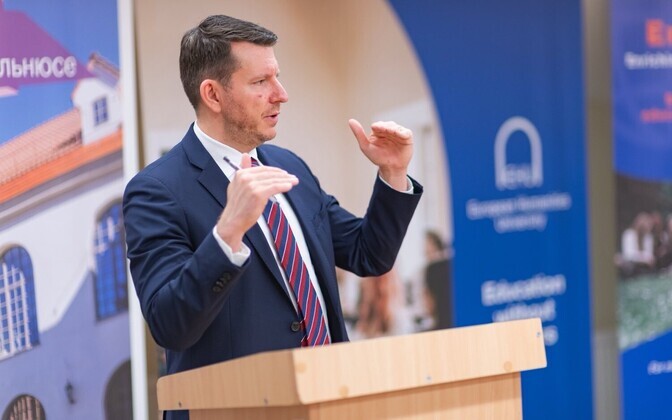
Ministry of Foreign Affairs Secretary General Jonatan Vseviov said no one should mourn the arrest of Venezuelan President Nicolás Maduro, calling him an illegitimate leader. At the same time, Vseviov stressed the importance of upholding international law as a foundation for global stability.
Does Estonia support Donald Trump’s military operation in Venezuela, which, as Trump himself very bluntly put it, aims simply to take over the country’s oil facilities?
Estonia certainly isn’t mourning Maduro’s downfall. We never considered him a legitimate president and the world is undoubtedly a safer place when such illegitimate leaders who spread instability in their regions are not in power. We have one such leader in our own neighborhood who should also be brought to justice. At the same time, it’s dangerous when the rules agreed upon by the international community aren’t upheld. The military operation was surgically executed, but what happens next remains an open question.
Deep concern has been expressed around the world over whether international law has now truly taken a hit and whether it has been eroded.
International law depends on the behavior of states — above all, on the behavior of the great powers. It’s no secret that international law is primarily shaped by major powers and their mutual agreements — not out of altruism or goodwill toward smaller nations, but because commonly agreed rules make a certain level of stability and predictability possible. They allow conflicts to be resolved somewhere other than the battlefield.
International law must be defended. Just as importantly, the Venezuelan people’s right to choose their own leaders and set their own domestic and foreign policy must be protected — something Maduro and his regime have not allowed. This moment could mark a turning point for the better for Venezuela and the world, but things could just as easily take a turn for the worse.
Still, the method — going in by force and practically dragging a person out of bed — hasn’t that undermined international law?
We’ll see once the results are clear and it becomes evident what’s going to happen in Venezuela. The state of international law had already been weakened by the situation in Venezuela before this operation. I don’t want people to come away with the impression that Maduro was a legitimate president. And yet he continues to be referred to as one. But our state did not recognize him as president. He was a tyrant who held power illegitimately.
Could the attack on Maduro also accelerate the peace process in Ukraine?
I don’t think so. If there’s one thing that’s become crystal clear in this situation, it’s that Russia either can’t, won’t or isn’t able to come to the aid of its allies. This isn’t the first time a Russian ally has found itself in, to put it mildly, a bind. I honestly don’t believe this event will force Russia to reassess its actions.
Of course, there’s always the hope that Russia might now understand the broader picture. Oil prices might start to fall and Russia too is ruled by an illegitimate tyrant. Oh, how we would love to see such an operation take place there! We’ve stated that our goal is to ensure no crime goes unpunished. But whether this will necessarily lead to positive change in Ukraine — I wouldn’t dare to predict that.
—