
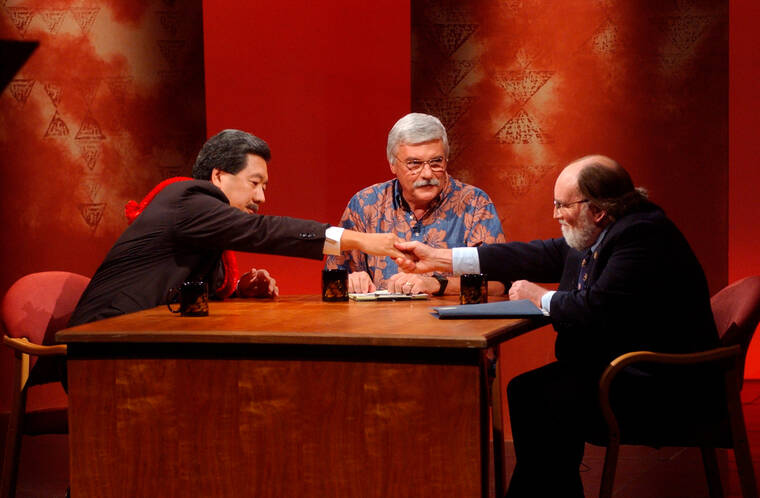
Never let anyone tell you politics doesn’t matter.
Hawaii has been shaped by the political battles, ranging from housing to taxes.
The big win is controlling the state’s governorship, but power struggles extend down to the simple committee appointments in the state Legislature.
Because the struggle in Hawaii is mostly within the dominant Democratic Party, it is Democrat blue. Either way, politics is important so pay attention and vote.
Meanwhile, don’t look to Hawaii to be home to many Republicans. The state has elected just one Republican U.S. senator, Hiram Fong, who served from 1959 to 1977, and two Republican U.S. House members.
The rest have been Democrats. Only two Republicans have been elected governor of this state — and Linda Lingle was the only one to be reelected, in 2006.
Stay in touch with breaking news, as it happens, conveniently in your email inbox. It’s FREE!
I covered Hawaii’s longest-serving mayor, Frank Fasi, and longest-serving governor, George Ariyoshi.
Now after 50 years of reporting on governors John Burns, George Ariyoshi, John Waihee, Ben Cayetano, Linda Lingle, Neil Abercrombie, David Ige, and current governor, Josh Green, thanks to this column, I’m signing off.
There’s nothing wrong with me or the paper, I just think 50 years of mulling over Hawaii politics is enough.
Longevity is also a trait for some of the significant politicians I have covered.
Of the long list of politicians I have covered and interviewed, they range from President Jimmy Carter at the historic Hickam Officer’s Club Lanai, to a feisty President Ronald Reagan at the Royal Hawaiian, who dared reporters to touch his hair as an answer to a question from a TV reporter as to whether or not he dyed it.
Fasi served as Honolulu’s mayor for a total of 22 years. He established key programs like TheBus, satellite city halls and city green spaces. Along the way he switched from Democrat to Republican before founding his own party after saying he was pushed out of both the Democratic and Republican parties.
Ariyoshi, the nation’s first elected Asian-American governor, was Hawaii’s longest-serving governor, holding office from 1974 to 1986.
Ariyoshi may not get the credit he deserves for being such an important part in Hawaii political history. He was steadfast, not flashy, compared to a flamboyant Fasi.
Importantly, Ariyoshi’s first gubernatorial victory cleared the path for other nonwhite politicians to be elected governor of Hawaii.
After Ariyoshi, voters in Hawaii elected a Native Hawaiian governor, a Filipino American and the first governor of Okinawan descent. Also, Linda Lingle was Hawaii’s first woman and first Jewish governor of Hawaii.
I’ve covered politicians long enough to know that you judge politicians according to their time and the existing situation. It doesn’t work to rate their politics as simply good or bad. What matters is whether it is good or bad compared to another fellow’s politics.
As Waihee used to say, “It is situational.”
Fasi will be remembered for his “Fasi Gets It Done” optimism and his ability to create legions of political enemies to battle against. It focused the public’s attention on him and his action-oriented style, often displayed with the Hawaiian shaka sign.
Ariyoshi’s impact echoed deeper with local politics because he helped shape and symbolize the Democratic Party of Hawaii. He was the first Asian-American governor in the United States and he saw it as a daily responsibility.
“I was concerned about doing a good job for those that would follow me. I never had any intention of being governor. But, I was asked to be lieutenant governor, and I knew that no person other than a white person had been governor, and there had never been a governor born in Hawaii. I wanted to break that chain. That’s why I decided to run for governor. It wasn’t that I wanted to be a ‘politician’ — I wanted to make a mark for the people of Hawaii and for the future of Hawaii,” Ariyoshi said in a 2010 interview discussing the influence former Gov. Burns had on guiding his career.
“(Burns’) feeling was if I could get elected, I would break the barrier and perhaps it might provide opportunities for some others to be able to follow me,” Ariyoshi said.
The former governor’s prediction was correct, and Hawaii Democrats have become the major institutional force in local politics.
Hawaii’s politicians will be measured not by what they said or promised, but by what they actually accomplished or changed.
For Fasi, he gave voice to the legions of voters who felt that they were left out of local politics. Fasi gave spirit to malcontents and those who had just arrived. In comparison, Ariyoshi was what the Democrats needed to solidify the party. He was the modest attorney who represented business clients and called activist Burns his “political father.”
If Hawaii’s future comes from its politics, it is a good reason to expect to have competition to be coming from both Democrats and Republicans.
Today the state’s politics is shaped by both party and person. And because Hawaii still knows how to discuss and not fight about politics, we can expect the discussion to continue long past one political column’s scope.
Reach Richard Borreca at 808onpolitics@gmail.com.