
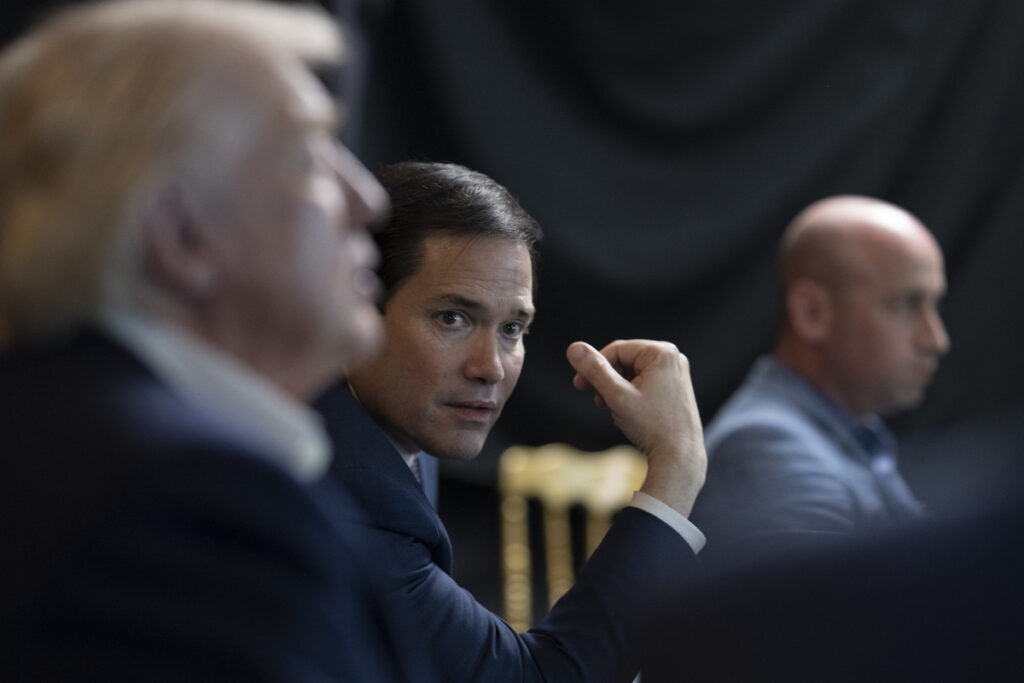
The top US diplomat Marco Rubio used a Sunday-show blitz to deliver a single, carefully calibrated message: the Trump administration’s dramatic move against Venezuela is not a war, not an occupation, and not a replay of Iraq or Libya – but it is a hard line in the Western Hemisphere.
Rubio’s argument, repeated across multiple networks, rested on a blunt premise. Venezuela, he said, had become a permissive hub for narco-trafficking, mass migration and foreign adversaries financed by an oil industry whose proceeds never reached the Venezuelan people.
Follow our coverage of the war on the @Kyivpost_official.
Rubio repeatedly singled out Russia as not merely present, but embedded – pointing to senior Venezuelan security officials with direct ties to Moscow and to oil revenues flowing to Russian-linked actors rather than Venezuelan citizens.
On NBC’s Meet the Press, he warned that Venezuela had become “the operating hub for Iran, for Russia, for Hizballah, for China,” a concentration of adversarial power he said the US would no longer tolerate in its own hemisphere.
“That’s not going to exist,” Rubio said on CBS’s Face the Nation. “We are not going to have a country like Venezuela in our own hemisphere… be a crossroads for Hizballah, for Iran, and for every other malign influence in the world.”
Oil as leverage – not occupation
Pressed repeatedly about President Donald Trump’s claim that the US would “run” Venezuela, Rubio consistently narrowed the definition.
Other Topics of Interest
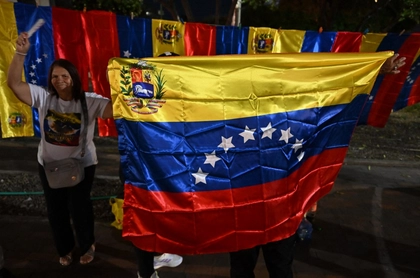
US Allies, Foes Alarmed by Toppling of Venezuela’s Maduro
International responses to the US action in Venezuela.
“It’s not running the country,” he told NBC. “It’s running policy.”
That policy, he said, hinges on oil – not because the US needs Venezuelan crude, but because the regime depends on it.
Rubio framed the oil issue as inseparable from Russia’s broader resource strategy. “Why does Russia need their oil?” he asked. “They’re not even in this continent.”
Allowing Russian-linked entities to profit from Venezuelan crude, he argued, would mirror Moscow’s extractive playbook elsewhere – siphoning resources while leaving instability behind.
Rubio described the Venezuela’s energy sector as “destroyed,” “decrepit,” and “looted,” producing a fraction of its capacity while enriching a small circle of elites and foreign intermediaries.
“None of the money from the oil gets to the people,” he said on CBS. “It’s all stolen by the people that are on the top there.”
The US administration’s response is what Rubio repeatedly called an oil “quarantine”: court-authorized seizures of sanctioned vessels enforced by US naval and Coast Guard assets.
“We go to court, we get a warrant, we seize the boats,” he said on NBC. “That’s tremendous leverage – incredible, crippling leverage – which we intend to continue to use until we see the changes that we need to see.”
Those changes, Rubio said, include severing Russia’s access to Venezuelan oil flows.
The quarantine, he explained, is designed to prevent crude from being sold at steep discounts to sanctioned buyers, including Russian-linked intermediaries who, he said, have benefited while Venezuelan infrastructure collapsed.
He emphasized that the quarantine is lawful, targeted and conditional – not a seizure of Venezuela’s oil fields or an American takeover of the industry.
“We don’t need Venezuela’s oil,” Rubio said on NBC. “What we’re not going to allow is for the oil industry in Venezuela to be controlled by adversaries of the US.”
Law enforcement, not war
Rubio was unequivocal in rejecting the idea that the US is at war with Venezuela.
“There’s not a war,” he said. “We are at war against drug trafficking organizations.”
But Rubio stressed that narco-trafficking was only part of the threat picture. Venezuela, he said on NBC, had also become a permissive environment for Russia to operate politically and economically in the region, protected by compromised security institutions and financed through illicit oil revenues.
The operation that resulted in Nicolás Maduro’s arrest, Rubio stressed across all three interviews, was a law-enforcement mission carried out under longstanding US indictments – with military support strictly limited to protecting the arrest team.
“This was a law enforcement function,” Rubio said. “An indicted drug trafficker was arrested, read his rights, and removed from the country.”
He acknowledged that US forces briefly entered Venezuela to execute the operation but said there are no US troops stationed on the ground and no ongoing military occupation.
“Everyone knows they were on the ground for about two hours,” Rubio emphasized. “That was it.”
Trump’s refusal to rule out future options, Rubio added, reflects presidential authority rather than imminent plans.
“The [US] President always retains optionality,” he said on CBS, adding that Trump “does not feel like he is going to publicly rule out options that are available to the US.”
Why Maduro – and not everyone else
Rubio also faced pointed questions about why the operation targeted Maduro and his wife, but not other indicted Venezuelan officials who remain in power.
“The number one person on the list was the guy who claimed to be the president of the country that he was not,” Rubio said.
He described the arrest as “one of the most daring, complicated, sophisticated missions this country has carried out in a very long time,” noting that Maduro was seized from a major military base and removed without any American casualties.
“You’re asking me why didn’t we do that in five other places at the same time?” Rubio said. “That’s absurd.”
Rubio made clear that other indicted figures remain wanted by the US, but that enforcement is constrained by operational realities – not a lack of intent.
Dealing with power as it exists
On democracy and governance, Rubio struck a notably cautious tone.
He reaffirmed his admiration for opposition leaders María Corina Machado and Edmundo González, whom he has long said won Venezuela’s disputed 2024 election.
But he acknowledged the immediate reality: they do not control the military, police or infrastructure.
“There has to be a little realism here,” Rubio said on CBS. “They’ve had this system of chavismo in place for 15 or 16 years… These things take time. There’s a process.”
The US, he said, will judge Venezuela’s post-Maduro leadership not by public rhetoric but by actions – particularly on drugs, gangs, migration and foreign influence.
“We are going to judge everything by what they do,” Rubio said. “Not what they say publicly.”
Among the clearest benchmarks, Rubio said on ABC, would be whether Russia is expelled from its privileged position inside Venezuela’s security and energy sectors – alongside Iran and Hizballah. Rhetoric would not suffice; only demonstrable curbs on Russian influence would count.
A hemispheric warning
Throughout the interviews, Rubio consistently widened the frame beyond Venezuela itself.
He portrayed the country as a test case for whether Washington will enforce red lines in its own neighborhood – and whether rival powers will be allowed to operate with impunity close to US shores.
“This is the Western Hemisphere,” Rubio said on NBC. “We’re not going to allow the Western Hemisphere to be a base of operation for adversaries, competitors, and rivals of the US.”
Cuba featured prominently in Rubio’s account. He described Cuban intelligence as deeply embedded in Venezuela’s internal security apparatus and cast Havana as a central enabler of Maduro’s survival.
“The ones who have sort of colonized… are Cubans,” Rubio said, noting that Maduro was guarded by Cuban security personnel.
Asked whether Cuba could be next, Rubio declined to preview future actions but left little doubt about the administration’s posture.
“I think they’re in a lot of trouble, yes,” he said.
Pressure, not promises
Rubio ended his Sunday tour returning to the same refrain: leverage over language, pressure over promises.
“If the drugs stop, if the changes are made, if Iran is expelled,” he said on ABC’s This Week, “that’s how we’ll judge it.”
If not, the quarantine remains – and the pressure intensifies.
“We retain all the options we had before,” Rubio said. “And that leverage is going to continue to be used.”
Rubio repeatedly situated Venezuela within a global pattern. The US, he said, has watched adversaries “extract resources from Africa, from every other continent,” and warned that i would not be allowed to replicate that model in Latin America.
“They’re not going to do it in the Western Hemisphere,” he said. “That is not going to happen under President Trump.”
In Rubio’s telling, Venezuela is no longer just a failed state on America’s doorstep. It is a proving ground for a more assertive hemispheric doctrine – one that insists the US will no longer tolerate hostile powers financing themselves, and projecting influence, from its own backyard.